
Understanding Current Assets: Definition & Importance
Current assets are all assets that a company expects to convert to cash within one year. They are commonly used to measure the liquidity of a company. A company’s assets on its balance sheetBalance SheetThe balance sheet is one of the three fundamental financial statements. The financial statements are key to both financial modeling and accounting. are split into two categories – current and non-current (long-term or capital assets).

Current (Short-term) vs. Non-Current (Long-term Assets)
Examples include:
- Cash and cash equivalents
- Accounts receivableAccounts ReceivableAccounts Receivable (AR) represents the credit sales of a business, which have not yet been collected from its customers. Companies allow
- Inventory
- Short-term investments
- Notes receivable
- Prepaid expenses (e.g., insurance premiums that have not yet expired)
- Marketable securities
On the other hand, long-term assets (also known as capital assets) take longer to, and are more difficult to, convert into cash. Examples include:
- Property, plant, and equipment
- Long-term investments
- Intangible assetsIntangible AssetsAccording to the IFRS, intangible assets are identifiable, non-monetary assets without physical substance. Like all assets, intangible assets (trademarks, patents, goodwill)
- Deferred charges
Listing Assets on a Balance Sheet
For example, consider the balance sheet of Walmart for the period ending January 31, 2017:
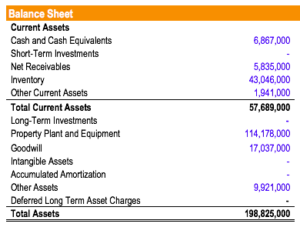
Note that the assets are clearly listed in order of liquidity. Cash and cash equivalents are the most liquid, followed by short-term investments, etc. The total current assets for Walmart for the period ending January 31, 2017, is simply the addition of all the relevant assets ($57,689,000).

Important Ratios That Use Current Assets
Below is a list of useful liquidity ratios:
The Cash Ratio is a liquidity ratio used to measure a company’s ability to meet short-term liabilities. The cash ratio is a conservative debt ratio since it only uses cash and cash equivalents. This ratio shows the company’s ability to repay current liabilities without having to sell or liquidate other assets.
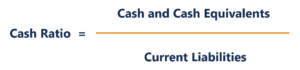
The Quick Ratio, also known as the acid-test ratio, is a liquidity ratio used to measure a company’s ability to meet short-term financial liabilities. The quick ratio uses assets that can be reasonably converted to cash within 90 days.

The Current Ratio is a liquidity ratio used to measure a company’s ability to meet short-term and long-term financial liabilities. The current ratio uses all of the company’s immediate assets in the calculation.
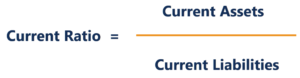
It is important to note that the current ratio can overstate liquidity. This is because the current ratio uses inventory, which may or may not be easily converted to cash within a year (this is the case for many retailers and other inventory-intensive businesses).
Download the Free Template
Enter your name and email in the form below and download the free template now!
Related Readings
Thank you for reading this CFI guide to assets. CFI’s mission is to create world-class financial analysts via the Financial Modeling & Valuation Analyst (FMVA)® Certification ProgramBecome a Certified Financial Modeling & Valuation Analyst (FMVA)®CFI's Financial Modeling and Valuation Analyst (FMVA)® certification will help you gain the confidence you need in your finance career. Enroll today!. To continue learning and advancing your career, these additional CFI resources will be helpful:
- Fixed Asset TurnoverFixed Asset TurnoverFixed Asset Turnover (FAT) is an efficiency ratio that indicates how well or efficiently the business uses fixed assets to generate sales. This ratio divides net sales into net fixed assets, over an annual period. The net fixed assets include the amount of property, plant, and equipment less accumulated depreciation
- Current RatioFinanceCFI's Finance Articles are designed as self-study guides to learn important finance concepts online at your own pace. Browse hundreds of articles!
- Profitability RatiosProfitability RatiosProfitability ratios are financial metrics used by analysts and investors to measure and evaluate the ability of a company to generate income (profit) relative to revenue, balance sheet assets, operating costs, and shareholders' equity during a specific period of time. They show how well a company utilizes its assets to produce profit
- Projecting Balance Sheet ItemsProjecting Balance Sheet Line ItemsProjecting balance sheet line items involves analyzing working capital, PP&E, debt share capital and net income. This guide breaks down how to calculate
-

Understanding Stranded Assets: Risks and Impacts
Stranded assets are assets that are unable to earn their original economic return due to changes in the landscape in which the assets operate. In simpler terms, stranded assets are assets that are wor
-

Tangible Assets: Definition, Examples & Importance
Tangible assets are assets with a physical form and that hold value. Examples include property, plant, and equipmentPP&E (Property, Plant and Equipment)PP&E (Property, Plant, and Equipment) is
Accounting
- Investable Assets: A Comprehensive Guide for Investors
- Understanding Household Assets: A Comprehensive Guide
- Current Ratio: Definition, Calculation & Financial Health
- Fixed Assets: Definition, Examples & Importance for Businesses
- Understanding Liquidity Ratios: A Guide to Short-Term Solvency
- Biological Assets: Definition, Examples & Accounting
- Understanding Current Debt: Definition & Implications
- Understanding Financial Assets: Definitions & Types
- Understanding Intangible Assets: Definition & Importance
-
 Understanding Current Liabilities: Definition & Examples
Current liabilities are financial obligations of a business entity that are due and payable within a year. A liability occurs when a company has undergone a transaction that has generated an expectati...
-
 Non-Current Assets: Definition, Examples & Accounting
Non-current assets are assets whose benefits will be realized over more than one year and cannot easily be converted into cash. The assets are recorded on the balance sheet at acquisition cost, and th...