
Understanding Translation Exposure: A Guide for Businesses
Translation exposure is a kind of accounting risk that arises due to fluctuations in currency exchange rates.

Summary
- Translation exposure is a kind of accounting risk that arises due to fluctuations in currency exchange rates.
- Converting the values of holdings of a foreign subsidiary into the domestic currency of the parent company can lead to inconsistencies if exchange rates change continuously.
- There are four methods of measuring translation exposure: Current/Non-current, Monetary/Non-monetary, Current Rate, and Temporal methods.
Understanding Translation Exposure
The assets, liabilities, equities, and earnings of a subsidiary of a multinational companyMultinational Corporation (MNC)A multinational corporation is a company that operates in its home country, as well as in other countries around the world. It maintains a are usually denominated in the currency of the country it is situated in. If the parent company is situated in a country with a different currency, the values of the holdings of each subsidiary need to be converted into the currency of the home country.
Such conversion can lead to certain inconsistencies in calculating the consolidated earnings of the company if the exchange rate changes in the interim period. It is translation exposure.
For example, an Austrian subsidiary of an American company purchases a building worth €100,000 on September 1, 2019. On this date, the euro-dollar exchange rate is €1 = $1.20, so the value of the building converted into dollars is $120,000.
The company decides to convert all of its foreign holdings into dollars, to present a consolidated balance sheet on March 31, 2020. On that day, the exchange rate changes to €1 = $1.15, so the value of the building falls to $115,000.
Measurement of Translation Exposure
Translation exposure can often depict a distorted representation of a company’s international holdings if foreign currencies depreciate considerably compared to the home currency.
Accountants can choose among several options while converting the values of foreign holdings into domestic currency. They can choose to convert at the current exchange rate or at a historical rate prevalent at the time of occurrence of an account.
Whichever rate they choose, however, needs to be used consistently for several years, in accordance with the accounting principleIB Manual – Accounting PrinciplesAccounting Principles for Investment Banking Analysts. A fundamental understanding of accounting principles is critical to creating any meaningful financial analysis. Analysis of mergers and acquisitions requires knowledge of accounting concepts. We build from the beginning and try to summarize and explain accounting of consistency. The consistency principle requires companies to use the same accounting techniques over time to maintain uniformity in the books of account.
In case a new technique is adopted, it should be mentioned clearly in the footnotes of the financial statements.
Consequently, there are four methods of measuring translation exposure:
1. Current/Non-current Method
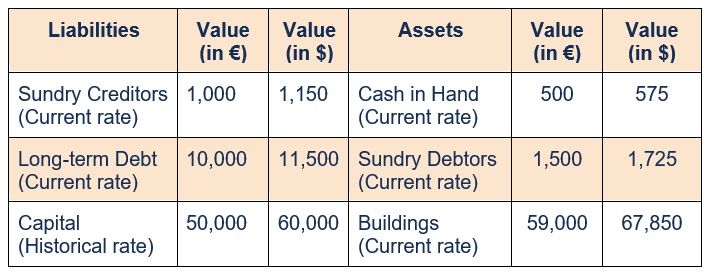
The values of current assets and liabilities are converted at the exchange rate that prevails on the date of the balance sheet. On the other hand, non-current assets and liabilities are converted at a historical rate.
Items on a balance sheetBalance SheetThe balance sheet is one of the three fundamental financial statements. The financial statements are key to both financial modeling and accounting. that are written off or converted into cash within a year are called current items, such as short-term loans, bills payable/receivable, and sundry creditors/debtors. Any item that remains on the balance sheet for more than a year is a non-current item, such as machinery, building, long-term loans, and investments.
Consider the following balance sheet of a European subsidiary of an American company, which follows the method. Assume that the historical exchange rate is €1 = $1.20, and the current rate is €1 = $1.15.
2. Monetary/Non-monetary Method
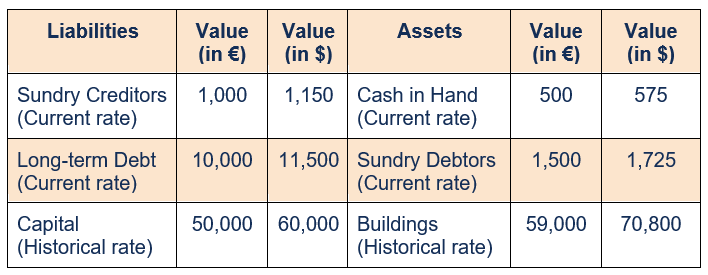
All monetary accounts are converted at the current rate of exchange, whereas non-monetary accounts are converted at a historical rate.
Monetary accounts are those items that represent a fixed amount of money, either to be received or paid, such as cash, debtors, creditors, and loans. Machinery, buildings, and capital are examples of non-monetary items because their market values can be different from the values mentioned on the balance sheet.
The balance sheet prepared using the monetary/non-monetary method will be as follows:
3. Current Rate Method
The current rate method is the easiest method, wherein the value of every item in the balance sheet, except capital, is converted using the current rate of exchange. The stock of capital is evaluated at the prevailing rate when the capital was issued.
The balance sheet prepared using the current rate method will be as follows:
4. Temporal Method
The temporal method is similar to the monetary/non-monetary method, except in its treatment of inventory. The value of inventory is generally converted using the historical rate, but if the balance sheet records inventory at market valueMarket ValueMarket value is usually used to describe how much an asset or company is worth in a financial market. Itis mutually determined by market participants and, it is converted using the current rate of exchange.
In the example above, if there is an inventory of goods recorded in the balance sheet at its historical value of, say €1,000, its value in dollars after conversion will be $(1,000 x 1.2), or $1,200.
However, if the inventory of goods is recorded at the current market value of, say €1,050, then its value will be $(1,050 x 1.15), or $1,207.50.
In each of the methods used above, there is a mismatch between the total values of assets and liabilities after conversion. While calculating income and net profit, variations in exchange rates can distort the amounts to a great extent, which is why accountants often use hedging to do away with this risk.
Related Readings
CFI is the official provider of the Commercial Banking & Credit Analyst (CBCA)™Program Page - CBCAGet CFI's CBCA™ certification and become a Commercial Banking & Credit Analyst. Enroll and advance your career with our certification programs and courses. certification program, designed to transform anyone into a world-class financial analyst.
To keep learning and developing your knowledge of financial analysis, we highly recommend the additional resources below:
- Nominal Effective Exchange Rate (NEER)Nominal Effective Exchange Rate (NEER)The nominal effective exchange rate (NEER) is a form of measuring a currency’s nominal exchange rate relative to a basket of other currencies using an
- Foreign Exchange Gain/LossForeign Exchange Gain/LossA foreign exchange gain/loss occurs when a company buys and/or sells goods and services in a foreign currency, and that currency fluctuates
- National CurrencyNational CurrencyA national currency is a currency issued by the monetary authority or central bank of a country. It is the medium through which the goods or services are
- Hedging ArrangementHedging ArrangementHedging arrangement refers to an investment whose aim is to reduce the level of future risks in the event of an adverse price movement of an asset. Hedging provides a sort of insurance cover to protect against losses from an investment.
-

Understanding CD Interest Rates: What's a Good Rate in 2024?
A CD (certificate of deposit) is a guaranteed investment tool. Unlike stocks, the principal of a CD cannot be lost, unless the investor violates the terms of the contract with the financial institutio
-

Relative Interest Rates: Understanding Their Impact on the Economy
Understanding relative interest rates. Relative interest rates are directly related to a nation's real interest rate and can drastically affect the direction and stability of a nation'
Accounting
- Understanding Exchange Rate Mechanisms (ERMs): A Comprehensive Guide
- Hurdle Rate: Definition, Calculation & Importance for Investors
- Understanding Interest Rates: A Comprehensive Guide
- Understanding Rate of Return: A Comprehensive Guide
- Understanding Dividend Yield: A Comprehensive Guide
- Ex-Ante: Understanding Predictions in Finance
- Understanding Financial Exposure: Investment Risk & Potential Losses
- Interest Rate Parity Explained: A Comprehensive Guide
- Understanding Translation Exposure: Risks and Mitigation Strategies
-
Jumbo CDs: Rates, Benefits & Requirements - [Year]
Jumbo certificates of deposit are usually defined as CDs with balances in excess of $100,000. However, some banks only describe CDs with balances in excess of $1 million as jumbo CDs. The rates paid o...
-
 Standard Mileage Rate: IRS Deduction for Business Vehicle Use
A standard mileage rate is the dollar amount per mile imposed by the Internal Revenue Service (IRS) when calculating the deductible costs for business use of automobiles. The standard mileage rate is ...