
Understanding Vouchers: A Guide to Accounts Payable Documents
A voucher is an internal document within a company that is issued by the accounts payable Accounts PayableAccounts payable is a liability incurred when an organization receives goods or services from its suppliers on credit. Accounts payables are(AP) department. It can be seen as a “memorandum” of the liabilities of the company, and it is used to authorize a payment.
In each company, there exists an accounts payable department that is in charge of making payments that are due to its creditors and suppliers.
A voucher is a backup document needed to initiate the procedure of collecting and filing all other documents required to settle a liability.
An important feature of the internal accounting of a company is the control mechanism. The mechanism ensures that each payment made by the company is previously authorized and that it is appropriate for the goods or servicesProducts and ServicesA product is a tangible item that is put on the market for acquisition, attention, or consumption while a service is an intangible item, which arises from received based on the pre-existing agreements.
In other words, a voucher is a supporting document for an invoice received by the company. Once the voucher is issued, it means that the invoice’s been checked, and it’s been confirmed that it needs to be paid. The voucher authorizes the payment of the invoice in one lump-sum that will be written on the balance sheet.
How Vouchers Work
In business-to-business transactions, often the payments are not due immediately. They can be paid with an allowed delay that can vary between 30, 60, or 90 days. When the company receives the supplies with the invoice, instead of releasing the payment immediately, it creates a voucher as a reminder of the payments due or as a statement of the payment already made.
A voucher can include various supporting documents. The most common are listed below:
- The invoice received from the supplier
- The data of the supplier to be paid (name, address, telephone number)
- The data for the payment (amount due, including a possible discount and due date for the payment)
- The initial purchase orderPurchase OrderA purchase order is a commercial source document that is issued by a business’ purchasing department when placing an order with the business’ vendors or made by the company
- The receipt that confirms that the company received the goods or the services stated in the invoice
- The general ledger accounts General LedgerIn accounting, a General Ledger (GL) is a record of all past transactions of a company, organized by accounts. General Ledger (GL) accounts– needed for accounting reasons
- The signature of an authorized representative at the company (such as the head of the accounts payable department) that validate the purchase and the payment
- The proof of payment, which is included in the voucher documentation
The graph below shows the process of preparing a voucher:
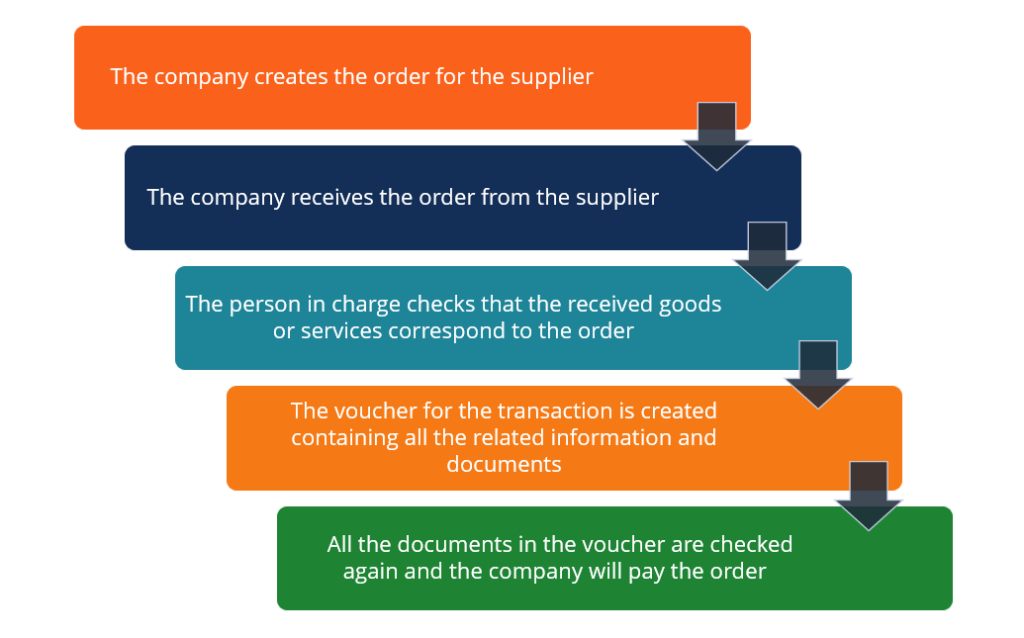
Accounting Principle
Considering the information above, you can see that there are two types of vouchers:
- Vouchers that have an outstanding balance due; and
- Vouchers that refer to an invoice already paid.
The first type (payment due) is registered on the balance sheetBalance SheetThe balance sheet is one of the three fundamental financial statements. The financial statements are key to both financial modeling and accounting. as accounts payable. After the voucher’s been paid, it will be registered as a paid voucher, and the proof of payment must be attached.
Importance of Vouchers
Vouchers are particularly important when an audit is performed. By law, public companies are subject to an audit procedure that verifies the veracity of the information in the financial statements. Thanks to the voucher, the auditor in charge can easily verify that all the goods purchased, or the services paid, were actually received by the company. Thus, the vouchers are used to justify and document the cash payments of the company.
On the other hand, the vouchers are used internally to reduce the risk of misconduct by employees and deter them from colluding to steal company assets. The vouchers create a paper trail, which documents all of the people involved with that particular transaction, as well as their tasks associated with that transaction. In such a way, it is easier to assess who is responsible for what.
Example of Vouchers
A small minimarket orders fresh food from its supplier every few days. The manager of the fresh food department orders 50 pounds of meat and fish, and the owner initiates the order to approve the delivery. When the minimarket receives the order, the content of the delivery is compared to the order to make sure everything was received.
At such a point, a voucher is issued. It contains the purchase order, the shipping receipt, and the invoice. The amount due is also included, and it will be registered in the accounts payable until the payment is made.
The voucher will be sent to the owner, who reviews everything to make sure that all the information is accurate, and then the payment will be approved. Afterward, the transaction is closed, and the voucher will be registered as a paid voucher in the balance sheet.
Related Readings
CFI is the official provider of the global Commercial Banking & Credit Analyst (CBCA)™Program Page - CBCAGet CFI's CBCA™ certification and become a Commercial Banking & Credit Analyst. Enroll and advance your career with our certification programs and courses. certification program, designed to help anyone become a world-class financial analyst. To keep advancing your career, the additional resources below will be useful:
- Analysis of Financial StatementsAnalysis of Financial StatementsHow to perform Analysis of Financial Statements. This guide will teach you to perform financial statement analysis of the income statement,
- Accounts Payable vs Accounts ReceivableAccounts Payable vs Accounts ReceivableIn accounting, accounts payable and accounts receivable are sometimes confused with the other. The two types of accounts are very similar in
- Projecting Balance Sheet ItemsProjecting Balance Sheet Line ItemsProjecting balance sheet line items involves analyzing working capital, PP&E, debt share capital and net income. This guide breaks down how to calculate
- Source DocumentsSource DocumentsThe paper trail of a company's financial transactions are referred to in accounting as source documents. Whether checks are written to be
-
Accrued Revenue: Definition, Examples & Accounting Explained
Accrued revenue is revenue that has been earned by providing goods or services but the payment has yet to be received. In other words, cash collection will occur in a subsequent period after the goods
-
Understanding Book Value: A Key Financial Metric
Book value is a company’s equity value as reported in its financial statementsThree Financial StatementsThe three financial statements are the income statement, the balance sheet, and the statem
Accounting
- Acquirer Definition: Understanding Corporate Acquisitions
- Understanding Clawbacks: Protecting Stakeholders from Failed Performance
- Understanding Financial Gearing: Debt & Leverage Explained
- Leverage in Finance: Strategies, Types & Risks
- Parent Company Explained: Definition, Control & Examples
- EBITA Explained: Understanding Earnings Before Interest, Taxes, and Amortization
- Understanding Expenditures: Definition and Types
- Goodwill in Accounting: Definition & Value
- OIBDA Explained: Understanding Operating Income Before Depreciation & Amortization
-
 Understanding the Role of an Accountant: Key Responsibilities & Importance
An accountant plays a very crucial role in an organizationTypes of OrganizationsThis article on the different types of organizations explores the various categories that organizational structures can ...
-
 Streamlining Processes: Definition, Benefits & Techniques
Streamlining refers to the improvement of the efficiency of a certain process within an organization. It can be done by automationExcel vs Automation in Financial ModelingBefore we discuss Excel vs au...