
Boost Sales with Facebook Remarketing: Re-engage Abandoned Carts
Digital cart abandonment is at an all-time high.
Recent studies show that the average abandonment is above 75 percent – and rising.
In other words, three out of every four shoppers on your website that actually go through the trouble of putting items in their cart just disappear.
Just imagine how much money you’re leaving on the table with these missed conversions.
Today, advertisers need to be more clever than ever to reel in these potential customers/leads.
Fortunately, remarketing allows you to keep your brand fresh in potential customers’ minds by following them around the web with targeted messages.
While the task might sound daunting, platforms that depend on advertisements like Google and Facebook make it surprisingly easy.
And social remarketing platforms are especially effective at generating a high ROAS, if you know how to set them up properly.
Let’s take a look at Facebook remarketing to get a better idea of how it can help improve your social campaigns and close more of those nearly-converting cart abandoners.
What Is Facebook Remarketing?
Before we dive in, let’s clarify what remarketing is and why it’s important.
Remarketing (or “retargeting,” depending on who you ask) shows your custom ads to users who have already engaged with your brand online.
When users visit your website, landing page, or social media page, a cookie or pixel is added to their browser and lets your ads “follow” them to other digital spaces with content based on the info in your cookie.

Wherever your users roam, their cookies will follow. – image source
Remarketing is a proven tactic for enticing customers who escaped your sales funnel to come back and convert.
For example:
- Visitors who see remarketing ads are 70% more likely to convert on a website compared to those who don’t.
- In a joint study, comScore and ValueClick Media found that remarketing lifted trademark scores by 1,046%, the highest performance out of six targeting strategies tested.
- Only 11% of consumers had a negative reaction to remarketing ads in an eMarketer study, while 30% of buyers who noticed responded positively.
Facebook remarketing is especially potent because of how specific the available targeting and tracking data is.
By zeroing in on specific users who took specific actions, you can use Meta Pixel to:
- Reinforce your message to users who viewed specific pages.
- Show targeted ads to visitors who bounced.
- Upsell and cross-sell new items to past purchasers.
- Encourage visitors to learn more or complete a purchase.
- and lots more.
Finally, despite the recent growth of other social networks, Facebook is still the standard for digital marketing success.
In a (different) eMarketer survey, more than 95% of social media marketers named Facebook as the best social network for producing ROI for their clients.
These results placed Facebook well ahead of Twitter (63.5%), Instagram (40.1%) and Snapchat (2.1%).
So in a nutshell, if you’re planning to use targeted advertising to increase sales, Facebook is probably the best place to start.
But that’s enough about how valuable Facebook is as a remarketing asset — let’s move on from the “why” and get into the “how” already.

Let’s not spend any longer in this nutshell than we have to. – image source
Maximize Your Paid Advertising
If you’re going to target specific Facebook users, it’s important to know what specific goals and actions you’re trying to initiate with your ads, especially since you’re using real budget dollars to reach them.
Remarketing is a great way to both fill-up and plug holes in your sales funnel — starting with one key leak near the bottom.
1. Reduce Cart Abandonment.
Did you know that if abandoned digital shopping carts were real shopping carts and you stacked them all up, they would reach the moon?
OK, that might not technically be true.
But abandoned digital carts are a real problem, and they aren’t going away.
In fact, the Baymard Institute’s collection of abandonment rate statistics shows the number of ditched carts going up, from around 60% in the late 2000s to higher than 80% in some cases today.
Remarketing on Facebook makes it possible for you to reach these “ghosts” and remind them that they probably still want that thing they were about to buy and that it’s not too late.
Facebook even offers specific “event codes” for granular on-site actions, so you can craft specific ads to reach users who added an item to a shopping cart or a wishlist.
2. Keep Your Product Fresh.
In addition to reaching cart abandoners, Facebook’s remarketing system lets you target users who visited specific product pages but didn’t put items in a cart.
These users are good targets for remarketing because visiting product pages typically indicates both interest and purchase intent.
They might even be looking at different versions of the same product on different sites before committing to a purchase.
Dynamic Facebook ads keep your products and your brand fresh in this audience’s mind.
By targeting users who clicked into specific products and excluding those who reached the “Order Complete” page, you can reconnect with visitors who weren’t ready to convert then but might be ready now.
And as a bonus, you’ve taken a sale away from the competition!
Another great strategy to use is link retargeting. It allows you to retarget ads to people who have already interacted with a link in your social media post. This adds potential customers to your retargeting funnel even when they haven’t visited your website yet.
3. Offer Special Incentives To Motivate Customers To Buy.
Customers who engage with your branded content but don’t convert are also ripe for remarketing on Facebook.
These visitors have already shared their personal information for access to gated content like a webinar or an ebook.
Basically, they climbed into your marketing funnel voluntarily, which makes them more likely to respond when you offer an incentive.

“No one told me the funnel was this small when I climbed in.” – image source
Special incentives for an audience that has shared their contact information can include sales-based ads targeting first-time purchasers or limited-time discounts for popular products.
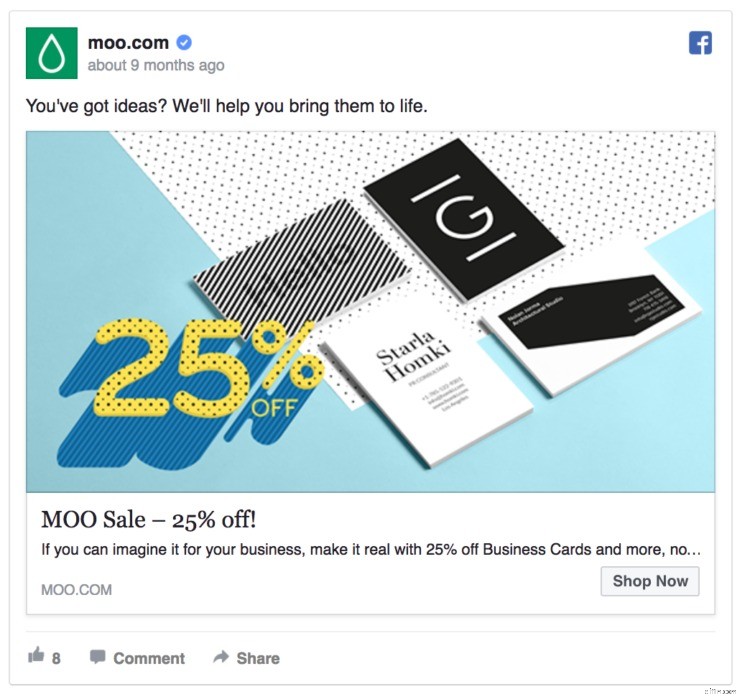
In this example, MOO offers a small discount on their entire product line for select leads. – image source
Sometimes an audience still needs nurturing at this stage. If that’s the case, you can create ads that offer a free trial to keep leads engaged and moving through your marketing funnel.
4. Target Based Off Specific Behavior.
If you really want to lure your cart abandoners back, Facebook’s tracking pixel makes it possible to run targeted ads based on the behavior of visitors who bounced.
For example, you can use Facebook remarketing to reach users based on the device they used, activities they completed, and more.
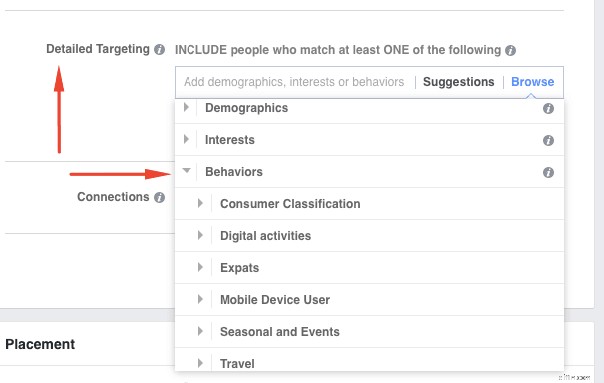
Just a sample of the options available in the Behaviors menu. – image source
Other user behaviors can demonstrate greater interest, like the amount of pages they visit, whether or not they scroll all the way to the end of an offer page, and other criteria.
Creating a Facebook remarketing campaign makes it easier to analyze this information and use it to improve your advertising efforts.
The next step is setting up Custom Audiences to further segment and personalize your message for your prospects.
-
Top 12 Automotive Ecommerce Sites Driving Online Sales Growth
U.S. ecommerce revenue from auto and parts retail sales are projected to reach $51.6 billion in 2018, representing a 121% increase compared to 2012 revenue. With automotive ecommerce revenue g
-
Top 15 B2B Ecommerce Sites Driving Sales Growth
B2B ecommerce sales in the U.S. are expected to reach $954 billion this year on their way to nearly $1.2 trillion by 2021. That’s a 25% increase over the next three years. B2B companies can’t
Business
- Leverage Social Proof: Boost E-commerce Sales & Conversions
- Advertising to Sales Ratio: Measuring Ad Effectiveness & ROI
- Boost Amazon Sales: 10 Proven Strategies for 2024
- Facebook Ads for Beginners: Campaigns, Objectives & Strategies
- Boost Ecommerce Sales: 10+ Expert Strategies for Rapid Growth
- Video Advertising for Ecommerce: Boost Sales in 2024
- Website Product Taxonomy: Improve Navigation & Boost Sales
- Boost Holiday Sales: Ecommerce Strategies for 2021
- Leverage Sales Psychology: 10 Proven Conversion Strategies
-
 Top 30 Shopify Apps for Sales Growth & Profit Maximization (Part 3: Selling)
E-commerce sellers are now looking for the best bargains and deals. For many entrepreneurs, the idea of running a business is a dream. Running your own company can offer you freedom to make decisio...
-
 Integrating BigCommerce with Amazon: A Step-by-Step Guide
Now that you know how to sell on Amazon, fully understand the vast potential of tapping into Amazon’s 304 million (and growing) active user base and you know how to successfully market products ...