
Advertising to Sales Ratio: Measuring Ad Effectiveness & ROI
The advertising to sales ratio, also called the “A to S” for short, measures the effectiveness, or how successful, a company’s advertising strategiesAIDA ModelThe AIDA model, which stands for Attention, Interest, Desire, and Action model, is an advertising effect model that identifies the stages that an individual are. The advertising to sales ratio is used to determine how helpful the company’s resources and investments in advertising are in generating new sales. A low ratio is preferred, as it indicates that the advertising campaign generated high sales relative to the amount of money spent on advertising.

Formula for the Advertising to Sales Ratio
The formula for the advertising to sales ratio is as follows:

Where:
- Total advertising expenses are the amount of money spent on advertising – the number can be found on a company’s income statementIncome StatementThe Income Statement is one of a company's core financial statements that shows their profit and loss over a period of time. The profit or
- Sales revenue is the income generated by a business – the number can be found on a company’s income statement
Example of Advertising to Sales Ratio
Netan recently launched a new clothing brand with his friend, Matt. The company, called Luxury Goods, Inc., is positioned to be a luxury-brand business catering to the ultra-wealthy. After four years of operation, the company’s income statement is as follows:
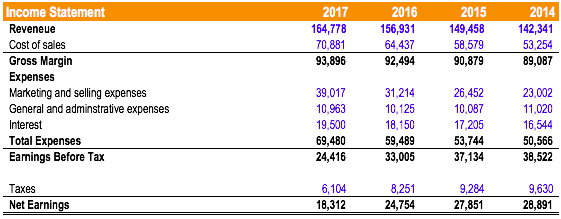
The two founders went over the income statement and realized that their net earnings have been decreasing year over year. Matt, with his finance background, decides to look deeper by calculating expenses as a percentage of revenueRevenueRevenue is the value of all sales of goods and services recognized by a company in a period. Revenue (also referred to as Sales or Income):
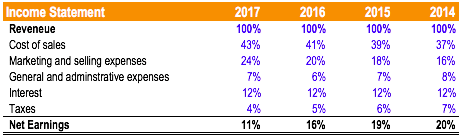
Matt quickly realizes that the cost of sales and marketing and selling expenses are driving net earnings down; the cost of sales and marketing and selling expenses increased by 7% and 8%, respectively.
Matt brings the issue to Netan, who tells Matt that the increase in the cost of sales is due to trade tariffs and higher import fees. The company operates in the United States and sources its high-quality leather from China. In addition, the increased marketing and selling expenses are a result of the company expanding its advertising horizons into print and magazines, which have not been performing very well.
The two founders then decide to re-evaluate their marketing plan to find more cost-effective means of reaching their target marketTotal Addressable Market (TAM)Total Addressable Market (TAM), also referred to as total available market, is the overall revenue opportunity that is available to a product or service if. In doing so, they hope to drive marketing and selling expenses down and boost their bottom line.
Advertising to Sales Ratio by Industry
It is important to note that there is no ideal advertising to sales ratio – it depends on the industry. For example, for retail goods such as clothing or perfume, the ratio can be as high as 10%, while paper and paper products can show a ratio as low as 0%. Therefore, when determining whether a company’s advertising to sales ratio is high or low, it is important to compare the figure to the industry average.
For example, the following are the 2017 advertising to sales ratio for various industries (source):
- Amusement parks: 6.2%
- Cigarettes: 1.2%
- Communication services: 4.9%
- Computer and office equipment: 1%
- Loan brokers: 17.3%
- Watches, clocks, and parts: 9.7%
Interpreting the Advertising to Sales Ratio
As mentioned previously, the advertising to sales ratio indicates the effectiveness of a company’s advertising strategies. It is important to compare the advertising to sales ratio within an industry and on a trending basis. In the example above, determining a single ratio would not provide much insight into how effective a company’s marketing strategies are in generating sales. If the industry average advertising to sales ratio in the example above was 25%, we can conclude that the company, Luxury Goods, is operating at a higher efficiency than that of its competitors.
A low ratio is desirable, as it improves the bottom line. In contrast, a high ratio may be detrimental to a company’s profitability. However, keep in mind that there are caveats. A company with a ratio of 1% with revenues decreasing on a trending basis may indicate that the company is not doing enough advertising to drive revenue growth.
Key Takeaways
- The ratio is used to determine how effective a company’s marketing strategies are relative to the revenue generated.
- It varies greatly among different industries; some industries have a larger percentage while other industries have a lower percentage.
- The ratio should be compared among industry competitors and on a trending basis.
- A low ratio is desirable, while a high ratio may be detrimental to a company’s profitability.
Related Readings
CFI offers the Financial Modeling & Valuation Analyst (FMVA)™Become a Certified Financial Modeling & Valuation Analyst (FMVA)®CFI's Financial Modeling and Valuation Analyst (FMVA)® certification will help you gain the confidence you need in your finance career. Enroll today! certification program for those looking to take their careers to the next level. To keep learning and advancing your career, the following CFI resources will be helpful:
- 5 P’s of Marketing5 P's of MarketingThe 5 P's of Marketing – Product, Price, Promotion, Place, and People – are key marketing elements used to position a business strategically. The 5 P's of
- Consumer ProductsConsumer ProductsConsumer products, also referred to as final goods, are products that are bought by individuals or households for personal use. From a marketing perspective, there are four types of consumer products, each with different marketing considerations.
- Projecting Income Statement Line ItemsProjecting Income Statement Line ItemsWe discuss the different methods of projecting income statement line items. Projecting income statement line items begins with sales revenue, then cost
- ROAS (Return on Ad Spend)ROAS (Return on Ad Spend)ROAS (Return on Ad Spend) is an important eCommerce metric. ROAS measures revenue generated per dollar of marketing spent. It is a similar and alternative profitability metric to ROI, or "Return on Investment". ROAS is commonly used in eCommerce businesses to evaluate the effectiveness of a marketing campaign.
-
Accounts Receivable to Sales Ratio: Definition & Analysis
The Accounts Receivable to Sales Ratio is a business liquidity ratio that measures how much of a company’s sales occur on credit. When a company has a larger percentage of its sales happening on
-

Asset Turnover Ratio: Definition & Calculation - Financial Analysis
The asset turnover ratio, also known as the total asset turnover ratio, measures the efficiency with which a company uses its assets to produce salesSales RevenueSales revenue is the income recei
finance
- Acid-Test Ratio: Understanding Your Company's Short-Term Liquidity
- Understanding the CAPE Ratio: A Guide to Cyclically Adjusted P/E
- Current Ratio: Definition, Calculation & Financial Health
- Debt-to-Assets Ratio: Definition, Calculation & Risk Assessment
- Operating Ratio: Definition, Calculation & Importance
- Quick Ratio: Understanding Your Business's Short-Term Liquidity
- Reserve Ratio Explained: Understanding Bank Reserves
- Understanding the Retention Ratio: Reinvesting for Growth
- Sharpe Ratio: Calculate & Interpret Investment Performance
-
![Shareholder Equity Ratio: Definition & Calculation | [Your Company Name]](https://www.etffin.com/article/uploadfiles/202110/2021100815180064_S.png) Shareholder Equity Ratio: Definition & Calculation | [Your Company Name]
Shareholder Equity Ratio: Definition & Calculation | [Your Company Name]The shareholder equity ratio is a ratio that shows the amount of a company’s assets that have been financed using the owner’s equity instead of debt. It shows the portion of shareholders&r...
-
 Treynor Ratio: Understanding Risk-Adjusted Portfolio Performance
The Treynor Ratio is a portfolio performance measure that adjusts for systematic riskSystematic RiskSystematic risk is that part of the total risk that is caused by factors beyond the control of a spe...