
Ansoff Matrix: Strategic Growth Planning Explained
The Ansoff Matrix, also called the Product/Market Expansion Grid, is a tool used by firms to analyze and plan their strategies for growthSustainable Growth RateThe sustainable growth rate is the rate of growth that a company can expect to see in the long term. Often referred to as G, the sustainable growth rate can be calculated by multiplying a company's earnings retention rate by its return on equity. The growth rate can be calculated on a historical basis and average. The matrix shows four strategies that can be used to help a firm grow and also analyzes the risk associated with each strategy. Learn more about business strategy in CFI’s Business Strategy Course.
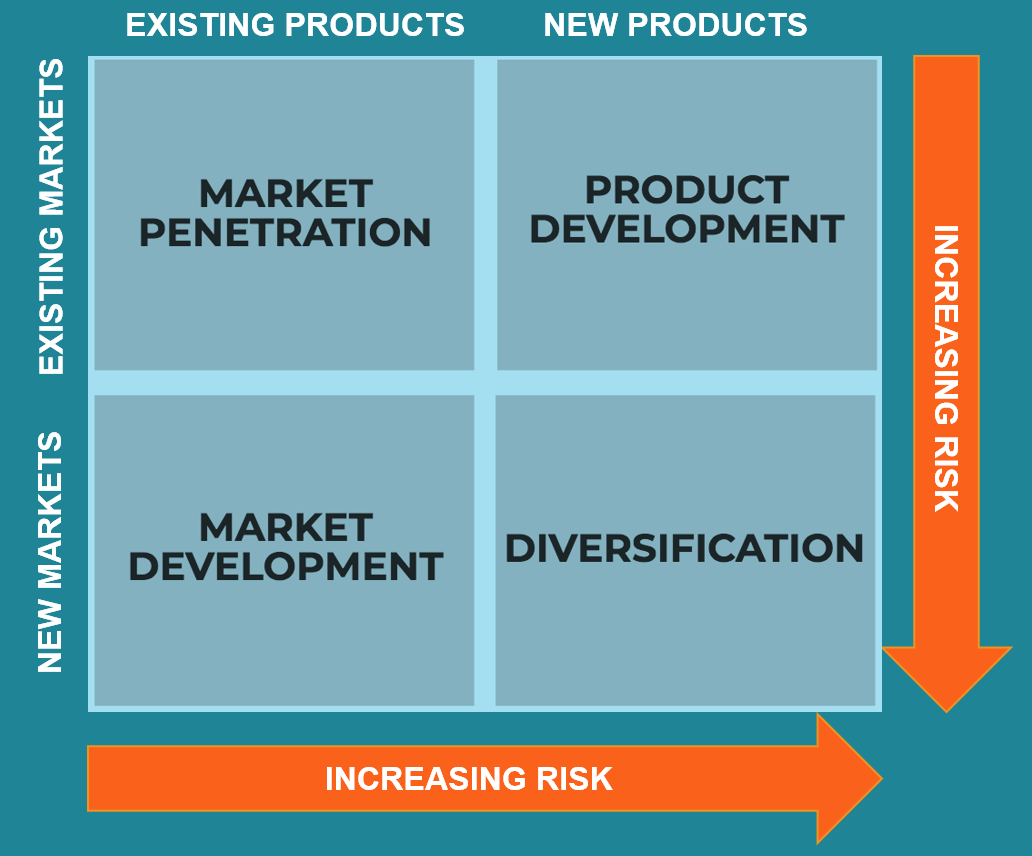
Understanding the Ansoff Matrix
The matrix was developed by applied mathematician and business manager, H. Igor Ansoff, and was published in the Harvard Business Review in 1957. The Ansoff Matrix has helped many marketers and executives better understand the risks inherent in growing their business.
The four strategies of the Ansoff Matrix are:
- Market Penetration: This focuses on increasing sales of existing products to an existing market.
- Product Development: Focuses on introducing new products to an existing market.
- Market Development: This strategy focuses on entering a new market using existing products.
- DiversificationProduct DiversificationProduct diversification is a strategy employed by a company to increase profitability and achieve higher sales volume from new products. Diversification: Focuses on entering a new market with the introduction of new products.
Of the four strategies, market penetration is the least risky, while diversification is the riskiest.
The Ansoff Matrix: Market Penetration
In a market penetration strategy, the firm uses its products in the existing market. In other words, a firm is aiming to increase its market share with a market penetration strategy.
The market penetration strategy can be executed in a number of ways:
- Decreasing prices to attract new customers
- Increasing promotion and distribution efforts
- Acquiring a competitor in the same marketplace
For example, telecommunication companies all cater to the same market and employ a market penetration strategy by offering introductory prices and increasing their promotion and distribution effortsAIDA ModelThe AIDA model, which stands for Attention, Interest, Desire, and Action model, is an advertising effect model that identifies the stages that an individual.
The Ansoff Matrix: Product Development
In a product development strategy, the firm develops a new product to cater to the existing market. The move typically involves extensive research and development and expansion of the company’s product range. The product development strategy is employed when firms have a strong understanding of their current market and are able to provide innovative solutions to meet the needs of the existing market.
This strategy, too, may be implemented in a number of ways:
- Investing in R&DResearch and Development (R&D)Research and Development (R&D) is a process by which a company obtains new knowledge and uses it to improve existing products and introduce to develop new products to cater to the existing market
- Acquiring a competitor’s product and merging resources to create a new product that better meets the need of the existing market
- Forming strategic partnerships with other firms to gain access to each partner’s distribution channels or brand
For example, automotive companies are creating electric cars to meet the changing needs of their existing market. Current market consumers in the automobile market are becoming more environmentally conscious.
The Ansoff Matrix: Market Development
In a market development strategy, the firm enters a new market with its existing product(s). In this context, expanding into new markets may mean expanding into new geographic regions, customer segments, etc. The market development strategy is most successful if (1) the firm owns proprietary technology that it can leverage into new markets, (2) potential consumers in the new market are profitable (i.e., they possess disposable income), and (3) consumer behavior in the new markets does not deviate too far from that of consumers in the existing markets.
The market development strategy may involve one of the following approaches:
- Catering to a different customer segment
- Entering into a new domestic market (expanding regionally)
- Entering into a foreign market (expanding internationally)
For example, sporting goods companies such as Nike and Adidas recently entered the Chinese market for expansion. The two firms are offering roughly the same products to a new demographic.
Learn more about strategy in CFI’s Business Strategy Course.
The Ansoff Matrix: Diversification
In a diversification strategy, the firm enters a new market with a new product. Although such a strategy is the riskiest, as both market and product development are required, the risk can be mitigated somewhat through related diversification. Also, the diversification strategy may offer the greatest potential for increased revenues, as it opens up an entirely new revenue stream for the company – accesses consumer spending dollars in a market that the company did not previously have any access to.
There are two types of diversification a firm can employ:
1. Related diversification: There are potential synergies to be realized between the existing business and the new product/market.
For example, a leather shoe producer that starts a line of leather wallets or accessories is pursuing a related diversification strategy.
2. Unrelated diversification: There are no potential synergies to be realized between the existing business and the new product/market.
For example, a leather shoe producer that starts manufacturing phones is pursuing an unrelated diversification strategy.
Related Readings
CFI is the official provider of the global Financial Modeling & Valuation Analyst (FMVA)™Become a Certified Financial Modeling & Valuation Analyst (FMVA)®CFI's Financial Modeling and Valuation Analyst (FMVA)® certification will help you gain the confidence you need in your finance career. Enroll today! certification program, designed to help anyone become a world-class financial analyst. To keep learning and advancing your career, the additional CFI resources below will be useful:
- 5 P’s of Marketing5 P's of MarketingThe 5 P's of Marketing – Product, Price, Promotion, Place, and People – are key marketing elements used to position a business strategically. The 5 P's of
- DemographicsDemographicsDemographics refer to the socio-economic characteristics of a population that businesses use to identify the product preferences and
- Market PlanningMarket PlanningMarket planning is the process of organizing and defining the marketing aims of a company and gathering strategies and tactics to achieve them. A solid
- Total Addressable Market (TAM)Total Addressable Market (TAM)Total Addressable Market (TAM), also referred to as total available market, is the overall revenue opportunity that is available to a product or service if
-

Understanding the S&P 500: A Comprehensive Guide
The Standard and Poor’s 500 Index, abbreviated as S&P 500 index, is an index comprising the stocks of 500 publicly traded companies in the U.S. with the highest values of market capitalizati
-

Understanding the Stock Market: A Beginner's Guide
The stock market refers to public markets that exist for issuing, buying, and selling stocks that trade on a stock exchange or over-the-counter. StocksStockWhat is a stock? An individual who owns stoc
Business strategy
- Understanding Stock Market Proxies: A Comprehensive Guide
- Understanding Stock Market Volume: A Comprehensive Guide
- Understanding the Call Market: Trading Hours & Price Determination
- Understanding the Money Market: Short-Term Debt & Lending
- NASDAQ Explained: A Comprehensive Guide to the Stock Market Exchange
- Beachhead Strategy: Definition, Advantages & Applications
- BCG Matrix: A Comprehensive Guide to Portfolio Analysis
- Cornering the Market: Definition, Strategies & Risks
- The Halloween Strategy: A Market Timing Approach
-
 NASDAQ Composite: Understanding the US Stock Market Index
The NASDAQ Composite is an index of more than 3,000 common equities listed on the NASDAQ stock market. The index is one of the most followed indices in the United States, alongside the Dow Jones Indus...
-
 Understanding the Primary Market: A Comprehensive Guide
The primary market is the financial market where new securitiesPublic SecuritiesPublic securities, or marketable securities, are investments that are openly or easily traded in a market. The securitie...