
NASDAQ Composite: Understanding the US Stock Market Index
The NASDAQ Composite is an index of more than 3,000 common equities listed on the NASDAQ stock market. The index is one of the most followed indices in the United States, alongside the Dow Jones Industrial AverageDow Jones Industrial Average (DJIA)The Dow Jones Industrial Average (DJIA), also referred to as "Dow Jones” or "the Dow", is one of the most widely-recognized stock market indices. and the S&P 500.

The majority of companies listed on the NASDAQ Composite are technology companies, such as Apple, Microsoft, Facebook, Dell, Cisco, Oracle, and Intel. The exchange also features the NASDAQ 100, an index of the largest non-financial companies that are listed on the NASDAQ Stock Market.
Since its establishment in 1971 with only 50 companies, NASDAQ’s grown to become the second-largest exchange after the NYSE in terms of market capitalizationMarket CapitalizationMarket Capitalization (Market Cap) is the most recent market value of a company’s outstanding shares. Market Cap is equal to the current share price multiplied by the number of shares outstanding. The investing community often uses the market capitalization value to rank companies.
History of the NASDAQ
Establishment
Headquartered in New York City, NASDAQ was founded in 1971. At the time of its establishment, NASDAQ was the first electronic stock exchange in the world, which helped it attract new technology companies, such as Microsoft, Apple, Dell, and Oracle. The composite index began with 50 companies and a starting value of 100, with the number of companies increasing to over 3,000 today and the index reaching a high of 7,846.76 in July 2018.
Dot-com boom and bust
During the dot-com boom and bust, the NASDAQ Composite displayed mixed outcomes between 1995 and 2005. In July 1995, the index crossed the 1,000-point mark for the first time. It was followed by a steady increase, peaking at 5,132.52 in March 2000.
In April 2000, the index fell to 3,227 and hit its lowest recent value in October 2002 at 1,108.49. After the bust, the index gradually recovered until 2007/2008, when the Global Financial Crisis happened.
Financial crisis
In the first quarter of 2007, the index reached an intra-day level of 2,861.51, the highest value since the dot-com bust. In September 2008, the index lost nearly 200 points to fall below the 2,000 level. In March 2009, the NASDAQ Composite closed at a low of 1,265.52.
Thereafter, the index gradually recovered with the help of the US Federal Reserve’s quantitative easingQuantitative EasingQuantitative easing (QE) is a monetary policy of printing money, that is implemented by the Central Bank to energize the economy. The Central Bank creates program. The index broke a 15-year record of over 5,000 points in April 2015.
Criteria for Inclusion in the NASDAQ Composite
For a security to be considered for listing in the NASDAQ Composite, it must meet the following criteria:
- The security must be exclusively listed on the NASDAQ Stock Exchange. The only exception to this requirement is if the security was listed on a different US stock exchange before 2004 and has maintained that listing.
- The security must be among the following types of securities: American Depositary ReceiptsAmerican Depositary Receipts (ADR)American Depositary Receipts (ADR) are negotiable security instruments that are issued by a US bank that represent shares in a foreign company, ordinary shares, common stock, Share of Beneficial Interest, Real Estate Investment Trusts, Limited Partnership Interests, and tracking stocks.
- If the security fails to meet these requirements, it becomes ineligible for the NASDAQ Composite and is removed.
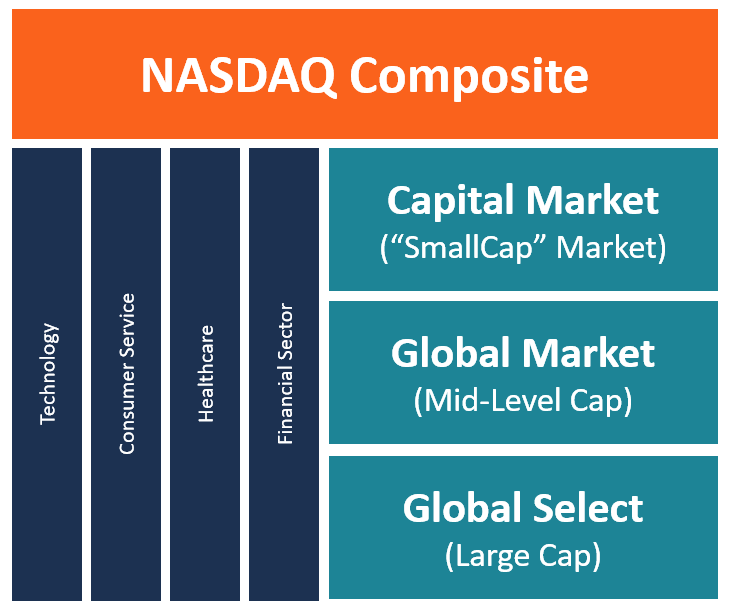
NASDAQ US Market Tiers
Stocks listed on the NASDAQ Composite index are categorized into three market tiers, based on the listing requirements they meet. The market tiers include:
#1 Capital market
The capital market has the least stringent requirements of the three market tiers. It is an equity market for companies with small market capitalizations. It was previously known as the “SmallCap” Market before it was rebranded to the capital market.
#2 Global market
The global market comprises companies with mid-level capitalization, and these companies must meet the liquidity and financial requirements provided by NASDAQ. The market has 1,450 stocks that are listed in the United States and on other international stock exchanges.
#3 Global select market
The global select market has the most stringent requirements in terms of finance, liquidity, and corporate governance requirements. Companies that meet these requirements are mostly companies with large market capitalizations. It comprises 1,200 United States and international stocks. The NASDAQ’s Listing Qualifications Department reviews these companies every year in October to determine their eligibility for this market.
NASDAQ Composite Methodology
The NASDAQ Composite is calculated using a market capitalization weighting method. It means that the largest companies listed on this exchange exert the greatest impact on the final value of the index. The index is calculated by taking the total value of the share weights of all the stocks on the exchange, multiplied by each security’s closing price. It is then divided by an index divisor to arrive at a more appropriate figure for reporting purposes.
The NASDAQ index is reported on the composite every second, but the final confirmed value is calculated at 4:16 p.m. Eastern Time at the close of each trading day. The final value is the NASDAQ price reported in financial news channels and publications.
Related Readings
CFI is the official provider of the Financial Modeling and Valuation Analyst (FMVA)™Become a Certified Financial Modeling & Valuation Analyst (FMVA)®CFI's Financial Modeling and Valuation Analyst (FMVA)® certification will help you gain the confidence you need in your finance career. Enroll today! certification program, designed to transform anyone into a world-class financial analyst. To keep learning and developing your knowledge of financial analysis, we highly recommend the additional resources below:
- Common StockCommon StockCommon stock is a type of security that represents ownership of equity in a company. There are other terms – such as common share, ordinary share, or voting share – that are equivalent to common stock.
- Nikkei IndexNikkei IndexThe Nikkei Index, or Nikkei 225, is the most recognized Japanese stock market index. It comprises Japan's top 225 companies listed on the Tokyo Exchange.
- Trading FloorTrading FloorA trading floor refers to a literal floor in a building where equity, fixed income, futures, options, commodities, or foreign exchange traders buy and sell securities.
- Types of Markets – Dealers, Brokers, ExchangesTypes of Markets - Dealers, Brokers, ExchangesMarkets include brokers, dealers, and exchange markets. Each market operates under different trading mechanisms, which affect liquidity and control. The different types of markets allow for different trading characteristics, outlined in this guide
-

Capitalization-Weighted Index (CWI): Explained
The Capitalization-Weighted Index (cap-weighted index, CWI) is a type of stock market index in which each component of the index is weighted relative to its total market capitalizationMarket Capitaliz
-

Understanding Derivatives: A Comprehensive Overview
The derivatives market refers to the financial market for financial instruments such as futures contracts or options that are based on the values of their underlying assets. SummaryThe deri
invest
- Understanding the Call Market: Trading Hours & Price Determination
- Hindenburg Omen: Predicting Stock Market Crashes - A Comprehensive Guide
- Understanding Market Support: What is 'Holding the Market'?
- Understanding the Money Market: Short-Term Debt & Lending
- NASDAQ Explained: A Comprehensive Guide to the Stock Market Exchange
- Nasdaq Capital Market: A Guide to Small-Cap Investing
- Nasdaq Global Select Market: Definition & Key Information
- NYSE Composite Index: Definition & What It Measures
- Understanding the Primary Market: A Comprehensive Guide
-
 Understanding the Secondary Market: A Guide for Investors
The secondary market is where investors buy and sell securities from other investors (think of stock exchangesStock MarketThe stock market refers to public markets that exist for issuing, buying and s...
-
 Advance/Decline Ratio (ADR): A Comprehensive Guide
The advance decline ratio (ADR) is a technical indicatorTechnical Analysis - A Beginners GuideTechnical analysis is a form of investment valuation that analyses past prices to predict future price act...