
BCG Matrix: A Comprehensive Guide to Portfolio Analysis
The Boston Consulting Group Matrix (BCG Matrix), also referred to as the product portfolio matrix, is a business planning tool used to evaluate the strategic position of a firm’s brand portfolioBrand EquityIn marketing, brand equity refers to the value of a brand and is determined by the consumer’s perception of the brand. Brand equity can be positive or. The BCG Matrix is one of the most popular portfolio analysis methods. It classifies a firm’s product and/or services into a two-by-two matrix. Each quadrant is classified as low or high performance, depending on the relative market share and market growth rateSustainable Growth RateThe sustainable growth rate is the rate of growth that a company can expect to see in the long term. Often referred to as G, the sustainable growth rate can be calculated by multiplying a company's earnings retention rate by its return on equity. The growth rate can be calculated on a historical basis and average. Learn more about strategy in CFI’s Business Strategy Course.
Understanding the Boston Consulting Group (BCG) Matrix
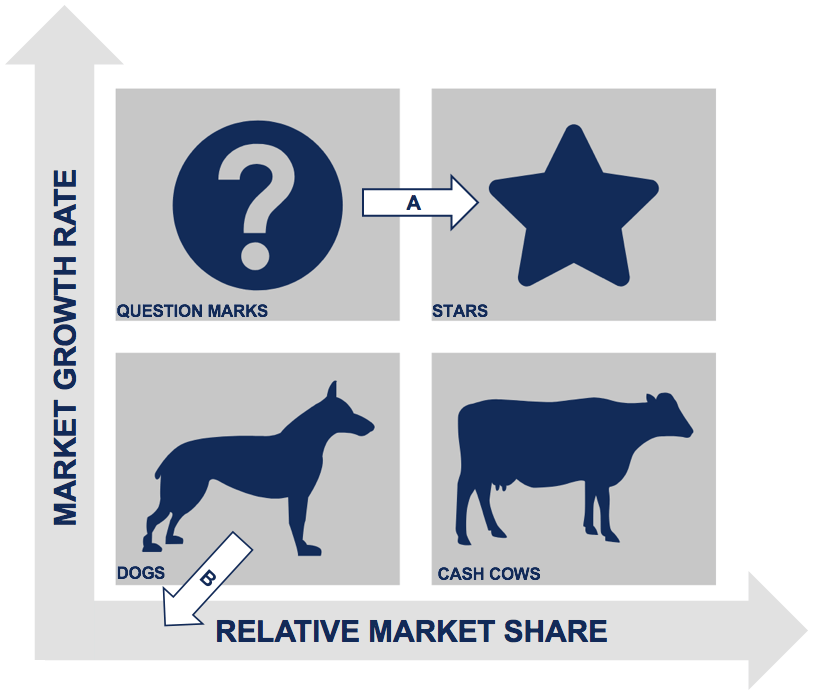
The horizontal axis of the BCG Matrix represents the amount of market share of a product and its strength in the particular market. By using relative market share, it helps measure a company’s competitiveness.
The vertical axis of the BCG Matrix represents the growth rate of a product and its potential to grow in a particular market.
In addition, there are four quadrants in the BCG Matrix:
- Question marks: Products with high market growth but a low market share.
- Stars: Products with high market growth and a high market share.
- Dogs: Products with low market growth and a low market share.
- Cash cows: Products with low market growth but a high market share.
The assumption in the matrix is that an increase in relative market share will result in increased cash flow. A firm benefits from utilizing economies of scaleEconomies of ScaleEconomies of scale refer to the cost advantage experienced by a firm when it increases its level of output.The advantage arises due to the and gains a cost advantage relative to competitors. The market growth rate varies from industry to industry but usually shows a cut-off point of 10% – growth rates higher than 10% are considered high while growth rates lower than 10% are considered low.
Learn more about strategy in CFI’s Business Strategy Course.
The BCG Matrix: Question Marks
Products in the question marks quadrant are in a market that is growing quickly but where the product(s) have a low market share. Question marks are the most managerially intensive products and require extensive investment and resources to increase their market share. Investments in question marks are typically funded by cash flows from the cash cow quadrant.
In the best-case scenario, a firm would ideally want to turn question marks into stars (as indicated by A). If question marks do not succeed in becoming a market leader, they end up becoming dogs when market growth declines.
The BCG Matrix: Dogs
Products in the dogs quadrant are in a market that is growing slowly and where the product(s) have a low market share. Products in the dogs quadrant are typically able to sustain themselves and provide cash flows, but the products will never reach the stars quadrant. Firms typically phase out products in the dogs quadrant (as indicated by B) unless the products are complementary to existing products or are used for a competitive purpose.
The BCG Matrix: Stars
Products in the star quadrant are in a market that is growing quickly and one where the product(s) have a high market share. Products in the stars quadrant are market-leading products and require significant investment to retain their market position, boost growth, and maintain a competitive advantageCompetitive AdvantageA competitive advantage is an attribute that enables a company to outperform its competitors. It allows a company to achieve superior margins.
Stars consume a significant amount of cash but also generate large cash flows. As the market matures and the products remain successful, stars will migrate to become cash cows. Stars are a company’s prized possession and are top-of-mind in a firm’s product portfolio.
The BCG Matrix: Cash Cows
Products in the cash cows quadrant are in a market that is growing slowly and where the product(s) have a high market share. Products in the cash cows quadrant are thought of as products that are leaders in the marketplace. The products already have a significant amount of investments in them and do not require significant further investments to maintain their position.
Cash flows generated by cash cows are high and are generally used to finance stars and question marks. Products in the cash cows quadrant are “milked” and firms invest as little cash as possible while reaping the profits generated from the products.
More Resources
CFI is the official provider of the global Financial Modeling & Valuation Analyst (FMVA)™Become a Certified Financial Modeling & Valuation Analyst (FMVA)®CFI's Financial Modeling and Valuation Analyst (FMVA)® certification will help you gain the confidence you need in your finance career. Enroll today! certification program, designed to help anyone become a world-class financial analyst. To keep learning and advancing your career, the additional CFI resources below will be useful:
- Aggregate Supply and DemandAggregate Supply and DemandAggregate supply and demand refers to the concept of supply and demand but applied at a macroeconomic scale. Aggregate supply and aggregate
- Market PositioningMarket PositioningMarket Positioning refers to the ability to influence consumer perception regarding a brand or product relative to competitors. The objective of market
- Network EffectNetwork EffectThe Network Effect is a phenomenon where present users of a product or service benefit in some way when the product or service is adopted by additional users. This effect is created by many users when value is added to their use of the product. The largest and best-known example of a network effect is the Internet.
- Substitute ProductsSubstitute ProductsSubstitute products offer consumers choices when making purchase decisions by providing equally good alternatives, thus increasing utility.
-
Understanding the Primary Market: A Comprehensive Guide
The primary market is the financial market where new securitiesPublic SecuritiesPublic securities, or marketable securities, are investments that are openly or easily traded in a market. The securitie
-

Understanding the S&P 500: A Comprehensive Guide
The Standard and Poor’s 500 Index, abbreviated as S&P 500 index, is an index comprising the stocks of 500 publicly traded companies in the U.S. with the highest values of market capitalizati
Business strategy
- Understanding Stock Market Proxies: A Comprehensive Guide
- Understanding the Call Market: Trading Hours & Price Determination
- Understanding the Money Market: Short-Term Debt & Lending
- NASDAQ Explained: A Comprehensive Guide to the Stock Market Exchange
- Ansoff Matrix: Strategic Growth Planning Explained
- Beachhead Strategy: Definition, Advantages & Applications
- Cornering the Market: Definition, Strategies & Risks
- Serviceable Obtainable Market (SOM): Definition & Calculation
- Understanding Total Addressable Market (TAM): A Comprehensive Guide
-
 Nasdaq Capital Market: A Guide to Small-Cap Investing
The Nasdaq Capital Market is one of the three tiers within the Nasdaq Composite Index. The Capital Market tier is an equity market for companies with the smallest levels of market capitalizationMarket...
-
 NASDAQ Composite: Understanding the US Stock Market Index
The NASDAQ Composite is an index of more than 3,000 common equities listed on the NASDAQ stock market. The index is one of the most followed indices in the United States, alongside the Dow Jones Indus...