
Nasdaq Capital Market: A Guide to Small-Cap Investing
The Nasdaq Capital Market is one of the three tiers within the Nasdaq Composite Index. The Capital Market tier is an equity market for companies with the smallest levels of market capitalizationMarket CapitalizationMarket Capitalization (Market Cap) is the most recent market value of a company’s outstanding shares. Market Cap is equal to the current share price multiplied by the number of shares outstanding. The investing community often uses the market capitalization value to rank companies within the Nasdaq Composite Index.

Market capitalization refers to the market value of a publicly-traded company’s outstanding shares. It is important to note that the market cap of a company only underlines the equity value of the company.
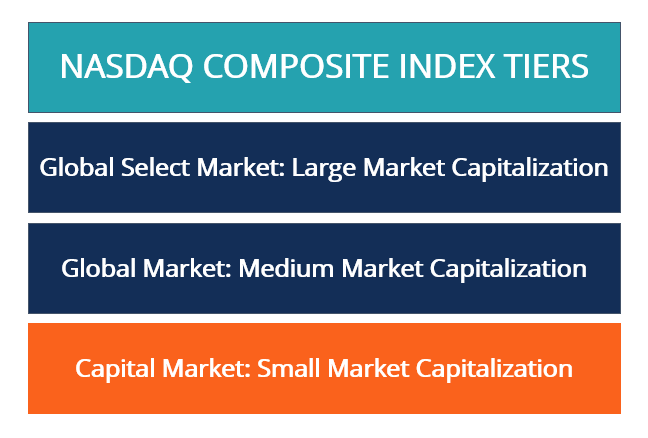
Since the Nasdaq Capital Market companies are the smaller capitalization companies, the requirements to list are not as strict as the larger companies in the other two tiers – Global Market and Global Select Market. The two other tiers include companies with medium to large market capitalization within the Nasdaq Composite IndexNASDAQ CompositeThe NASDAQ Composite is an index of more than 3,000 common equities listed on the NASDAQ stock market. The index is one of the most followed indices in the.
Summary
- The Nasdaq Capital Market is one of three tiers within the Nasdaq Composite Index, with the other two tiers being the Global Market and Global Select Market.
- The Capital Market tier is an equity market for companies with the smallest levels of market capitalization within the Nasdaq Composite Index.
- For a company to become part of Nasdaq’s Capital Market, it will need to fulfill certain criteria and requirements, including financial and liquidity requirements and corporate governance requirements.
Listing Requirements and Criteria
For a company to become part of Nasdaq’s Capital Market tier, it will need to fulfill certain criteria and requirements. They include financial and liquidity requirements and corporate governanceCorporate GovernanceCorporate governance is something altogether different from the daily operational management activities enacted by a company’s executives. It is a system of requirements.
In terms of financials and liquidity, there are three different standards companies may follow, but they need to meet the criteria for at least one. Some of the requirements include stockholders’ equity of at least 4-5 million and unrestricted publicly held shares of one million. In addition to the more specific criteria, companies also need a minimum average daily volume of 2,000 shares, and they need to be over 30 trading days before listing.
It is important to note that even if a company does meet all the requirements, Nasdaq still might deny the initial listing or apply specific conditions. If you compare the criteria of the Capital Market to the other two tiers within the Composite Index, you will see that the numbers are lower, and it is less strict.
Entry Fees
The entry fees to be listed on the Nasdaq Capital Market are based on the aggregate number of shares outstandingOutstanding SharesOutstanding shares represent the number of a company’s shares that are traded on the secondary market and, therefore, available to investors. Outstanding shares include all restricted shares held by the company’s officers and insiders (senior employees), as well as the equity portion owned by institutional investors at the point of initial listing, in addition to a $5,000 application fee that is non-refundable.
If the company has over 15 million total shares outstanding, the entry fee will be $75,000. If they have under 15 million shares outstanding, the entry fee will be $50,000.
In addition to the entry fees, there is an inclusive annual fee that varies and other fees, depending on the types of securities.
Nasdaq Composite Index
The National Association of Securities Dealers Automated Quotation (NASDAQ) Composite Index is a stock market index that includes common stocks and other similar securities that are listed on the Nasdaq stock market. It consists of more than 3,000 components, as it includes all stocks listed on the Nasdaq Exchange.
Within the Nasdaq Composite Index, there are three tiers – Capital Market, Global Market, and Global Select Market. There are two main requirements for the Nasdaq Composite Index.
Firstly, to be eligible for the Nasdaq Composite Index, the security needs to be listed exclusively on the Nasdaq stock market.
Secondly, there are only certain security types that are eligible – common stockCommon StockCommon stock is a type of security that represents ownership of equity in a company. There are other terms – such as common share, ordinary share, or voting share – that are equivalent to common stock., American Depositary Receipts (ADRs), Limited Partnership Interests, ordinary shares, Real Estate Investment Trusts (REITs), Shares of Beneficial Interest (SBIs), or tracking stocks.
It’s important to note that if at any time, a security no longer meets the two requirements, they are immediately removed.
Importance of the Nasdaq Capital Market Tier
The Capital Market tier is important because investors use it to rank the size of a company. Overall, it advises society and investors on which companies are part of the Nasdaq Composite Index’s first tier, which comprises companies with smaller market capitalization.
Additionally, the Index, as a whole, is known for including companies that are at the forefront of innovation in many industries and places emphasis on the large technology sector companies that many are interested in.
More Resources
CFI is the official provider of the Capital Markets & Securities Analyst (CMSA)®Program Page - CMSAEnroll in CFI's CMSA® program and become a certified Capital Markets &Securities Analyst. Advance your career with our certification programs and courses. certification program, designed to transform anyone into a world-class financial analyst.
To keep learning and developing your knowledge of financial analysis, we highly recommend the additional resources below:
- American Depositary Receipts (ADRs)American Depositary Receipts (ADR)American Depositary Receipts (ADR) are negotiable security instruments that are issued by a US bank that represent shares in a foreign company
- Dow Jones Industrial Average (DJIA)Dow Jones Industrial Average (DJIA)The Dow Jones Industrial Average (DJIA), also referred to as "Dow Jones” or "the Dow", is one of the most widely-recognized stock market indices.
- Equity Capital MarketEquity Capital Market (ECM)The equity capital market is a subset of the capital market, where financial institutions and companies interact to trade financial instruments
- Main Street vs. Wall StreetMain Street vs. Wall Street“Main Street vs Wall Street” is used to describe the contrast of general consumers, investors, or small local businesses with large investment corporations
-

Capitalization-Weighted Index (CWI): Explained
The Capitalization-Weighted Index (cap-weighted index, CWI) is a type of stock market index in which each component of the index is weighted relative to its total market capitalizationMarket Capitaliz
-

Understanding Derivatives: A Comprehensive Overview
The derivatives market refers to the financial market for financial instruments such as futures contracts or options that are based on the values of their underlying assets. SummaryThe deri
invest
- Equity Capital Market: Definition & How It Works
- Understanding the Call Market: Trading Hours & Price Determination
- Hindenburg Omen: Predicting Stock Market Crashes - A Comprehensive Guide
- Understanding Market Support: What is 'Holding the Market'?
- Understanding the Money Market: Short-Term Debt & Lending
- NASDAQ Explained: A Comprehensive Guide to the Stock Market Exchange
- NASDAQ Composite: Understanding the US Stock Market Index
- Nasdaq Global Select Market: Definition & Key Information
- Understanding the Primary Market: A Comprehensive Guide
-
 Understanding the Secondary Market: A Guide for Investors
The secondary market is where investors buy and sell securities from other investors (think of stock exchangesStock MarketThe stock market refers to public markets that exist for issuing, buying and s...
-
 Advance/Decline Ratio (ADR): A Comprehensive Guide
The advance decline ratio (ADR) is a technical indicatorTechnical Analysis - A Beginners GuideTechnical analysis is a form of investment valuation that analyses past prices to predict future price act...