
Understanding Markets: Definition, Types & Examples
A market refers to a space that facilitates an economic transaction between parties: the buyers and the sellers. An economic transaction may involve an exchange of goods, information, services, currency, etc., and does not necessarily involve legal tender.

A market is not necessarily a physical space, such as a retail outlet. It may also be a virtual marketplace without any physical contact, such as Amazon or eBay. It may also be one where securities can be traded without any direct contact between the buyer and the seller, such as a stock exchangeStock ExchangeA stock exchange is a marketplace where securities, such as stocks and bonds, are bought and sold. Stock exchanges allow companies to raise capital and investors to make informed decisions using real-time price information. Exchanges can be a physical location or an electronic trading platform.. It may likewise be a collection of individuals aiming to buy a product, such as the global oil market.
Summary
- A market refers to a space that facilitates an economic transaction between parties: the buyers and the sellers.
- A market facilitates a price-setting mechanism, which means that it uses demand and supply to arrive at the actual prices of a given good or service.
- In order to avoid malpractices in a market, regulatory and intermediary institutions such as the SEC are set up.
A market facilitates a price-setting mechanism, which means that it uses demand and supplySupply and DemandThe laws of supply and demand are microeconomic concepts that state that in efficient markets, the quantity supplied of a good and quantity to arrive at the actual prices of a given good or service. The supply of a given good is generated by its sellers, while the buyers for that particular product make up its demand.
Markets tend to find a balanced price for each good, which may be subject to disruptions due to changes in the price of the factors of production (such as raw materials and labor), changes in the number of willing buyers and sellers, technological innovations, etc.
Market – Types
There are several types of markets where buyers and sellers may gather to engage in economic transactions and can be classified according to their location, size, the kind of goods sold, and duration, among other factors. The total number of buyers and sellers that are part of a market, as well as the value of goods traded, make up the size of any market.
The most common types of markets are as follows:
1. Auction Markets
An auction market refers to a space meant for the sale and purchase of a specific type of good. It includes one seller and multiple buyers. The buyers bid their purchase prices, and in the end, the item is sold to the highest bidder.
AuctionAuctionAn auction is a system of buying and selling goods or services by offering them for bidding, allowing people to bid, and selling to the highest bidder. The bidders compete against each other markets aren’t limited to rare artwork or prices of jewelry but may also include real estate and livestock. eBay is a virtual auction market that enables bidders to place anonymous bids and win auctions.
2. Financial Markets
A financial market is one that facilitates the sale and purchase of any security or financial instrument. Securities may include real assets such as currencies, bonds, or company stock. They may also include derivative instruments that derive their value from other securities, such as mortgage-backed CDOs or options.
Financial market trading is the basis of capital formation and liquidity provision. They may be physical or virtual, such as the New York Stock Exchange (NYSE)New York Stock Exchange (NYSE)The New York Stock Exchange (NYSE) is the largest securities exchange in the world, hosting 82% of the S&P 500, as well as 70 of the biggest, foreign exchange market, and bond market.

3. Black Markets
Black markets refer to an illegal market that functions outside the realm of regulatory industries established by the government. Such type of markets is essentially illegal, which means that any contract for the sale of goods is not only null and void. They may also attract criminal or financial liability.
Most black market sales are executed in the form of cash transactions in order to avoid fulfillment of tax obligations, making them difficult to track and subsequently be taxed. They may also exist for the sale of illegally acquired goods, such as stolen works of art or illegally poached animals.
Black markets are observed in developing economies with a shortage of certain goods and services. For example, alcohol bootleggers became commonplace during the Prohibition Era in the United States.
Black markets do not function on the principle of automatic price-setting in accordance with demand and supply. It enables the sellers to sell unique or rare products at inflated prices. They include ticket scalping or the sneaker resale economy. Middlemen buy such goods in bulk and sell them at inflated prices in the black market.
Market – Regulatory Institutions
In order to avoid malpractices in a market, regulatory and intermediary institutions are set up. They help negate asymmetries of information relating to the market and establish rules and guidelines about the functions of the market.
They also work with the judiciary of a country to establish civil or criminal liabilities for malpractices. In the US, the market regulator is the Securities and Exchange Commission (SEC). In India, it is the Securities and Exchange Board of India (SEBI).
Additional Resources
CFI is the official provider of the global Commercial Banking & Credit Analyst (CBCA)™Program Page - CBCAGet CFI's CBCA™ certification and become a Commercial Banking & Credit Analyst. Enroll and advance your career with our certification programs and courses. certification program, designed to help anyone become a world-class financial analyst. To keep advancing your career, the additional CFI resources below will be useful:
- Aggregate Supply and DemandAggregate Supply and DemandAggregate supply and demand refers to the concept of supply and demand but applied at a macroeconomic scale. Aggregate supply and aggregate
- Asymmetric InformationAsymmetric InformationAsymmetric information is, just as the term suggests, unequal, disproportionate, or lopsided information. It is typically used in reference to some type of business deal or financial arrangement where one party possesses more, or more detailed, information than the other.
- Products and ServicesProducts and ServicesA product is a tangible item that is put on the market for acquisition, attention, or consumption while a service is an intangible item, which arises from
- Price IndicesPrice IndicesA price index (PI) is a measure of how prices change over a period of time, or in other words, it is a way to measure inflation. There are multiple methods on how to calculate inflation (or deflation).
-
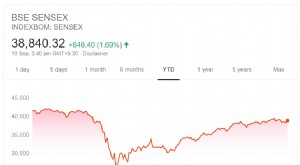
Sensex Explained: Understanding India's Key Stock Market Index
Sensex, also known as the S&P BSE Sensex Index, is the benchmark index that tracks India’s Bombay Stock Exchange (BSE). The Sensex is composed of the 30 largest and most-traded stocks within
-

Understanding Algorithmic Trading Spoofing: Definition & Impact
Spoofing is a disruptive algorithmic trading practice that involves placing bids to buy or offers to sell futures contractsFutures ContractA futures contract is an agreement to buy or sell an underlyi
finance
- Eurodollars: Understanding Foreign Currency Time Deposits
- Understanding Auction Markets: How Prices Are Determined
- Doji Candlestick Pattern: Meaning & Trading Signals
- Understanding Frothy Markets: Risks & Opportunities
- Understanding Inefficient Markets: Causes & Implications
- Understanding Market Cycles: Trends & Economic Environments
- Understanding Market Depth: A Guide for Traders
- Understanding Market Exposure: Risk & Portfolio Allocation
- Understanding Market Indexes: A Comprehensive Guide
-
 Understanding Stock Rallies: Definition & What Causes Them
A rally refers to a period of continuous increase in the prices of stocks, indexes or bondsBondsBonds are fixed-income securities that are issued by corporations and governments to raise capital. The ...
-
 Understanding Secular Markets: Long-Term Trends & Investment Strategies
A secular market is predominantly driven and impacted by elements or forces that are likely to be present in the foreseeable future. The forces can impact the price or value of a financial assetFinanc...