
Eclectic Paradigm: Understanding Foreign Direct Investment (FDI)
Based on the internalization theory of British economist J.H Dunning, the eclectic paradigm is an economic and business method for analyzing the attractiveness of making a foreign direct investment (FDI)Foreign Direct Investment (FDI)Foreign direct investment (FDI) is an investment from a party in one country into a business or corporation in another country with the intention of establishing a lasting interest. Lasting interest differentiates FDI from foreign portfolio investments, where investors passively hold securities from a foreign country.. The eclectic paradigm model follows the OLI framework. The framework follows three tiers – ownership, location, and internalization.
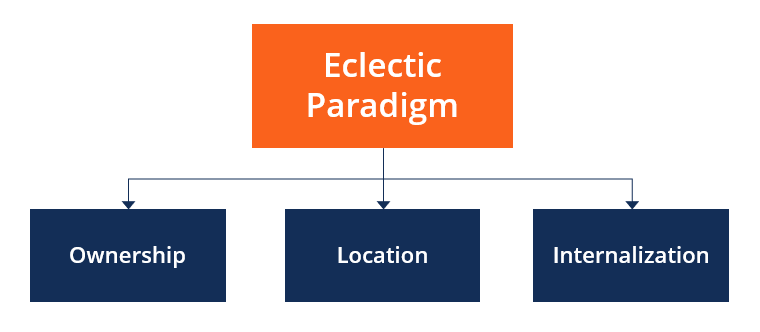
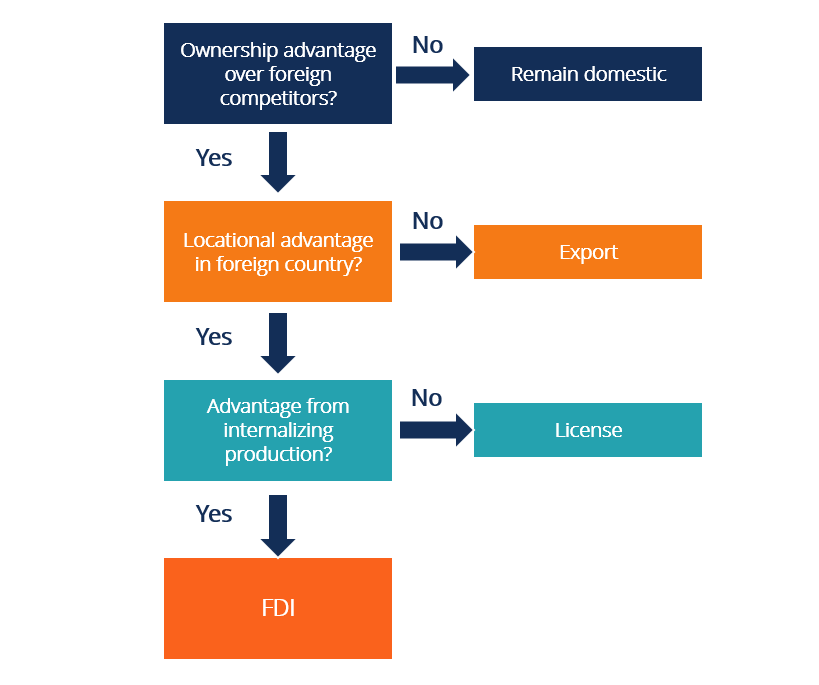
The eclectic paradigm assumes that companies are not likely to follow through with a foreign direct investment if they can get the service or product provided internally and at lower costs.
Summary
- The eclectic paradigm is an economic and business method for analyzing the attractiveness of making a foreign direct investment.
- The eclectic paradigm model follows the OLI framework. The framework follows three tiers – ownership, location, and internalization.
- Ownership can be defined as the proprietorship of a unique and valuable resource that cannot easily be imitated, which creates a competitive advantage against potential foreign competitors.
Ownership Advantage
The ownership advantage can also be seen as the competitive advantage that comes with the FDI. Ownership, in this instance, can be defined as the proprietorship of a unique and valuable resource that cannot easily be imitated, thereby creating a competitive advantageCompetitive AdvantageA competitive advantage is an attribute that enables a company to outperform its competitors. It allows a company to achieve superior margins against potential foreign competitors.
The intrinsic disadvantages or challenges associated with FDIs, in terms of ownership, circle around the liabilities that come with foreignness since the potential investor is a non-native in the country that the FDI will be made. The challenges can include (but are not limited to) possible language barriers or lack of knowledge of the demand trends that are common among the local consumer markets.
Companies and their management teams normally need to consider the possibilities of transference of the competitive advantage to other foreign markets in order to counterbalance the liabilities mentioned above. Ideally, an attractive investment should include notable economies of scaleEconomies of ScaleEconomies of scale refer to the cost advantage experienced by a firm when it increases its level of output.The advantage arises due to the, a sound reputation, and a well-known brand name, advanced technology, etc.
Location Advantage
The potential business host countries being considered for FDIs must present numerous competitive advantages; location is one of them. The location advantage focuses more on the geographic advantages of the host country or countries. An example of a geographic advantage can be access to the ocean (for sea freight or other purposes) versus a land-locked country.
Other location advantages can include low-cost labor and raw materials, lower taxes and other tariffs, a well-trained labor force, etc. Normally, the Porter’s diamond model can be used to evaluate location advantages.
Companies and their management teams normally need to consider whether any location advantages, as mentioned above, exist in the market they wish to enter. Should the advantages exist, the companies can consider taking on the investment through an FDI or other pathways (e.g., franchising or licensing) provided that there is a demand in the foreign markets.
Internalization Advantage
In order for companies to choose which investment pathway or method is best suited for their needs, their management team must analyze the internalization advantage. They normally need to consider whether it would be more sensible to get the value chain activity performed locally with their own team or outsource it to a foreign country.
The advantages of outsourcing from different countries can include (but are not limited to) lower costs and better skills to perform the value chain activities and/or better knowledge of the local markets.
In such a case, management can choose between two options on how to proceed. It can either outsource its production to an original equipment manufacturer (OEM)Original Equipment Manufacturer (OEM)An Original Equipment Manufacturer or OEM is a company that manufactures and sells products or parts of a product that their buyer, another company or license its product design to an independent foreign company
If the company does so, however, it should keep control over its activities and engage in FDI. It can be done by starting from scratch through a greenfield investment, entering into joint ventures with local partners, or purchasing existing local companies.
More Resources
CFI is the official provider of the global Commercial Banking & Credit Analyst (CBCA)™Program Page - CBCAGet CFI's CBCA™ certification and become a Commercial Banking & Credit Analyst. Enroll and advance your career with our certification programs and courses. certification program, designed to help anyone become a world-class financial analyst. To keep advancing your career, the additional CFI resources below will be useful:
- FranchiseFranchiseA franchise refers to a contractual arrangement whereby one party (the franchisor) allows another party (the franchisee) to use its trademarks
- Greenfield InvestmentGreenfield InvestmentIn economics, a greenfield investment (GI) refers to a type of foreign direct investment where a company establishes new operations in a foreign country
- OutsourcingOutsourcingOutsourcing is a strategic decision by a company to reduce costs and increase efficiency by hiring another individual or company to perform tasks, provide
- Value ChainValue ChainA value chain is all the activities and processes within a company that help add value to the final product. In today’s business landscape, companies across
-

Understanding Foreign Exchange Risk: A Comprehensive Guide
Foreign exchange risk, also known as exchange rate risk, is the risk of financial impact due to exchange rate fluctuations. In simpler terms, foreign exchange risk is the risk that a business’ f
-

Understanding Forward Rates: A Comprehensive Guide
The forward rate, in simple terms, is the calculated expectation of the yield on a bondBondsBonds are fixed-income securities that are issued by corporations and governments to raise capital. The bond
Business strategy
- Understanding Foreign Exchange: Impact on Investment & Economy
- Navigating International Banking Risks: A Comprehensive Guide
- Understanding Forex Spreads: A Comprehensive Guide
- Dow 30 Explained: Understanding the Dow Jones Industrial Average
- Rule of 72: Calculate Investment Doubling Time | [Your Brand Name]
- Competitive Advantage: Definition & Key Metrics for Business Success
- Understanding the Experience Curve: Cost Reduction & Efficiency
- First-Mover Advantage: Definition, Benefits & Strategies
- Nifty 50: History, Significance & Key Stocks - A Comprehensive Guide
-
 Current Ratio: Definition, Calculation & Financial Health
The current ratio, also known as the working capitalNet Working CapitalNet Working Capital (NWC) is the difference between a companys current assets (net of cash) and current liabilities (net of debt)...
-
 Foreign Exchange (Forex): A Comprehensive Guide
Foreign exchange (Forex or FX) is the conversion of one currency into another at a specific rate known as the foreign exchange rate. The conversion rates for almost all currencies are constantly float...