
Foreign Exchange (Forex): A Comprehensive Guide
Foreign exchange (Forex or FX) is the conversion of one currency into another at a specific rate known as the foreign exchange rate. The conversion rates for almost all currencies are constantly floating as they are driven by the market forces of supply and demandSupply and DemandThe laws of supply and demand are microeconomic concepts that state that in efficient markets, the quantity supplied of a good and quantity.
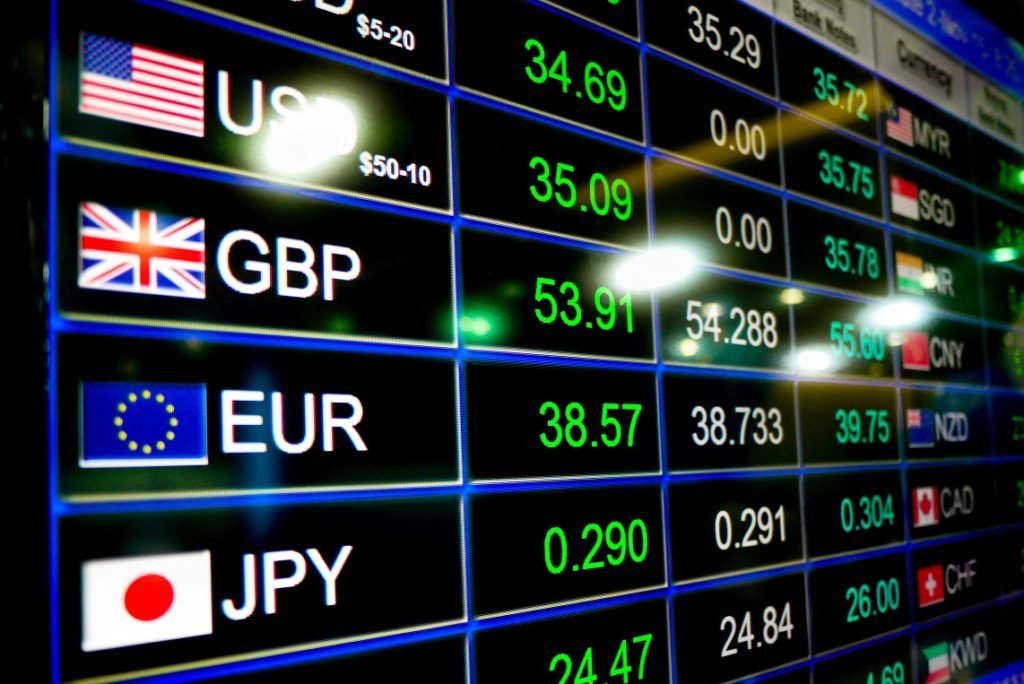
The most traded currencies in the world are the United States dollar, Euro, Japanese yen, British pound, and Australian dollar. The US dollar remains the key currency, accounting for more than 87% of total daily value traded.
Factors that Affect Foreign Exchange Rates
Many factors can potentially influence the market forces behind foreign exchange rates. The factors include various economic, political, and even psychological conditions. The economic factors include a government’s economic policies, trade balances, inflationInflationInflation is an economic concept that refers to increases in the price level of goods over a set period of time. The rise in the price level signifies that the currency in a given economy loses purchasing power (i.e., less can be bought with the same amount of money)., and economic growth outlook.
Political conditions also exert a significant impact on the forex rate, as events such as political instability and political conflicts may negatively affect the strength of a currency. The psychology of forex market participants can also influence exchange rates.
The Foreign Exchange Market
The foreign exchange market is a decentralized and over-the-counter market where all currency exchange trades occur. It is the largest (in terms of trading volume) and the most liquid market in the world. On average, the daily volume of transactions on the forex market totals $5.1 trillion, according to the Bank of International Settlements’ Triennial Central Bank Survey (2016).
The forex market major trading centers are located in major financial hubs around the world, including New York, London, Frankfurt, Tokyo, Hong Kong, and Sydney. Due to this reason, foreign exchange transactions are executed 24 hours, five days a week (except weekends). Despite the decentralized nature of forex markets, the exchange rates offered in the market are the same among its participants, as arbitrage opportunities can arise otherwise.
The foreign exchange market is probably one of the most accessible financial markets. Market participants range from tourists and amateur traders to large financial institutions (including central banks) and multinational corporationsMultinational Corporation (MNC)A multinational corporation is a company that operates in its home country, as well as in other countries around the world. It maintains a.
Also, the forex market does not only involve a simple conversion of one currency into another. Many large transactions in the market involve the application of a wide variety of financial instruments, including forwards, swaps, optionsOptions: Calls and PutsAn option is a derivative contract that gives the holder the right, but not the obligation, to buy or sell an asset by a certain date at a specified price., etc.
Related Readings
CFI is the official provider of the global Financial Modeling & Valuation Analyst (FMVA)™Become a Certified Financial Modeling & Valuation Analyst (FMVA)®CFI's Financial Modeling and Valuation Analyst (FMVA)® certification will help you gain the confidence you need in your finance career. Enroll today! certification program, designed to help anyone become a world-class financial analyst. To keep advancing your career, the additional CFI resources below will be useful:
- EUR/USD Currency CrossEUR/USD Currency CrossThe Euro to Dollar exchange rate (EUR/USD or €/$ for short) is the number of U.S. dollars for every 1 Euro. It is the convention for quoting the exchange rate between the two currencies. This guide will provide an overview of the factors that impact the FX rate, and what investors and speculators need to know
- Foreign Exchange Gain/LossForeign Exchange Gain/LossA foreign exchange gain/loss occurs when a company buys and/or sells goods and services in a foreign currency, and that currency fluctuates
- International Fisher EffectInternational Fisher Effect (IFE)The International Fisher Effect (IFE) states that the difference between the nominal interest rates in two countries is directly proportional
- USD/CAD Currency CrossUSD/CAD Currency CrossThe USD/CAD currency pair represents the quoted rate for exchanging US to CAD, or, how many Canadian dollars one receives per US dollar. For example, a USD/CAD rate of 1.25 means 1 US dollar is equivalent to 1.25 Canadian dollars. The USD/CAD exchange rate is affected by economic and political forces on both
-

Understanding Market Manipulation: Definition, Tactics & SEC Role
Market manipulation refers to artificial inflation or deflation of the price of a security. Also known as price manipulation or stock manipulation, it involves the literal manipulation of a financial
-
Understanding Market Risk: A Comprehensive Guide
The term market risk, also known as systematic risk, refers to the uncertainty associated with any investment decision. Price volatility often arises due to unanticipated fluctuations in factors that
finance
- Understanding Foreign Exchange: Impact on Investment & Economy
- Understanding Forex Spreads: A Comprehensive Guide
- Eurodollars: Understanding Foreign Currency Time Deposits
- Foreign Exchange Reserves: Definition & Importance
- Understanding Foreign Exchange Risk: A Comprehensive Guide
- Understanding Markets: Definition, Types & Examples
- Understanding the Equity Market: A Comprehensive Guide
- Foreign Exchange Swaps: Definition, Mechanics & Uses
- Understanding Foreign Exchange Gains & Losses: A Comprehensive Guide
-
 Understanding Market Indexes: A Comprehensive Guide
Market index refers to a portfolio of securities that represent a particular section of the stock marketStock MarketThe stock market refers to public markets that exist for issuing, buying and selling...
-
 Understanding Market Makers: How They Fuel Liquidity
Market maker refers to a firm or an individual that engages in two-sided markets of a given security. It means that it provides bids and asks in tandem with the market size of each security. A market ...