
Understanding Forex Spreads: A Comprehensive Guide
The foreign exchange spread (or bid-ask spread) refers to the difference in the bid and ask prices for a given currency pair. The bid price refers to the maximum amount that a foreign exchange trader5-Step Guide to Winning Forex TradingHere are the secrets to winning forex trading that will enable you to master the complexities of the forex market. The forex market is the largest market in the world in terms of the dollar value of average daily trading, dwarfing the stock and bond markets. is willing to pay to buy a certain currency, and the ask price is the minimum price that a currency dealer is willing to accept for the currency.

How can we calculate the foreign exchange spread?
The foreign exchange spread is usually expressed as a percentage, and can be calculated using the formula below:
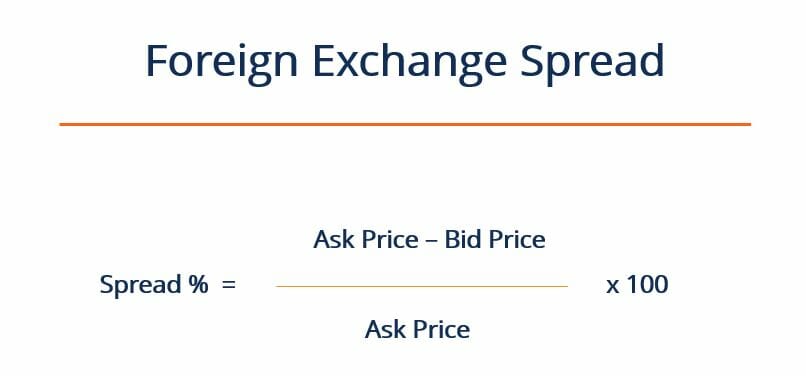
Where:
Ask Price – Refers to the lowest price that a currency dealer is willing to sell units of the currency for
Bid Price – Refers to the highest price that a currency trader is willing to buy units of the currency for
Thus, traders and dealers are able to exploit different parties’ valuation of the given currency and profit from the discrepancy. In some cases, the argument can be made that certain forex trades follow the Greater Fool TheoryGreater Fool TheoryThe Greater Fool Theory simply states that there will always be a “greater fool” in the market who will be ready to pay a price based on higher valuation for an already overvalued security., which exploits environments where there is asymmetrical information.
The “midpoint” of the foreign exchange spread refers to the theoretical price at which there would be a trade. It can be calculated by adding the ask and bid prices and then dividing the sum by two.
For example, if a dealer is willing to sell a certain number of units of a given currency for the equivalent of US$1.50, whereas a trader is only willing to buy a number of the currency units for US$1.00, the midpoint price of the foreign exchange spread would be (1.50+1.00)/2 = US$1.25.
Factors that influence the foreign exchange spread
There are a great number of factors that can affect the magnitude of bid-ask spreads that prevail on certain trading floors. For example:
1. Trading volumes
Generally speaking, higher trading volumes are indicative of a more liquid market, which implies a lower bid-ask spread. As the foreign exchange spread decreases, so does the discrepancy between dealer and buyer valuations of the currency. Therefore, dealers are able to more easily find a buyer with a similar bid price to their ask price and proceed with a trade.
Likewise, a buyer is able to find a dealer more easily who is willing to accept their offer to buy the currency for a certain price.
Higher foreign exchange spreads typically signify lower trading volumes since buyers and dealers have greater difficulty finding a willing trade partner.
2. Economic/Political risks
Nations that experience tumultuous political climates or unstable economies typically have their currencies associated with high risk. Such economies usually have fairly high inflation ratesInflationInflation is an economic concept that refers to increases in the price level of goods over a set period of time. The rise in the price level signifies that the currency in a given economy loses purchasing power (i.e., less can be bought with the same amount of money). and do not have a disciplined approach to monetary policyQuantitative EasingQuantitative easing (QE) is a monetary policy of printing money, that is implemented by the Central Bank to energize the economy. The Central Bank creates. As a result of this, the foreign exchange spread will become larger. This is because dealers will perceive the currency as a high-risk investment, and thus will only sell the currency at a premium. Buyers seek to buy at a discount to compensate for the higher risk.
Thus, the bid-ask spread will widen and, as noted, trade volumes will decrease.
3. Currency volatility
If a currency is not supported by a disciplined monetary policy and a stable central bank, it is usually more susceptible to changes in value. As a result, dealers will push ask prices higher, which will, in turn, drive the bid-ask spread upward.
More Resources
We hope you’ve enjoyed reading CFI’s explanation of Foreign Exchange Spread. CFI offers the Financial Modeling & Valuation Analyst (FMVA)™Become a Certified Financial Modeling & Valuation Analyst (FMVA)®CFI's Financial Modeling and Valuation Analyst (FMVA)® certification will help you gain the confidence you need in your finance career. Enroll today! certification program for those looking to take their careers to the next level. To learn more about related topics, check out the following CFI resources:
- Fixed vs. Pegged Exchange RatesFixed vs. Pegged Exchange RatesForeign currency exchange rates measure one currency's strength relative to another. The strength of a currency depends on a number of factors such as its inflation rate, prevailing interest rates in its home country, or the stability of the government, to name a few.
- Forex Trading – How to Trade the Forex MarketForex Trading - How to Trade the Forex MarketForex trading allows users to capitalize on appreciation and depreciation of different currencies. Forex trading involves buying and selling currency pairs based on each currency's relative value to the other currency that makes up the pair.
- The Winning Mindset of a TraderThe Winning Mindset of a TraderBeing a master trader is not just about formulating better strategies and analysis but is also about developing a winning mindset.
- Trade Order TimingTrade Order Timing - TradingTrade order timing refers to the shelf-life of a specific trade order. The most common types of trade order timing are market orders, GTC orders,
-

Danish Krone (DKK): Currency Overview, Value & Facts
The Danish Krone is the legal tender of the Kingdom of Denmark – and also of the Faroe Islands and Greenland, two Danish territories. The krone is sometimes referred to by its translation into E
-
Indian Rupee (INR): History, Value & Key Facts
The Indian rupee refers to India’s national currency and is represented by ISO code INR. It is regulated by the Reserve Bank of India (RBI), the country’s central bank. The Indian rupee is
finance
- Understanding Foreign Exchange: Impact on Investment & Economy
- Currency Forward Explained: Contracts for Future Exchange Rates
- Understanding Direct Quotes in Forex: A Comprehensive Guide
- Understanding Foreign Exchange Rates: A Comprehensive Guide
- Foreign Exchange (Forex): A Comprehensive Guide
- Foreign Exchange Reserves: Definition & Importance
- Understanding Foreign Exchange Risk: A Comprehensive Guide
- Understanding the Temporal Method for Currency Translation
- Understanding Foreign Exchange Gains & Losses: A Comprehensive Guide
-
 Understanding Average Selling Price (ASP): Definition & Calculation
The average selling price (ASP) is a term that refers to the price that a good or service is sold for. As the name implies, it is an average price. If a company sells hundreds of thousands of cell pho...
-
 Canadian Dollar (CAD): Your Complete Guide to the Canadian Currency
The Canadian Dollar refers to Canada’s domestic currency and is abbreviated as CAD. A Canadian dollar consists of 100 cents and is also described as C$ to differentiate it from other dollar-deno...