
High-Low Pricing Strategy: Definition & How It Works
High low pricing is a pricing strategy in which a firm relies on sale promotions5 P's of MarketingThe 5 P's of Marketing – Product, Price, Promotion, Place, and People – are key marketing elements used to position a business strategically. The 5 P's of to encourage consumer purchases. In other words, it is a pricing strategy where a firm initially charges a high price for a product and then subsequently decreases the price through promotions, markdowns, or clearance sales. With this strategy, a product’s price alternates between “high” and “low” over a given time period.

Breaking Down High Low Pricing
A high low pricing strategy combines aspects of price skimmingPrice SkimmingPrice skimming, also known as skim pricing, is a pricing strategy in which a firm charges a high initial price and then gradually lowers the price to and loss leader pricingLoss Leader PricingA loss leader pricing strategy, a term common in marketing, refers to an aggressive pricing strategy in which a store prices its goods below cost to. It involves decreasing prices on products through sales promotion and re-increasing the price after the promotion. The promotional sales are an important aspect of the strategy, as they create a sense of urgency – e.g., “get it while it’s a bargain!”.
Additionally, similar to a loss leader pricing strategy, high low pricing aims to drive store traffic and hopefully encourages consumers to purchase additional items once they are at the store. For example, the price of a product over a time period may look as follows under the pricing strategy.
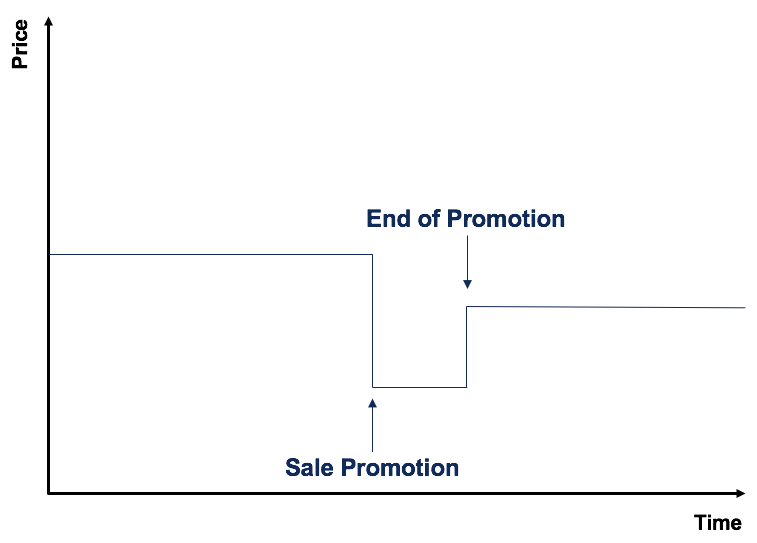
The reasoning behind this pricing strategy is to give consumers the perception of a bargain and, thereby, to generate high sales during a promotional period. By applying a discount to a product that is priced “high,” consumers will be more likely to purchase the product because of their presumption that it is a bargain. In essence, the initial high price establishes the value of the product to consumers. Then, when the price is later reduced during a promotional period, the low price is established as a bargain for consumers.
The strategy’s goal is, fundamentally, the same as that of most business strategies – increase revenues, grow the customer base, and improve a company’s bottom line – profits. This is accomplished through means such as the following:
- Generate additional sales
- Generate excitement, drive traffic to the store, and stimulate the sale of other products
- Sell (turn) inventoryInventoryInventory is a current asset account found on the balance sheet, consisting of all raw materials, work-in-progress, and finished goods that a that would otherwise be unsellable at the initial price
High Low Pricing and Reference Price
When using this pricing strategy, a reference price must be established. The reference price is the price that buyers compare to the discounted sale price of the product. The reference price is important in high low pricing, as it makes consumers perceive that the product is a bargain when it is offered at a substantially lower price.
For example, consider a product with a normal selling price of $15. A 50% discount is applied, resulting in a “low” price of $7.50. In this context, the $15 price is the reference price.
Advantages of High Low Pricing
- Revenue generation: By offering a product at various price levels, a firm can generate additional sales and reach more price-sensitive consumers.
- Excitement creation: Firms that use the strategy generate consumer excitement and create a “buy it while it’s on sale” atmosphere.
- Increased store traffic: Promotions increase traffic to the firm, which can help it gain exposure and generate additional sales on other items.
- Turning inventory: The strategy can be used to sell slow-moving inventory.
Disadvantages
- Marketing expenses: As the strategy relies heavily on sale promotions, it requires strong marketing efforts and incurs significant advertising expenses.
- Consumer expectations: The pricing strategy runs the risk of encouraging consumers to always wait for a sale before buying items at the store.
- Risk of losing profit: Although the strategy generates additional traffic and sales for the store, it is important to introduce other items at the store to generate additional sales. A store runs the risk of losing money if consumers only go purchase the discounted item.
- Perception of quality: Consumers may believe that items are discounted because they are of subpar quality. This belief can create the sense that the store’s items are of lower quality than those of its competitors.
Additional Resources
CFI is the official provider of the Financial Modeling and Valuation Analyst (FMVA)™Become a Certified Financial Modeling & Valuation Analyst (FMVA)®CFI's Financial Modeling and Valuation Analyst (FMVA)® certification will help you gain the confidence you need in your finance career. Enroll today! certification program, designed to transform anyone into a world-class financial analyst. To keep learning and developing your knowledge of financial analysis, we highly recommend the additional CFI resources below:
- Market PositioningMarket PositioningMarket Positioning refers to the ability to influence consumer perception regarding a brand or product relative to competitors. The objective of market
- Price DiscriminationPrice DiscriminationPrice discrimination refers to a pricing strategy that charges consumers different prices for identical goods or services.
- Price TakerPrice TakerA price taker, in economics, refers to a market participant that is not able to dictate the prices in a market. Therefore, a price taker must
- Total Addressable MarketTotal Addressable Market (TAM)Total Addressable Market (TAM), also referred to as total available market, is the overall revenue opportunity that is available to a product or service if
-

Understanding Stock Price Appreciation: A Guide for Investors
Research your chosen stocks in the financial press. Investing in the stock market is one way to build long-term wealth, but it is important to understand your goals when you invest in individ
-

Value Deflation: Understanding Shrinking Product Sizes & Price Stability
Value deflation refers to a practice by retailers and service providers to reduce the size of products while retaining the price. This way, the business reduces its operational costs by selling smalle
Business strategy
- Understanding 52-Week Highs & Lows: A Key Stock Indicator
- Understanding Divergence in Technical Analysis: A Guide
- Understanding Forward Prices: Definition & How They Work
- High Close Trading Strategy: Definition, Risks & Legal Implications
- Predatory Pricing: Definition, Tactics & Legal Implications
- Price Discrimination Explained: Types, Examples & Strategies
- What is Price Fixing?
- Price Skimming: Definition, Strategy & When to Use It
- Value-Based Pricing: A Comprehensive Guide to Maximizing Revenue
-
 Understanding 52-Week Highs & Lows: A Stock Market Indicator
In a stock table, the 52-week high and the 52-week low tell you the highest and lowest prices that one share of a stock fetched in the previous year's worth of trading. Combined with current share...
-
 Loss Leader Pricing: Strategy, Benefits & Examples
A loss leader pricing strategy, a term common in marketing, refers to an aggressive pricing strategy in which a store prices its goodsCost of Goods Sold (COGS)Cost of Goods Sold (COGS) measures the &l...