
Hiring Freeze: Definition, Causes & Impact on Your Career
A hiring freeze is a scenario where a company stops hiring new employees or creating new positions to be filled. It is common when a company experiences financial distress and needs to begin cost-cutting to reduce operating costsOperating ExpensesOperating expenses, operating expenditures, or "opex," refers to the expenses incurred regarding a business’s operational activities..

Hiring freezes are the preferred option by companies to avoid laying off staff members. Other factors that may contribute to a hiring freeze in an organization are market condition fluctuations or economic instability.
Summary
- A hiring freeze is a scenario where a company stops hiring new employees or creating new positions to be filled.
- The following scenarios are the common circumstances that may lead to hiring freezes: changes in market conditions, global crisis, budget deficit, and arising liquidity concerns.
- Hiring freezes allow companies to stabilize costs or slow expenditures.
Why Companies Implement Hiring Freezes
Every business is run to ensure financial longevity. In a case where a company experiences notable cash flow problems as a result of unfavorable market conditions or a significant reduction in revenue, the main aim is to preserve finances to keep operations afloat. It is under these conditions when a company’s management is likely to implement a hiring freeze. The following scenarios are some common circumstances where a company may consider a hiring freeze:
1. Changes in market conditions
The shifts in market conditions can have a notable impact on revenue generation and overall profitability. An example of this can be a downturn in the ceiling board industry. All firms directly involved in the manufacturing, distribution, or value-added services in the ceiling board industry, may implement hiring freezes in aims to counter the impacts of the changing market conditions.
2. Global crisis
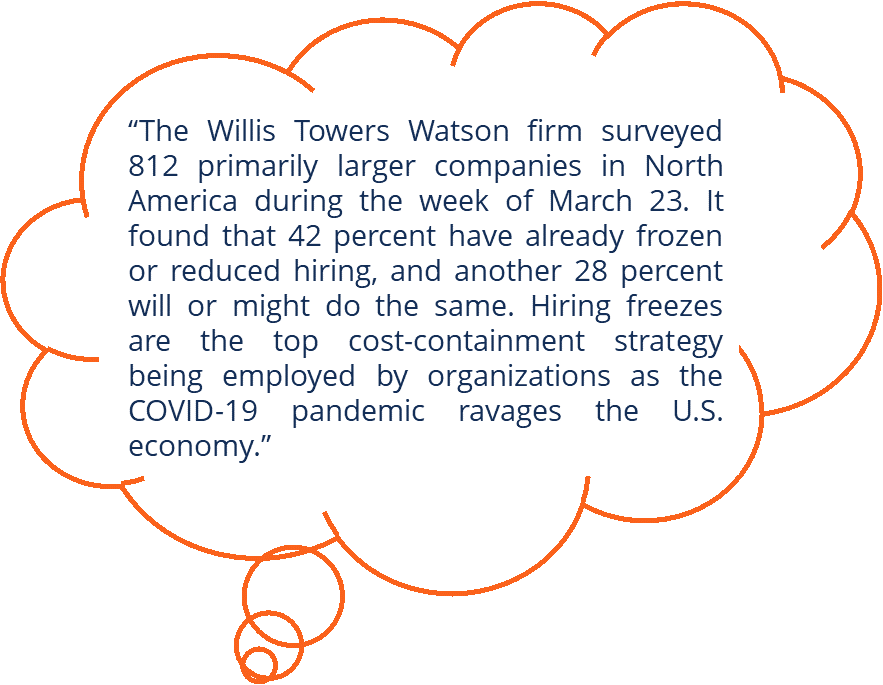
As seen with the outbreak of the COVID-19 pandemic, businesses all over the world have been negatively impacted by these crises. During such times, businesses may delay taking on new employees, and continue to monitor global markets and trends. During this time, employers become more conservative and prudent to ensure they can at least keep their current workforce.
3. Budget deficit
If a company notices that the recruitment of new employees will result in a budget deficit for a certain financial period (short or long-term), it will hold off on hiring new employees until such a time where the financial position of the company has improved. This delayed recruitment is a hiring freeze.
4. Emerging liquidity concerns
When the management of a company sees that there’s been a decline in liquid assets, it may hold off on recruitment processes. Through the use of liquidity ratiosLiquidity RatioA liquidity ratio is a type of financial ratio used to determine a company's ability to pay its short-term debt obligations. T, an employer can easily detect liquidity issues. Ideally, there should always be sufficient current assets to cater for short-term obligations. To improve liquidity, an employer may choose to allocate funds from the salary budget towards financing current assets. This is normally performed as a last option.
Hiring freezes allow companies to minimize or avoid creating or filling non-essential roles. With hiring freezes, an employer will be able to reorganize work teams and integrate staff members to achieve greater productivity in delivering the necessary products and servicesProducts and ServicesA product is a tangible item that is put on the market for acquisition, attention, or consumption while a service is an intangible item, which arises from to the consumers. Even after implementing a hiring freeze, a business’s objective remains to increase its profitability.
Furthermore, it should be noted that the pause in hiring does not mean that recruitment’s been completely stopped. Businesses will still need to replace employees who have critical roles such as fulfilling customer needs or for specialist roles in a company.
Such vacancies can be filled more quickly by consultants, part-time, hourly (non-paid), or by contract employees, allowing employers to work around the hiring restriction and still have resources to complete the work to sustain their core operations.
Effects of a Hiring Freeze
The pause on hiring new employees may lead to an increased workload for existing employees because the work that may have been the responsibility of the new employees can only be allocated to them.
Similarly, the workload resulting from exiting employees must be divided among the existing employees. It can result in a negative impact on morale and employee productivity in the long term, which may ultimately cause more employees to leave the company.
Learn More
CFI offers the Commercial Banking & Credit Analyst (CBCA)™Program Page - CBCAGet CFI's CBCA™ certification and become a Commercial Banking & Credit Analyst. Enroll and advance your career with our certification programs and courses. certification program for those looking to take their careers to the next level. To keep learning and developing your knowledge base, please explore the additional relevant resources below:
- Being Laid Off vs Getting FiredBeing Laid Off vs. Getting FiredThe key difference between being laid off vs getting fired is that a layoff is the fault of an employer while a firing occurs because of the employee’s
- Employee MoraleEmployee MoraleEmployee morale is defined as the overall satisfaction, outlook, and feelings of well-being that an employee holds in the workplace. In other
- Financial DistressFinancial DistressFinancial distress is a term commonly used in corporate finance that describes any situation where an individual’s or company’s financial
- Voluntary TerminationVoluntary TerminationVoluntary termination occurs when an individual decides to leave the organization where they are currently employed. They may be leaving the
-

Competitive Advantage: Definition & Key Metrics for Business Success
A competitive advantage is an attribute that enables a company to outperform its competitors. This allows a company to achieve superior marginsOperating MarginOperating margin is equal to operating in
-
![Corporate Actions: Definition, Types & Impact | [Your Company Name]](https://www.etffin.com/article/uploadfiles/202110/2021100815410257_S.jpeg)
Corporate Actions: Definition, Types & Impact | [Your Company Name]
A corporate action is a move – enacted by a publicly-traded company – that encourages or furthers processes that have a direct impact on whatever assets the company issues. In other words,
Business strategy
- Acquirer Definition: Understanding Corporate Acquisitions
- Understanding Clawbacks: Protecting Stakeholders from Failed Performance
- Understanding Financial Gearing: Debt & Leverage Explained
- Leverage in Finance: Strategies, Types & Risks
- Holding Companies: Definition, Purpose & How They Work
- Kaizen: Understanding Continuous Improvement for Business
- Outsourcing: A Comprehensive Guide to Benefits & Strategy
- Ramp-Up: Definition, Benefits & How to Achieve It
- Streamlining Processes: Definition, Benefits & Techniques
-
 Understanding Vouchers: A Guide to Accounts Payable Documents
A voucher is an internal document within a company that is issued by the accounts payable Accounts PayableAccounts payable is a liability incurred when an organization receives goods or services from ...
-
 Understanding Associate Companies: Definition & Ownership
An associate company, also known as an affiliate company, is a company in which a notable portion of shares is owned by a parent company. The portion usually lies between 20% and 50%. Ownership of hig...