
Understanding Multilevel Marketing (MLM): How It Works
Multilevel marketing (MLM) is a strategy that sells products and services through a non-salaried workforce in a pyramid-shaped commission system. The MLM strategy is also known as network marketing or referral marketing.
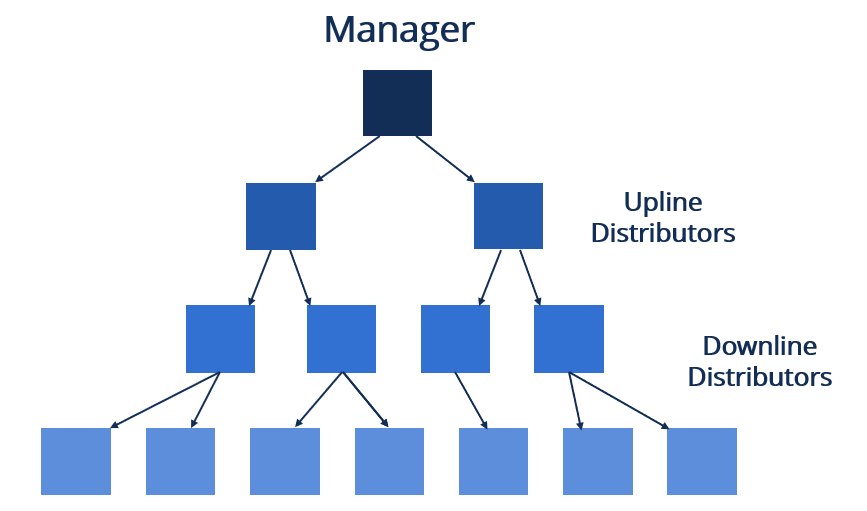
Companies that implement multilevel marketing encourage existing distributors to recruit new distributors, known as the “downline” of the existing distributors. Multilevel marketing is often confused with a pyramid schemePyramid SchemeA pyramid scheme is an unsustainable business model in which original investors make money by recruiting others rather than by selling actual products or, but the latter is illegal.
Summary
- The multilevel marketing (MLM) strategy encourages existing distributors to recruit new distributors and has a pyramid-shaped commission system.
- Multilevel marketing distributors are independent and non-salaried. The distributors receive commissions on the sales made by themselves and their downline teams.
- Through multilevel marketing, companies can build up a large customer base with low sales costs.
How Multilevel Marketing Works
There are multiple layers of salesforce in multilevel marketing. The salesforce is known as distributors, who are independent non-salaried participants. There are two sources of income for a distributor. One is the commissionCommissionCommission refers to the compensation paid to an employee after completing a task, which is, often, selling a certain number of products or services of selling products to customers directly. The other one is through recruiting new distributors.
A distributor is not paid when a new (downline) participant is recruited. Yet, the sales from his downline distributors are also attributable to him. The distributor is compensated by a certain percentage of the sales from his downline team.
Many distributors with large-scale downline teams even do not sell products by themselves. They can receive sufficient commissions from their downline teams’ sales. The commission system effectively motivates existing distributors to build up or expand their downline teams. It allows the company to employ a bigger salesforce, and thus, access to a larger customer base.
Pros and Cons of Multilevel Marketing
The multilevel marketing strategy is beneficial to both the companies and the distributors. A company can gain access to a large customer baseTypes of CustomersCustomers play a significant role in any business. By better understanding the different types of customers, businesses can be better equipped to develop in a wide geographical range through multilevel marketing.
Since the distributors are independent, the company does not need to pay any fixed salaries, but only commissions when sales are made, which allows it to save sales expenses.
To distributors, multilevel marketing allows them to make extra income with sufficient flexibility. They can choose to work full-time or part-time to best adapt their schedules.
However, the distributors in the lower tiers may find themselves in a disadvantaged position. They usually work harder but make much lower incomes than the ones in the upper tiers, since the upper-tier distributors share the commission on their sales.
The high degree of flexibility and autonomy also comes with a drawback. Distributors only receive limited support from the company. The lack of sales training or support from expertise may make their sales efforts very inefficient.
Also, a multilevel marketing organization lacks control over its salesforce. It may experience damage to its reputation if some of its distributors are acting irresponsibly or not keeping trustworthy to customers.
Another concern of multilevel marketing is pyramid schemes. Pyramid schemes are fraudulent and can cause huge economic losses to participants.
Multilevel Marketing vs. Pyramid Scheme
A pyramid scheme looks very similar to multilevel marketing. It also expands the business by recruiting several layers of members, which form a pyramid system. However, pyramid schemes are illegal scams, while multilevel marketing is legitimate.
The major difference is that the primary goal of a multilevel marketing company is to sell actual products or services to its customers. Conversely, a pyramid scheme does not supply any real products or investments.
Participants are convinced that the company owns a valuable product or investment project. They only receive “promised payments” by recruiting downline participants. The more downline participants are recruited, the more people are dragged into the fraudulent activity.
Multilevel marketing distributors, especially the lower-tier ones, usually make small amounts of money. Participants deceived by a pyramid scheme typically lose all the money they invested in or paid as “membership fees.”
It is essential to identify whether the business model is legitimate multilevel marketing or the fraudulent pyramid scheme before joining. If a business places a greater focus on recruitment rather than sales of products, the business is very likely a pyramid scheme.
The Federal Trade Commission (FTC) is responsible for investigating MLM companies. In some cases, it is even difficult for the federal agency to determine whether the company is operating legally or not.
More Resources
CFI is the official provider of the Commercial Banking & Credit Analyst (CBCA)™Program Page - CBCAGet CFI's CBCA™ certification and become a Commercial Banking & Credit Analyst. Enroll and advance your career with our certification programs and courses. certification program, designed to transform anyone into a world-class financial analyst.
In order to help you become a world-class financial analyst and advance your career to your fullest potential, the additional resources below will be very helpful:
- 4 P’s of Marketing4 P’s of MarketingThe “4 P’s of Marketing” refer to the four key elements comprising the process of marketing a product or service. They involve a marketing
- Affiliate MarketingAffiliate MarketingAffiliate marketing occurs when an individual or company markets another entity's or company’s products or services.
- Ponzi SchemePonzi SchemeA Ponzi scheme is considered a fraudulent investment program. It involves using payments collected from new investors to pay off the earlier investors. The
- Top Accounting ScandalsTop Accounting ScandalsThe last two decades saw some of the worst accounting scandals in history. Billions of dollars were lost as a result of these financial disasters. In this
-

Portfolio Diversification: Reduce Risk & Enhance Returns
Diversification is a technique of allocating portfolio resources or capital to a mix of different investments. The ultimate goal of diversification is to reduce the volatilityVIXThe Chicago Board Opti
-

Understanding Business Entities: Types & Legal Structures
An entity is an organization created by one or more individuals to carry out the functions of a business, and that maintains a separate legal existence for tax purposesAccounting For Income TaxesIncom
Business strategy
- Understanding Contribution Margin After Marketing (CMAM): Definition & Calculation
- Affiliate Marketing: A Comprehensive Guide for Beginners
- Guerrilla Marketing: Definition, Tactics & Examples | [Your Brand/Site Name]
- Market Planning: A Comprehensive Guide to Strategy & Tactics
- Comprehensive Marketing Plan: Definition, Elements & Strategy
- Understanding Multilevel Marketing (MLM): How It Works
- Pull Marketing Strategy: Definition, Benefits & Examples
- Push Marketing Strategy: Definition & Tactics | [Your Brand/Company]
- Product Marketing: A Beginner's Guide to Launching and Growing Products
-
 Contingency Planning: Understanding & Managing Risk
A contingency is the chance occurrence that a future event is likely to cause a negative impact on an organization or person. It is a condition or a probable future event occurring by chance, delibera...
-
 Disintermediation: Definition, Benefits & Examples
Disintermediation is the removal of different elements within the middle of a supply chain. The intermediaries in product development – or “middlemen” – are removed from the su...