
Ramp-Up: Definition, Benefits & How to Achieve It
In business, ramp-up is a term that describes a significant increase in the output of a company’s products or services. Essentially, ramp-up implies bringing the company’s capacity utilizationCapacity UtilizationCapacity utilization refers to the manufacturing and production capabilities that are being utilized by a nation or enterprise at any given close to maximum. It can be achieved through substantial capital expendituresCapital ExpendituresCapital expenditures refer to funds that are used by a company for the purchase, improvement, or maintenance of long-term assets to improve or improvements in product development, and triggered by a company entering new markets or geographic locations.
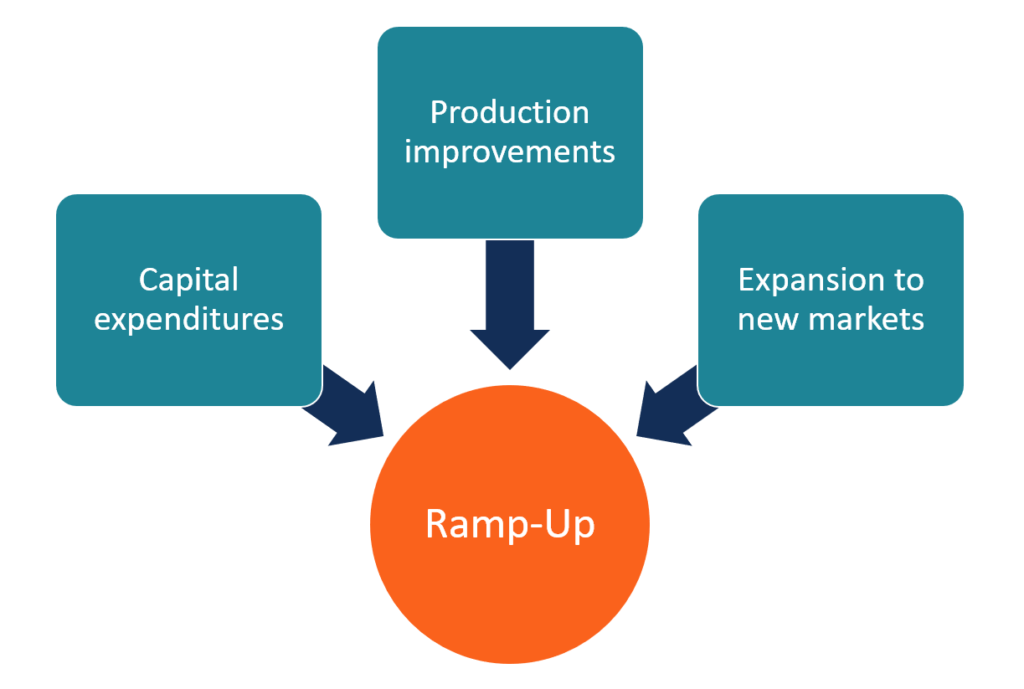
Breaking Down the Ramp-Up Concept
The right timing is essential for successful ramp-ups. The main prerequisite for its success is the correct anticipation of an increase in demand for the company’s products or services. If the selected time for ramp-up does not correspond to the period of higher demand, then the company’s efforts to increase its output will not result in attractive financial returns. Thus, a company that is planning to ramp up should be certain about the demand outlook.
Although the concept is widely attributed to smaller companies, ramp-up can be used by large corporationsCorporationA corporation is a legal entity created by individuals, stockholders, or shareholders, with the purpose of operating for profit. Corporations are allowed to enter into contracts, sue and be sued, own assets, remit federal and state taxes, and borrow money from financial institutions. as well. Big companies use ramp-up to introduce new lines of products or services to customers, or to expand its operation into new markets. Announcements of ramp-ups by large companies generally indicate a company’s solid financial position, as well as the management’s confidence regarding the future outlook for the business.
In addition, the term is frequently used in the context of venture capitalVenture CapitalVenture capital is a form of financing that provides funds to early stage, emerging companies with high growth potential, in exchange for equity or an ownership stake. Venture capitalists take the risk of investing in startup companies, with the hope that they will earn significant returns when the companies become a success.. In venture capital financing, ramp-up occurs prior to the exit of a venture capitalist from the investment. In such a case, the venture capitalist uses the ramp-up to increase the company’s output and performance to boost its valuation. A higher valuation of the company delivers more lucrative exit opportunities for the venture capitalists and increases the investors’ return on investmentReturn on Investment (ROI)Return on Investment (ROI) is a performance measure used to evaluate the returns of an investment or compare efficiency of different investments..
Example of Ramp-Up
One of the most notable examples of a ramp-up is automotive and energy company Tesla’s production of its all-electric Model 3 sedan. The Model 3 is probably the most anticipated among the company’s vehicle lineup, because of its affordability. Following the announcement of the model, the company faced an enormous demand from customers.
In order to meet the high demand, Tesla went through an extensive ramp-up from sluggish production levels that could not meet initial targets to the massive production of more than 4,000 vehicles per week.
The automaker managed to achieve its targets by redesigning the company’s production operations. It turned to widespread automation to increase efficiency and built new manufacturing facilities to achieve its desired production rates.
Additional Resources
CFI is the official provider of the global Financial Modeling & Valuation Analyst (FMVA)™Become a Certified Financial Modeling & Valuation Analyst (FMVA)®CFI's Financial Modeling and Valuation Analyst (FMVA)® certification will help you gain the confidence you need in your finance career. Enroll today! certification program, designed to help anyone become a world-class financial analyst. To keep learning and advancing your career, the additional CFI resources below will be useful:
- Cost of Goods Manufactured (COGM)Fixed and Variable CostsCost is something that can be classified in several ways depending on its nature. One of the most popular methods is classification according
- DiversificationDiversificationDiversification is a technique of allocating portfolio resources or capital to a variety of investments.The goal of diversification is to mitigate losses
- Economic EfficiencyEconomic EfficiencyEconomic efficiency is, in mathematical terms, a function of the ratio of the actual value of an economic variable divided by the potential
- Supply and DemandSupply and DemandThe laws of supply and demand are microeconomic concepts that state that in efficient markets, the quantity supplied of a good and quantity
-
![Corporate Actions: Definition, Types & Impact | [Your Company Name]](https://www.etffin.com/article/uploadfiles/202110/2021100815410257_S.jpeg)
Corporate Actions: Definition, Types & Impact | [Your Company Name]
A corporate action is a move – enacted by a publicly-traded company – that encourages or furthers processes that have a direct impact on whatever assets the company issues. In other words,
-

Understanding Cross-Holding: Risks & Implications
Cross holding, also referred to as cross shareholding, describes a situation where one publicly-traded company holds a significant number of shares of another publicly-traded company. The shares owned
Business strategy
- Acquirer Definition: Understanding Corporate Acquisitions
- Understanding Clawbacks: Protecting Stakeholders from Failed Performance
- Understanding Financial Gearing: Debt & Leverage Explained
- Leverage in Finance: Strategies, Types & Risks
- Parent Company Explained: Definition, Control & Examples
- Holding Companies: Definition, Purpose & How They Work
- Kaizen: Understanding Continuous Improvement for Business
- Outsourcing: A Comprehensive Guide to Benefits & Strategy
- Streamlining Processes: Definition, Benefits & Techniques
-
 Understanding Associate Companies: Definition & Ownership
An associate company, also known as an affiliate company, is a company in which a notable portion of shares is owned by a parent company. The portion usually lies between 20% and 50%. Ownership of hig...
-
 Competitive Advantage: Definition & Key Metrics for Business Success
A competitive advantage is an attribute that enables a company to outperform its competitors. This allows a company to achieve superior marginsOperating MarginOperating margin is equal to operating in...