
Leverage in Finance: Strategies, Types & Risks
In finance, leverage is a strategy that companies use to increase assets, cash flows, and returns, though it can also magnify losses. There are two main types of leverage: financial and operating. To increase financial leverage, a firm may borrow capital through issuing fixed-income securitiesTrading & InvestingCFI's trading & investing guides are designed as self-study resources to learn to trade at your own pace. Browse hundreds of articles on trading, investing and important topics for financial analysts to know. Learn about assets classes, bond pricing, risk and return, stocks and stock markets, ETFs, momentum, technical or by borrowing money directly from a lender.
Operating leverage can also be used to magnify cash flows and returns, and can be attained through increasing revenues or profit margins. Both methods are accompanied by risk, such as insolvency, but can be very beneficial to a business.
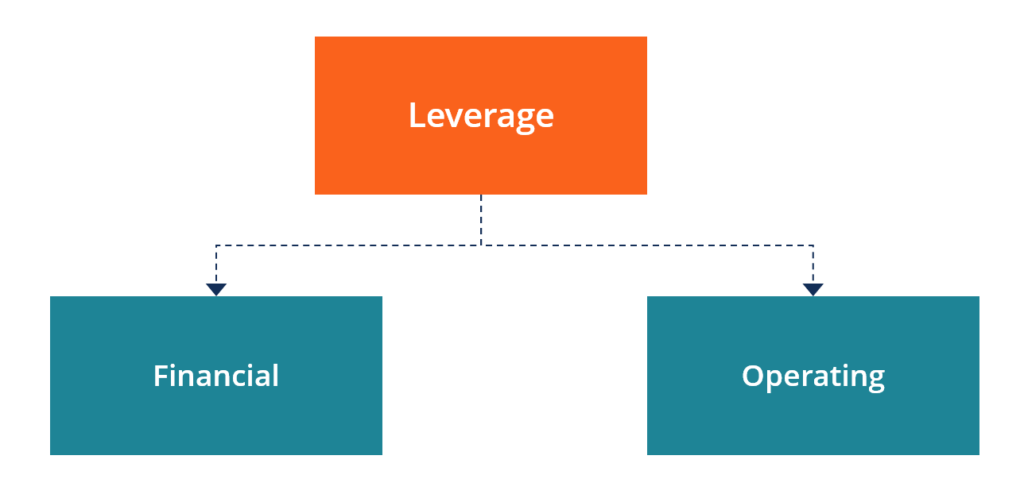
Financial Leverage
When a company uses debt financing, its financial leverage increases. More capital is available to boost returns, at the cost of interest payments, which affect net earnings.
Example 1
Bob and Jim are both looking to purchase the same house that costs $500,000. Bob plans to make a 10% down payment and take a $450,000 mortgage for the rest of the payment (mortgage cost is 5% annually). Jim wants to purchase the house for $500,000 cash today. Who will realize a higher return on investment if they sell the house for $550,000 a year from today?
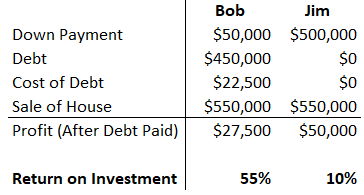
Although Jim makes a higher profit, Bob sees a much higher return on investment because he made $27,500 profit with an investment of only $50,000 (while Jim made $50,000 profit with a $500,000 investment).
Example 2
Using the same example above, Bob and Jim realize they can only sell the house for $400,000 after a year. Who will see a greater loss on their investment?
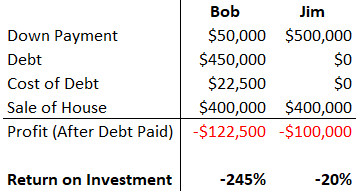
Now that the value of the house decreased, Bob will see a much higher percentage loss on his investment (-245%), and a higher absolute dollar amount loss because of the cost of financing. In this instance, leverage has resulted in an increased loss.
Financial Leverage Ratio
The financial leverage ratio is an indicator of how much debt a company is using to finance its assets. A high ratio means the firm is highly levered (using a large amount of debt to finance its assets). A low ratio indicates the opposite.
Example
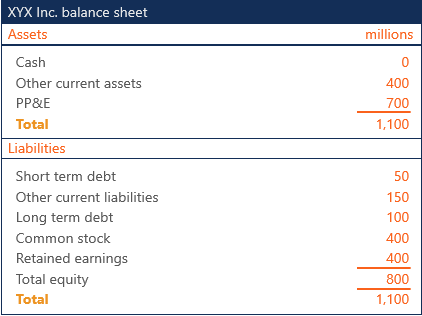
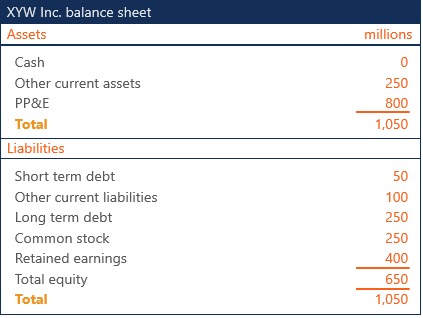
The balance sheet of Companies XYX Inc. and XYW Inc. are as follows. Which company has a higher financial leverage ratio?
XYX Inc.
- Total Assets = 1,100
- Equity = 800
- Financial Leverage Ratio = Total Assets / Equity = 1,100 / 800 = 1.375x
XYW Inc.
- Total Assets = 1,050
- Equity = 650
- Financial Leverage Ratio = Total Assets / Equity = 1,050 / 650 = 1.615x
Company XYW Inc. reports a higher financial leverage ratio. This indicates that the company is financing a higher portion of its assets by using debt.
Operating Leverage
Fixed operating expenses, combined with higher revenues or profit, give a company operating leverage, which magnifies the upside or downside of its operating profit.
Example
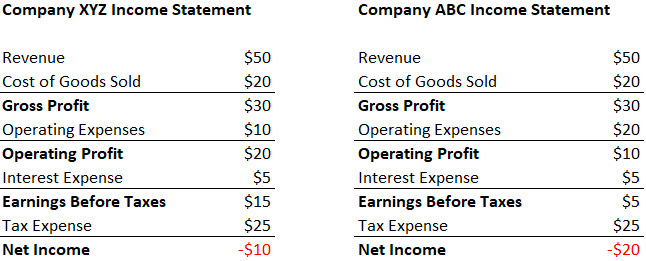
The income statement of Companies XYZ and ABC are the same. Company XYZ’s operating expenses are variable, at 20% of revenue. Company ABC’s operating expenses are fixed at $20.
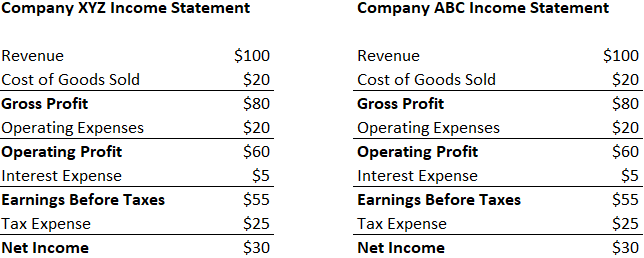
Which company will see a higher net income if revenue increases by $50?
If revenue increases by $50, Company ABC will realize a higher net income because of its operating leverage (its operating expenses are $20 while Company XYZ’s are at $30).
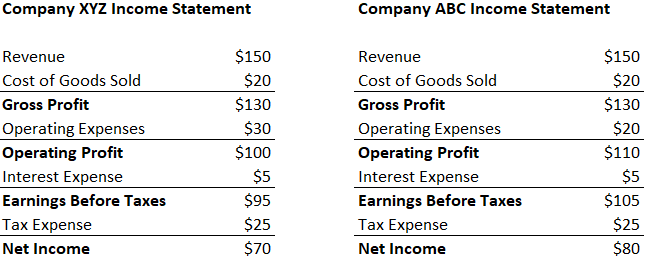
Which company will realize a lower net income if revenue decreases by $50?
When revenue decreases by $50, Company ABC loses more due to its operating leverage, which magnifies its losses (Company XYZ’s operating expenses were variable and adjusted to the lower revenue, while Company ABC’s operating expenses stayed fixed).
Operating Leverage Formula
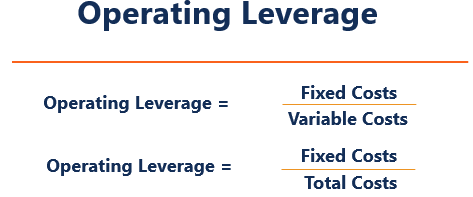
The operating leverage formula measures the proportion of fixed costs per unit of variable or total cost. When comparing different companies, the same formula should be used.
Example
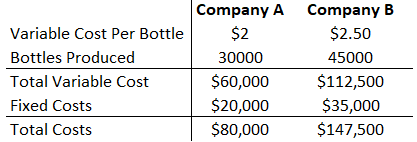
Company A and company B both manufacture soda pop in glass bottles. Company A produced 30,000 bottles, which cost them $2 each. Company B produced 45,000 bottles at a price of $2.50 each. Company A pays $20,000 in rent, and company B pays $35,000. Both companies pay an annual rent, which is their only fixed expense. Compute the operating leverage of each company using both methods.
Step 1: Compute the total variable cost
- Company A: $2/bottle * 30,000 bottles = $60,000
- Company B: $2.50/bottle * 45,000 bottles = $112,500
Step 2: Find the fixed costs
In our example, the fixed costs are the rent expenses for each company.
- Company A: $20,000
- Company B: $35,000
Step 3: Compute the total costs
- Company A: Total variable cost + Total fixed cost = $60,000 + $20,000 = $80,000
- Company B: Total variable cost + Total fixed cost = $112,500 + $35,000 = $147,500
Step 4: Compute the operating leverages
Method 1:
Operating Leverage = Fixed costs / Variable costs
- Company A: $20,000 / $60,000 = 0.333x
- Company B: $35,000 / $112,500 = 0.311x
Method 2:
Operating Leverage = Fixed costs / Total costs
- Company A: $20,000 / $80,000 = 0.250x
- Company B: $35,000 / $147,500 = 0.237x
More Resources
Thank you for reading CFI’s explanation of leverage. CFI is the official provider of the global Financial Modeling & Valuation Analyst (FMVA)® certification programBecome a Certified Financial Modeling & Valuation Analyst (FMVA)®CFI's Financial Modeling and Valuation Analyst (FMVA)® certification will help you gain the confidence you need in your finance career. Enroll today!, designed to help anyone become a world-class financial analyst. To keep advancing your career, the additional CFI resources below will be useful:
- Analysis of Financial StatementsAnalysis of Financial StatementsHow to perform Analysis of Financial Statements. This guide will teach you to perform financial statement analysis of the income statement,
- Coverage RatiosCoverage RatioA Coverage Ratio is used to measure a company’s ability to pay its financial obligations. A higher ratio indicates a greater ability to meet obligations
- Guide to Financial ModelingFree Financial Modeling GuideThis financial modeling guide covers Excel tips and best practices on assumptions, drivers, forecasting, linking the three statements, DCF analysis, more
- Valuation MethodsValuation MethodsWhen valuing a company as a going concern there are three main valuation methods used: DCF analysis, comparable companies, and precedent transactions
-
Ramp-Up: Definition, Benefits & How to Achieve It
In business, ramp-up is a term that describes a significant increase in the output of a company’s products or services. Essentially, ramp-up implies bringing the company’s capacity utiliza
-

Streamlining Processes: Definition, Benefits & Techniques
Streamlining refers to the improvement of the efficiency of a certain process within an organization. It can be done by automationExcel vs Automation in Financial ModelingBefore we discuss Excel vs au
finance
- Acquirer Definition: Understanding Corporate Acquisitions
- Understanding Clawbacks: Protecting Stakeholders from Failed Performance
- Financial Leverage: Definition, Calculation & Impact on Profitability
- Understanding Degree of Operating Leverage (DOL): A Comprehensive Guide
- Understanding Total Leverage: A Comprehensive Guide
- Financial Leverage Explained: Using Debt for Growth
- Understanding Financial Gearing: Debt & Leverage Explained
- Parent Company Explained: Definition, Control & Examples
- Understanding Stocks: A Beginner's Guide to Share Ownership
-
 Kaizen: Understanding Continuous Improvement for Business
Kaizen is a Japanese word (改善) that means “improvement” or “to improve.” When applied to the world of business, kaizen refers to every action, operation, or rule ...
-
 Outsourcing: A Comprehensive Guide to Benefits & Strategy
Outsourcing is a strategic decisionCorporate StrategyCorporate Strategy focuses on how to manage resources, risk and return across a firm, as opposed to looking at competitive advantages in business s...