
Parent Company Explained: Definition, Control & Examples
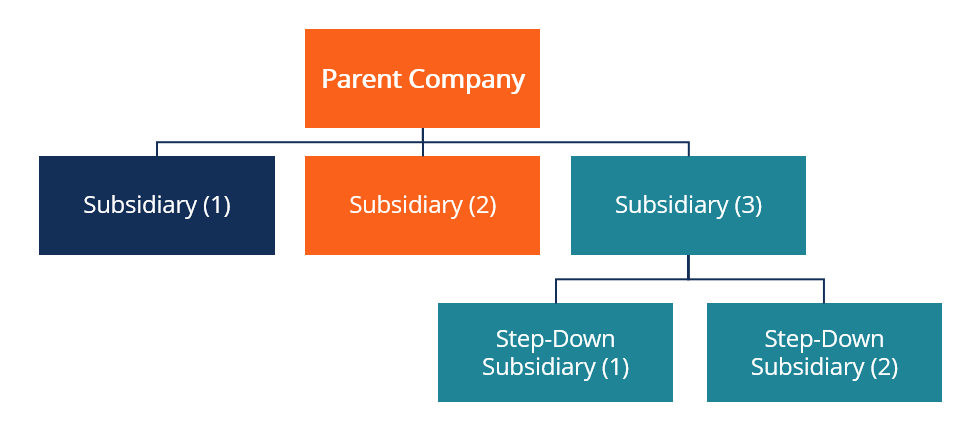
A parent company is a company that owns more than 50% of the outstanding voting shares of another company. Therefore, it controls the other company or companies and can directly influence the business’ operations or take a more hands-off approach on ownership.
A parent company typically actively manages its own ventures and makes purchases to aid in its overall operations with its other subsidiaries. Parent companies are most commonly created by mergers and acquisitions or through spin-offsSpin-OffA corporate spin-off is an operational strategy used by a company to create a new business subsidiary from its parent company. . The subsidiaries can be vertically or horizontally integrated to help improve the parent company’s structure.
What is a Subsidiary?
A subsidiary company, also known as a daughter company, is owned or controlled by a parent company or a holding companyHolding CompanyA holding company is a company that doesn’t conduct any operations, ventures, or other active tasks for itself. Instead, it exists for the purpose of owning. Such an organizational structure is extremely common, especially for multinational corporations trying to spread their risks across several companies. They also usually keep several levels of subsidiaries and are both vertically and horizontally integrated.
By definition, subsidiaries are distinct legal entities for tax, regulation, and liability purposes. As a result, any lawsuit aimed at a subsidiary would be handled separately from its parent company, helping separate liability. Subsidiaries are different from business divisions as divisions stay wholly joined within the parent company.
The ownership of a subsidiary can be quite complex, and there are many ways to get control. The most common and straightforward way is through 50% or more ownership of voting shares to exercise control of that subsidiary.
An important accounting rule for parent companies that own more than 50% of their subsidiaries is that they must produce consolidated financial statements to combine the parent and subsidiary’s financials into one larger statement. The practice eliminates the overlap that can appear as a result of intercompany transfers or transactions.
Parent Company vs. Holding Company
A parent company and a holding company are virtually identical; however, depending on the organization’s location, the legal status can vary. The main difference usually comes from the business activity found within the parent company.
Parent companies often oversee their own business ventures and focus their acquisitions to help their current subsidiaries and other operations.
Holding companies are relatively inactive with their subsidiaries and only act as a shell to hold the outstanding stock of their subsidiaries. Generally, they don’t produce goods or services and only provide control/oversight to their daughter companies.
Practical Examples
As was previously stated, the parent companies can take on different organizational structures associated with their subsidiaries. Whether a parent company or a holding company, the subsidiaries can be vertically or horizontally integratedHorizontal IntegrationHorizontal integration is a competitive strategy where business entities operating at the value chain level and within the same industry.
An example of a very successful vertically integrated company is Apple. From the birth of Apple to the present day, they’ve controlled their manufacturing and distribution of its products. It designs the software that perfectly fits its iPad, iPhone, and computers.
Even more recently, in 2020, Apple announced that they would be cutting its 14-year partnership with Intel and will be transitioning to in-house design for all products, including components such as its processors and much more. The move expands Apple’s vertically integrated supply chain and will help improve their control over their products and hopefully give them a competitive advantageCompetitive AdvantageA competitive advantage is an attribute that enables a company to outperform its competitors. It allows a company to achieve superior margins.
A very noteworthy example of horizontal integration came from Facebook’s acquisition of Instagram back in 2012. They both operate in the same industry of social media, and Facebook saw an opportunity to grow its market share and strengthen its photo-sharing platform with the acquisition of Instagram. Although Instagram still operates on its own, Facebook saw the additional benefits of reduced competition, increased operating and marketing synergies, and much more.
Although we often see the above strategies of integration, some conglomerates don’t focus on related businesses. For example, Warren Buffet’s Berkshire Hathaway is a conglomerate that owns many seemingly unrelated businesses. It has helped reduce seasonality and overall risk through the very diverse portfolio of companies held under the parent company, Berkshire Hathaway.
Becoming a Parent Company
There are many ways for a company to become a parent company. The most common is through mergers and acquisitions (M&A) or spin-offs. The previous example of Facebook buying out Instagram is an excellent example of an acquisition that added a subsidiary to a parent company. If Facebook were not already a parent company, it would’ve turned them into one.
Spin-offs are another common example. A current business, often one that already reached maturity and is seeing very little growth, will spin off one of its products or services with greater growth possibilities. It helps unlock value that the larger parent company would not be able to develop or grow.
More Resources
CFI is the official provider of the global Certified Banking & Credit Analyst (CBCA)®Program Page - CBCAGet CFI's CBCA™ certification and become a Commercial Banking & Credit Analyst. Enroll and advance your career with our certification programs and courses. certification program, designed to help anyone become a world-class financial analyst. To keep advancing your career, the additional CFI resources below will be useful:
- Conglomerate MergerConglomerate MergerA Conglomerate Merger is a union between companies that operate in different industries and are involved in distinct, unrelated business activities. Conglomerate mergers are divided into pure conglomerate mergers and mixed conglomerate mergers.
- Vertical IntegrationVertical IntegrationA vertical integration is when a firm extends its operations within its supply chain. It means that a vertically integrated company will bring in previously
- Corporate StructureCorporate StructureCorporate structure refers to the organization of different departments or business units within a company. Depending on a company’s goals and the industry
- Multinational Corporation (MNC)Multinational Corporation (MNC)A multinational corporation is a company that operates in its home country, as well as in other countries around the world. It maintains a
-

Understanding Acquisition Cost: Definitions & Applications
Acquisition cost is the cost of purchasing an asset. It is generally used in three different contexts in business, which include the following:Mergers and acquisitionsFixed assetsCustomer acquisition&
-

Streamlining Processes: Definition, Benefits & Techniques
Streamlining refers to the improvement of the efficiency of a certain process within an organization. It can be done by automationExcel vs Automation in Financial ModelingBefore we discuss Excel vs au
finance
- Understanding Parent Companies: Definition, Control & Subsidiaries
- Acquirer Definition: Understanding Corporate Acquisitions
- Understanding Clawbacks: Protecting Stakeholders from Failed Performance
- Understanding Financial Gearing: Debt & Leverage Explained
- Leverage in Finance: Strategies, Types & Risks
- Corporate Spin-Offs: Definition, Strategy & Examples
- Understanding Stocks: A Beginner's Guide to Share Ownership
- Understanding Subsidiaries: Definition, Ownership & Key Attributes
- Understanding Net-Net: A Financial Health Indicator
-
 Outsourcing: A Comprehensive Guide to Benefits & Strategy
Outsourcing is a strategic decisionCorporate StrategyCorporate Strategy focuses on how to manage resources, risk and return across a firm, as opposed to looking at competitive advantages in business s...
-
 Ramp-Up: Definition, Benefits & How to Achieve It
In business, ramp-up is a term that describes a significant increase in the output of a company’s products or services. Essentially, ramp-up implies bringing the company’s capacity utiliza...