
Understanding Shark Repellents: Protecting Your Company from Takeovers
Shark repellent refers to measures employed by a company to lock out hostile takeoverHostile TakeoverA hostile takeover, in mergers and acquisitions (M&A), is the acquisition of a target company by another company (referred to as the acquirer) by going directly to the target company’s shareholders, either by making a tender offer or through a proxy vote. The difference between a hostile and a friendly attempts. The measures may be periodic or continuous efforts exerted by management to make special amendments to its bylaws. The bylaws become active when a takeover attempt is made public to the company’s management and shareholders. It fends off unwanted takeover attempts by making the target less attractive to the shareholders of the acquiring firm, hence preventing them from proceeding with the hostile takeover.

Some takeover attempts can be beneficial to shareholdersStockholders EquityStockholders Equity (also known as Shareholders Equity) is an account on a company's balance sheet that consists of share capital plus since the potential takeover gives them an opportunity to maximize their shareholdings’ value, and shark repellent measures deny them that opportunity. However, a successful takeover attempt is also likely to result in the termination of the management’s services and their replacement with a new team from the acquirer’s company.
Common Examples of Shark Repellents
There are several shark repellent measures that companies can take to counter hostile takeovers. Most of the measures are included in the company’s charter and bylaws, which make the company less attractive to acquire. Some common examples of shark repellents include:
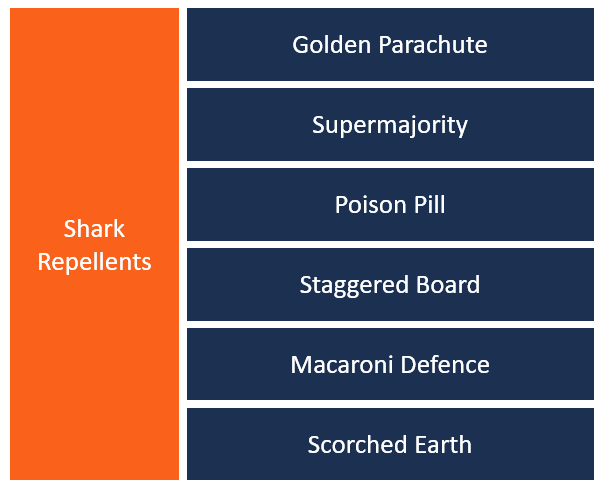
#1. Golden parachute
A golden parachuteGolden ParachuteA golden parachute, in mergers and acquisitions (M&A), refers to a large financial compensation or substantial benefits guaranteed to company executives upon termination following a merger or takeover. Benefits include severance pay, cash bonuses, and stock options. involves including a provision in an executive’s contract that gives them a fairly large compensation in the form of cash or stock if the takeover attempt succeeds. The provision makes it more expensive and less attractive to acquire the company since the acquirer will incur a large debt in the sum of money to pay the senior executives.
The clause mainly protects the senior management who are likely to get terminated if the takeover process becomes successful. However, some executives may intentionally insert the clause to make it unattractive for the acquirer to pursue the forced acquisition.
#2. Supermajority
A supermajority is a defense tactic that requires more than an ordinary majority of the shareholders (usually 70%-80%) to approve the takeover. This makes it difficult for the acquiring company to convince shareholders into accepting the initiative since the acquirer will be required to purchase a large number of stocks in order to ensure that the takeover will be approved. The supermajority requirement is usually stated in the company’s bylaws, and it becomes activated at any time an acquirer initiates a takeover attempt.
#3. Poison pill
A poison pillPoison PillThe Poison Pill is a structural maneuver designed to thwart attempted takeovers, where the target company seeks to make itself less desirable to potential acquirers. This can be accomplished by selling cheaper shares to existing shareholders, thereby diluting the equity an acquirer receives is any strategy that creates a negative financial event and leads to value destruction after a successful takeover. The most common form of poison pill is including a provision that enables existing shareholders to buy extra shares at a large discount during a takeover process. The provision is triggered when the acquirer’s stake in the company reaches a certain point (20% to 40%). The purchase of additional shares dilutes the existing shareholders’ stake, making the shares less attractive and making it more difficult and more expensive for the potential acquirer to obtain a controlling interest in the target company.
#4. Staggered board of directors
The tenures of all the directors of the company are staggered over several years, such that the directorsStaggered BoardA staggered board of directors, also known as a classified board, refers to a board that consists of different classes of directors. In a staggered board of of the company are elected at different periods. Some directors are elected every two years, while others serve for a period of four years. Staggering the directors’ tenures makes it difficult for an acquirer to influence a majority of the directors at the same time since the company will elect new members of the board every two years.
#5. Macaroni defense
The macaroni defense allows the company to sell a large number of bonds that must be redeemed at a future date when an acquirer attempts a takeover against the company. The bonds are redeemed at a high price to make it less attractive for the acquiring entity to proceed with the takeover.
#6. Scorched earth policies
This tactic is borrowed from the military – it involves destroying anything along the way that the enemy might find useful during the battle. The scorched earth strategy is applied during takeover threats by making the company less attractive to the acquirer. It may involve excessive dilution of shares through extreme poison pills.
Practical Example of Shark Repellent
In 1983, wines and spirits maker Brown Forman Corporation initiated a takeover of Lenox Corporation, a leading producer of bone china ceramics and collectibles, by offering to buy the latter’s shares at $87 each. At the time, Lenox’s shares were trading at $60 on the New York Stock Exchange. In a bid to protect itself from the takeover threat, Lenox offered its shareholders a special cumulative dividend in the form of preferred shares that were convertible to common stock shares.
The proposal would’ve given shareholders the right to purchase additional shares at steep discounts at Brown Forman Corporation if the takeover attempt was successful. The action made the company less attractive to the acquirer since the shares would be diluted when the preferred stocks were converted to shares of the acquirer. Brown Forman Corporation was later forced to raise its offer and get into a negotiated agreement with the directors of Lennox Corporation.
Related Readings
CFI is the official provider of the Financial Modeling and Valuation Analyst (FMVA)™Become a Certified Financial Modeling & Valuation Analyst (FMVA)®CFI's Financial Modeling and Valuation Analyst (FMVA)® certification will help you gain the confidence you need in your finance career. Enroll today! certification program, designed to transform anyone into a world-class financial analyst. To keep learning and developing your knowledge of financial analysis, we highly recommend the additional CFI resources below:
- DividendDividendA dividend is a share of profits and retained earnings that a company pays out to its shareholders. When a company generates a profit and accumulates retained earnings, those earnings can be either reinvested in the business or paid out to shareholders as a dividend.
- Horizontal MergerHorizontal MergerA horizontal merger occurs when companies operating in the same or similar industry combine together. The purpose of a horizontal merger is to more
- M&A Considerations and ImplicationsM&A Considerations and ImplicationsWhen conducting M&A a company must acknowledge & review all factors and complexities that go into mergers and acquisitions. This guide outlines important
- Vertical IntegrationVertical IntegrationA vertical integration is when a firm extends its operations within its supply chain. It means that a vertically integrated company will bring in previously
-

Understanding Associate Companies: Definition & Ownership
An associate company, also known as an affiliate company, is a company in which a notable portion of shares is owned by a parent company. The portion usually lies between 20% and 50%. Ownership of hig
-

Competitive Advantage: Definition & Key Metrics for Business Success
A competitive advantage is an attribute that enables a company to outperform its competitors. This allows a company to achieve superior marginsOperating MarginOperating margin is equal to operating in
Business strategy
- Acquirer Definition: Understanding Corporate Acquisitions
- Understanding Clawbacks: Protecting Stakeholders from Failed Performance
- Understanding Financial Gearing: Debt & Leverage Explained
- Holding Companies: Definition, Purpose & How They Work
- Kaizen: Understanding Continuous Improvement for Business
- Outsourcing: A Comprehensive Guide to Benefits & Strategy
- Ramp-Up: Definition, Benefits & How to Achieve It
- Understanding Shark Repellents: Protecting Your Company from Takeovers
- Streamlining Processes: Definition, Benefits & Techniques
-
 OIBDA Explained: Understanding Operating Income Before Depreciation & Amortization
OIBDA is an abbreviation for Operating Income Before Depreciation and Amortization. It is a non-GAAP measure of the financial performance of a company during a specific period of time while excluding ...
-
 Understanding Vouchers: A Guide to Accounts Payable Documents
A voucher is an internal document within a company that is issued by the accounts payable Accounts PayableAccounts payable is a liability incurred when an organization receives goods or services from ...