
Shareholder Value: Definition, Calculation & Importance
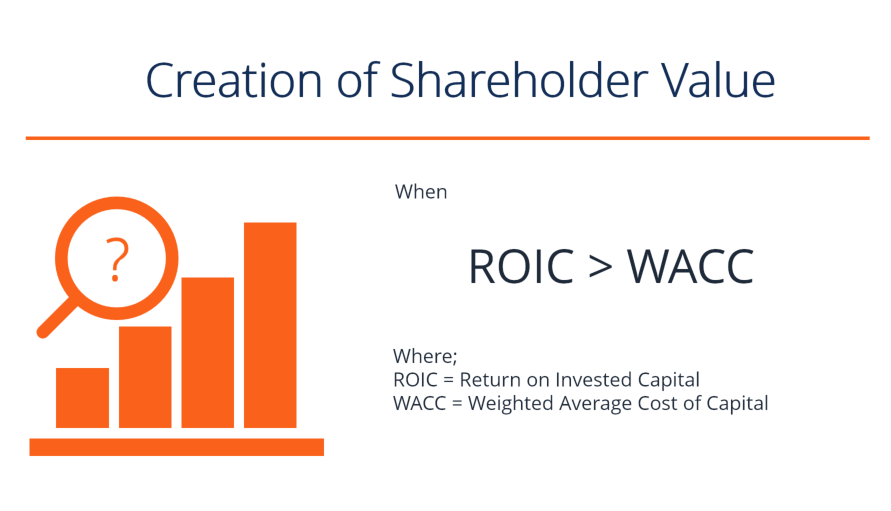
Shareholder value is the financial worth owners of a business receive for owning shares in the company. An increase in shareholder value is created when a company earns a return on invested capital (ROIC)ROICROIC stands for Return on Invested Capital and is a profitability ratio that aims to measure the percentage return that a company earns on invested capital. that is greater than its weighted average cost of capital (WACC). Put more simply, value is created for shareholders when the business increases profits.
Since the value of a company and its shares are based on the net present valueNet Present Value (NPV)Net Present Value (NPV) is the value of all future cash flows (positive and negative) over the entire life of an investment discounted to the present. of all future cash flows, that value can be increased or decreased by changes in cash flow and changes in the discount rate. Since the company has little influence over discount rates, its managers focus on investing capital effectively to generate more cash flow with less risk.
How to Create Shareholder Value
In order to maximize shareholder value, there are three main strategiesStrategyCorporate and business strategy guides. Read all CFI articles and resources on business and corporate strategy, important concepts for financial analysts to incorporate in their financial modeling and analysis. First mover advantage, Porter's 5 Forces, SWOT, competitive advantage, bargaining power of suppliers for driving profitability in a company: (1) revenue growth, (2) increasing operating margin, and (3) increasing capital efficiency. We will discuss in the following sections the major factors in boosting each of the three measures.
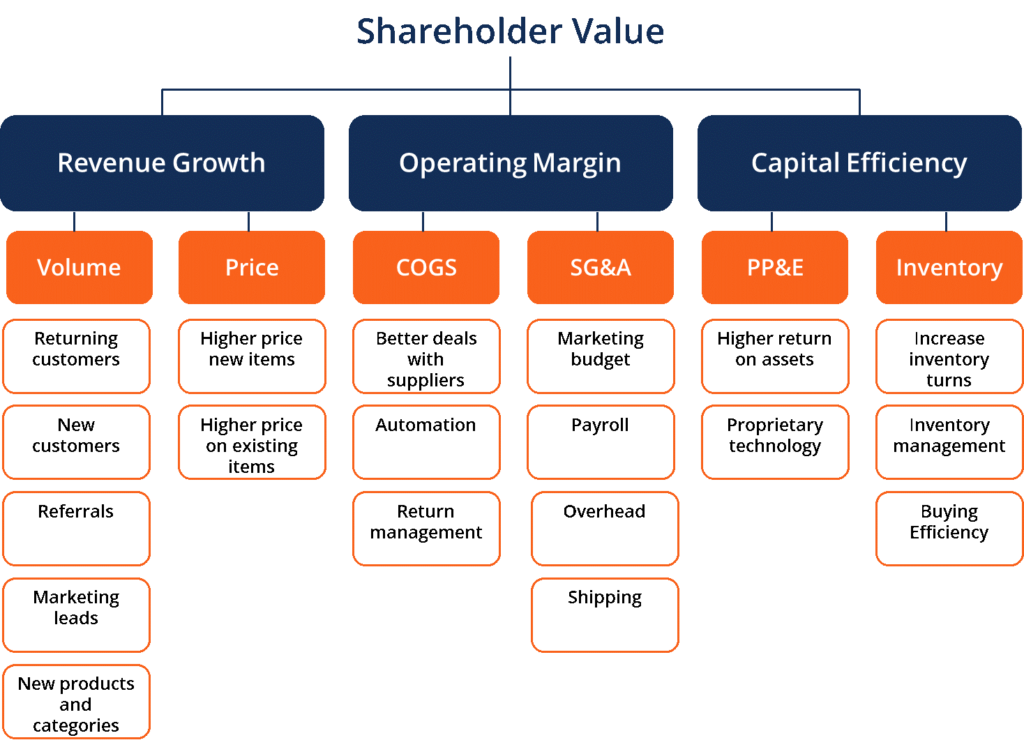
#1 Revenue Growth
For any goods and services businesses, sales revenueSales RevenueSales revenue is the income received by a company from its sales of goods or the provision of services. In accounting, the terms "sales" and can be improved through the strategies of sales volume increase or sales price inflation.
Increasing Sales Volume
A company would want to retain its current customers and keep them away from competitors to maintain its market share. It should also attract new customers through referrals from existing customers, marketing and promotions, new products and services offerings, and new revenue streamsRevenue StreamsRevenue Streams are the various sources from which a business earns money from the sale of goods or provision of services. The types of.
Raising Sales Price
A company may increase current product prices as a one-time strategy or gradual price increases throughout several months, quarters, or years to achieve revenue growth. It can also offer new products with advanced qualities and features and price them at higher ranges.
Ideally, a business can combine both higher volume and higher prices to significantly increase revenue.
#2 Operating Margin
Besides maximizing sales, a business must identify feasible approaches to cost reductions leading to optimal operating margins. While a company should strive to reduce all its expenses, COGS (Cost of Goods SoldCost of Goods Sold (COGS)Cost of Goods Sold (COGS) measures the “direct cost” incurred in the production of any goods or services. It includes material cost, direct) and SG&A (Selling, General, and Administrative) expenses are usually the largest categories that need to be efficiently managed and minimized.
Cost of Goods Sold (COGS)
When a company builds a good relationship with its suppliers, it can possibly negotiate with suppliers to reduce material prices or receive discounts on large orders. It may also form a long-term agreement with the suppliers to secure its material source and pricing.
Many companies use automation in their manufacturing processes to increase efficiency in production. Automation not only reduces labor and material costs, but also improves the quality and precision of the products and, thus, largely reduces defective and return rates.
Return management is the process by which activities associated with returns and reverse logistics are managed. It is an important factor in cost reduction because a good return management process helps the company manage the product flow efficiently and identify ways to reduce undesired returns by customers.
Selling, General, and Administrative (SG&A) Expenses
SG&ASG&ASG&A includes all non-production expenses incurred by a company in any given period. It includes expenses such as rent, advertising, marketing is usually one of the largest expenses in a company. Therefore, being able to minimize them will help the company achieve an optimal operating margin. The company should tightly control its marketing budget when planning for next year’s spending. It should also carefully manage its payroll and overhead expenses by evaluating them periodically and cutting down on unnecessary labor and other costs.
Shipping cost is directly associated with product sales and returns. Therefore, good return management will help reduce the cost of goods sold as well as logistics costs.
#3 Capital Efficiency
Capital efficiency is the ratio between dollar expenses incurred by a company and dollars that are spent to make a product or service, which can be referred to as ROCE (Return on Capital Employed) or the ratio between EBIT (Earnings Before Interest and Tax) over Capital Employed. Capital efficiency reflects how efficiently a company is deploying its cash in its operations.
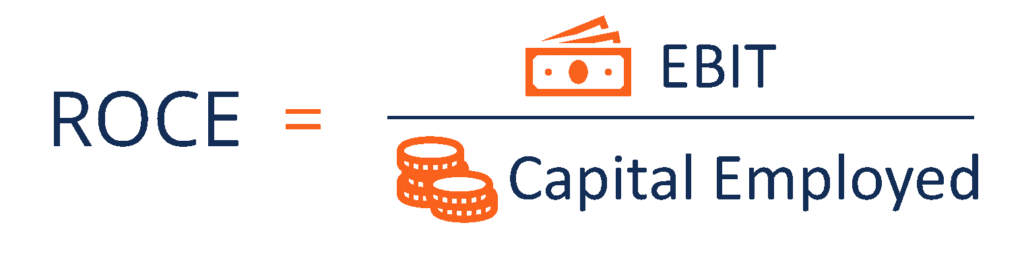
Capital employed is the total amount of capital a company uses to generate profit, which can be simplified as total assets minus current liabilities. A higher ROCE indicates a more efficient use of capital to generate shareholder value, and it should be higher than the company’s capital cost.
Property, Plant, and Equipment (PP&EPP&E (Property, Plant and Equipment)PP&E (Property, Plant, and Equipment) is one of the core non-current assets found on the balance sheet. PP&E is impacted by Capex,)
To achieve high capital efficiency, a company would first want to achieve a high return on assets (ROAReturn on Assets & ROA FormulaROA Formula. Return on Assets (ROA) is a type of return on investment (ROI) metric that measures the profitability of a business in relation to its total assets.), which measures the company’s net incomeNet IncomeNet Income is a key line item, not only in the income statement, but in all three core financial statements. While it is arrived at through generated by its total assets.
Over time, the company might also shift to developing proprietary technology, which is a system, application, or tool owned by a company that provides a competitive advantage to the owner. The company can then profit from utilizing this asset or licensing the technology to other companies. Proprietary technology is an optimal asset to possess because it increases capital efficiency to a great extent.
Inventory
InventoryInventoryInventory is a current asset account found on the balance sheet, consisting of all raw materials, work-in-progress, and finished goods that a is often a major component of a company’s total assets, and a company would always want to increase its inventory turnover, which equals net sales divided by average inventory. A higher inventory turnover ratio means that more revenues are generated given the amount of inventory. Increasing inventory turnover also reduces holding costs, consisting of storage space rent, utilities, theft, and other expenses. It can be achieved by effective inventory management, which involves constant monitoring and controlling of inventory orders, stocks, returns, or obsolete items in the warehouse.
Inventory buying efficiency can be greatly improved by using the Just-in-time (JIT) system. Costs are only incurred when the inventory goes out and new orders are being placed, which allows companies to minimize costs associated with keeping and discarding excess inventory.
Shareholder Value in Practice
There are many factors that influence shareholder value and it can be very difficult to accurately attribute the causes in its rise or fall.
Managers of businesses constantly speak of “generating shareholder value” but it is often more of a soundbite than an actual practice. Due to a host of complications, including executive compensation incentives and principal-agent issues, the primacy of shareholder value can sometimes be called into question.
Businesses are influenced by many outside forces, and thus the impact of management vs external factors can be very hard to measure.
Read more from Harvard about strategies for creating shareholder value.
Additional Resources
CFI is the official global provider of the Financial Modeling and Valuation Analyst (FMVA)™Become a Certified Financial Modeling & Valuation Analyst (FMVA)®CFI's Financial Modeling and Valuation Analyst (FMVA)® certification will help you gain the confidence you need in your finance career. Enroll today! designation, a leading financial analyst certification program. To continue learning and advancing your career, the additional CFI resources below will be helpful:
- Return on Equity (ROE)Return on Equity (ROE)Return on Equity (ROE) is a measure of a company’s profitability that takes a company’s annual return (net income) divided by the value of its total shareholders' equity (i.e. 12%). ROE combines the income statement and the balance sheet as the net income or profit is compared to the shareholders’ equity.
- Return on Invested Capital (ROIC)Return on Invested CapitalReturn on Invested Capital - ROIC - is a profitability or performance measure of the return earned by those who provide capital, namely, the firm’s bondholders and stockholders. A company's ROIC is often compared to its WACC to determine whether the company is creating or destroying value.
- Earnings Per Share (EPS)Earnings Per Share (EPS)Earnings per share (EPS) is a key metric used to determine the common shareholder's portion of the company’s profit. EPS measures each common share's profit
- Expected ReturnExpected ReturnThe expected return on an investment is the expected value of the probability distribution of possible returns it can provide to investors. The return on the investment is an unknown variable that has different values associated with different probabilities.
-
Acquirer Definition: Understanding Corporate Acquisitions
An acquirer is a registered company that purchases a portion of, or all the rights to, another company. The acquiring company takes over the management of another company by obtaining a majority stake
-

Value Proposition: Definition, Examples & How to Create One
A value proposition is a promise of value stated by a company that summarizes how the benefit of the company’s product or service will be delivered, experienced, and acquired. Essentially, a val
Business strategy
- Calculating Shareholder Value: A Comprehensive Guide
- Activist Shareholders: Definition, Tactics & Impact
- Shareholders: Understanding Ownership and Dividends
- Shareholder Activism: Understanding Shareholder Activists and Their Tactics
- Understanding Your Company's Shareholder Base: A Comprehensive Guide
- Shareholder Letter: Understanding Company Performance & Outlook
- Stakeholders vs. Shareholders: Understanding the Key Differences
- Understanding Book Value: A Key Financial Metric
- Understanding Salvage Value: Definition & Importance
-
 Streamlining Processes: Definition, Benefits & Techniques
Streamlining refers to the improvement of the efficiency of a certain process within an organization. It can be done by automationExcel vs Automation in Financial ModelingBefore we discuss Excel vs au...
-
 Value Engineering: Definition, Benefits & Implementation
Value engineering refers to the systematic method of improving the value of a product that a project produces. It is used to analyze a service, system, or product to determine the best way to manage t...