
Understanding Stock Buybacks: Methods & Impact on Share Value
Stock buyback methods involve reducing the number of shares outstanding and raising the price for the remaining shares. Similar to dividend payments, stock buybacks can be used to distribute invested capital back to the shareholders.
What is a Stock Buyback?
A stock buyback (also known as a share repurchase) is a financial transaction in which a company repurchases its previously issued shares from the market using cash. Since a company cannot be its own shareholders, repurchased shares are either canceled or are held in the company’s treasury. Either way, the shares are no longer eligible for dividend paymentsDividend PolicyA company’s dividend policy dictates the amount of dividends paid out by the company to its shareholders and the frequency with which the dividends are paid and lose their voting power.
Summary
- A stock buyback occurs when a company buys back all or part of its shares from the shareholders.
- Common reasons for a stock buyback include signaling that the company’s stock is undervalued, leveraging tax efficiency, absorbing the excess of the shares outstanding, and defending from a hostile takeover.
- Open market buybacks, fixed price tender offer, Dutch auction tender offer, and direct negotiation with the shareholders are four methods of stock buybacks.
Reasons for a Stock Buyback
Some reasons that urge a company to initiate a stock buyback include the following:
1. To signal that a stock is undervalued
If a company’s management believes that the company’s stock is undervalued, they may decide to buy back some of its shares from the market to increase the price of the remaining shares.
2. To distribute capital to shareholders with a high degree of flexibility in the amount and time
Dividend payments do not provide much flexibility to the company’s management since they must be paid on certain dates, and all common shareholders must be paid. On the other hand, stock buybacks generally provide a high degree of flexibility since they do not specify the amounts that must be paid or dates when the transactions must occur.
3. To take advantage of tax benefits
Stock buybacks can be a great alternative to dividend cash payments in countries in which the capital gain tax rate (money that shareholders receive from the stock buyback are treated as capital gains) is lower than the dividend tax rate.
4. To absorb the increases in the number of shares outstanding due to the exercise of stock options
Companies that offer stock options as a part of compensation packages to its employees commonly initiate stock buybacks. The rationale behind the practice is that when the company’s employees exercise their stock options, the number of shares outstanding increases. In order to maintain optimal levels of shares outstanding, a company buys back some of the shares from the market.
5. To use as a hostile takeover defense
If there is a threat of a hostile takeoverHostile TakeoverA hostile takeover, in mergers and acquisitions (M&A), is the acquisition of a target company by another company (referred to as the acquirer) by going directly to the target company’s shareholders, either by making a tender offer or through a proxy vote. The difference between a hostile and a friendly, the management of a target company can buy back some of its shares from the market as a defense strategy. The goal of the defense strategy is to diminish the acquirer’s chances of obtaining a controlling interest in the target company.
Methods of Stock Buybacks
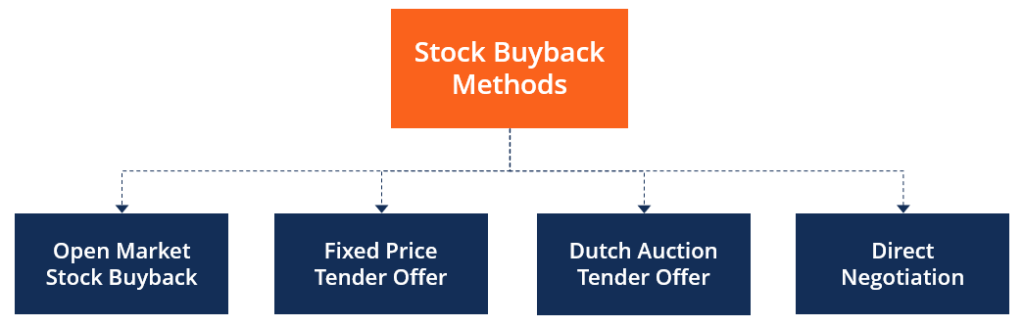
Generally, a stock buyback can be undertaken using open market operations, a fixed price tender offer, a Dutch auction tender offer, or direct negotiation with shareholders.
1. Open market stock buyback
A company buys back its shares directly from the market. The transactions are executed via the company’s brokers. The buyback of shares generally happens over a long period of time as a large number of shares must be bought. At the same time, unlike other methods, stock buybacks via open market do not impose any legal obligations on a company to complete the buyback program.
Thus, a company enjoys the flexibility to cancel the stock buyback program at any time. The primary advantage of the open market stock buyback is its cost-effectiveness because a company buys back its shares at the current market price and doesn’t need to pay a premium.
2. Fixed-price tender offer
A company makes a tender offer to the shareholders to buy back the shares on a fixed date and at a fixed price. The price of the tender offer almost always includes a premium relative to the current share price. Then, those shareholders who are interested in selling their stocks submit their number of shares for sale to the company. Generally, a fixed price tender offer can allow completing a stock buyback within a short period of time.
3. Dutch auction tender offer
In a Dutch auction, a company makes a tender offer to the shareholders to buy back shares and provides a range of possible prices, with setting the minimum price of a range above the current market price. Then, the shareholders make their bids by specifying the number of shares and the minimum price at which they are willing to sell their shares. A company reviews the bids received from the shareholders and determines the suitable price within a previously specified price range to complete the buyback program.
The main advantage of the Dutch auction is that it allows a company to identify the buyback price directly from shareholders. Additionally, using such a method, the stock buyback program can be completed within a relatively short time frame.
4. Direct negotiation
A company directly approaches one or several large shareholders to buy back the company’s shares from them. In such a scenario, the purchase price of the shares includes a premium. Note that the key benefit of this method is that a company can negotiate the buyback price directly with a shareholder. Due to this reason, this method can be highly cost-effective under certain conditions. However, direct negotiations with shareholders can also be time-consuming.
Related Readings
CFI is the official provider of the global Financial Modeling & Valuation Analyst (FMVA)™Become a Certified Financial Modeling & Valuation Analyst (FMVA)®CFI's Financial Modeling and Valuation Analyst (FMVA)® certification will help you gain the confidence you need in your finance career. Enroll today! certification program, designed to help anyone become a world-class financial analyst. To keep learning and advancing your career, the additional CFI resources below will be useful:
- Employee Stock Ownership Plan (ESOP)Employee Stock Ownership Plan (ESOP)An Employee Stock Ownership Plan (ESOP) refers to an employee benefit plan that gives the employees an ownership stake in the company. The employer allocates a percentage of the company’s shares to each eligible employee at no upfront cost. The distribution of shares may be based on the employee’s pay scale, terms of
- Negotiation TacticsNegotiation TacticsNegotiation is a dialogue between two or more people with the aim of reaching a consensus over an issue or issues where conflict exists. Good negotiation tactics are important for negotiating parties to know in order for their side to win or to create a win-win situation for both parties.
- Preferred SharesPreferred SharesPreferred shares (preferred stock, preference shares) are the class of stock ownership in a corporation that has a priority claim on the company’s assets over common stock shares. The shares are more senior than common stock but are more junior relative to debt, such as bonds.
- Treasury StockTreasury StockTreasury stock, or reacquired stock, is a portion of previously issued, outstanding shares of stock that a company repurchased from shareholders.
-

Authorized Shares: Understanding a Company's Issuance Limit
Authorized shares, or authorized stock, are simply a legally allowed maximum number of shares that a company can issue to investors. The number of authorized shares is specified in the company’s
-

Cash Reserves: Definition, Benefits & Short-Term Needs
Cash reserves are funds that companies set aside for use in emergency situations. The cash that is saved is used to cover costs or expenses that are unplanned or unexpected. In most cases, the reserve
Business strategy
- Understanding Common Stock: Ownership and Basics
- Understanding Company Bylaws: A Comprehensive Guide
- Dual-Class Stock Structures: Understanding Voting Rights & Dividends
- Understanding Earnings: A Guide to Financial Profitability
- Shareholders: Understanding Ownership and Dividends
- Understanding Stocks: A Beginner's Guide to Share Ownership
- Stock Splits Explained: Understanding Share Division & Impact
- Allotment Explained: Resource & Equity Distribution in Business
- Stock Buybacks: Understanding Share Repurchases and Their Impact
-
 Understanding Domestic Stocks: A Guide for Investors
What Are Domestic Stocks? Domestic stocks are the stocks of American companies traded on the various stock exchanges. Foreign stocks are the stocks of companies outside the United States. If ...
-
 Stock Options Explained: A Beginner's Guide to Understanding Equity Contracts
Have you ever wondered, “what are stock options?” Understanding this method of stock trading is essential to any investor who’s looking to make the most of the public mark...