
SWOT Analysis: A Comprehensive Guide for Strategic Planning
A SWOT Analysis is one of the most commonly used tools to assess the internal and external environments of a company and is part of a company’s strategic planning processCorporate StrategyCorporate Strategy focuses on how to manage resources, risk and return across a firm, as opposed to looking at competitive advantages in business strategy. In addition, a SWOT analysis can be done for a product, place, industry, or person. A SWOT analysis helps with both strategic planningStrategic AnalysisStrategic analysis refers to the process of conducting research on a company and its operating environment to formulate a strategy. The definition and decision-making, as it introduces opportunities to the company as a forward-looking bridge to generating strategic alternatives.
SWOT is an acronym for Strengths, Weaknesses, Opportunities, and Threats.
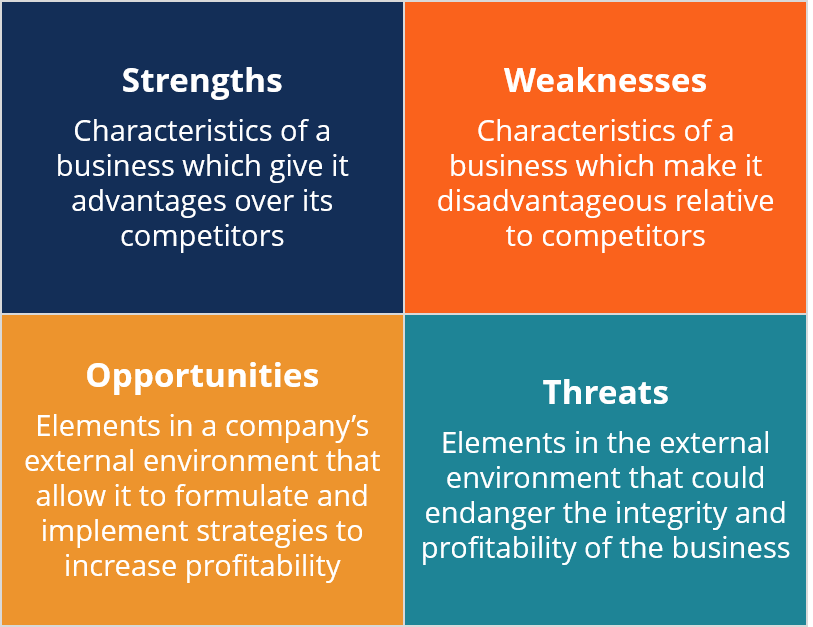
SWOT Analysis – Internal and External Factors
A SWOT analysis is divided into two main categories: internal factors and external factors.

It s important to point out that strengths and weaknesses are current or backward-looking, and opportunities and threats are forward-looking. By performing a SWOT analysis, we will be able to build a bridge between what the company has accomplished to date and the strategic alternatives that are going to be generated.
Internal:
Internal factors are the strengths and weaknesses of the company. Strengths are the characteristics that give the business its competitive advantage, while weaknesses are characteristics that a company needs to overcome in order to improve its performance.
Examples of internal factors include:
- Company culture
- Company image
- Operational efficiencyEconomies of ScaleEconomies of scale refer to the cost advantage experienced by a firm when it increases its level of output.The advantage arises due to the
- Operational capacity
- Brand awareness
- Market share
- Financial resources
- Key staff
- Organizational structureCorporate StructureCorporate structure refers to the organization of different departments or business units within a company. Depending on a company’s goals and the industry
External:
External factors are the opportunities and threats to the company. Opportunities are elements that the company sees in the external environment that it could pursue in the future to generate value. Threats are elements in the external environment that could prevent the company from achieving its goal or its mission or creating value.
Changes in the external environment may be due to:
- Societal changes
- Customers
- Competitors
- Economic environment
- Government regulationsFiscal PolicyFiscal Policy refers to the budgetary policy of the government, which involves the government controlling its level of spending and tax rates
- Suppliers
- Partners
- Market trendsLaw of SupplyThe law of supply is a basic principle in economics that asserts that, assuming all else being constant, an increase in the price of goods
Conducting a SWOT Analysis
To conduct a SWOT analysis, identify the strengths, weaknesses, opportunities, and threats to your company.
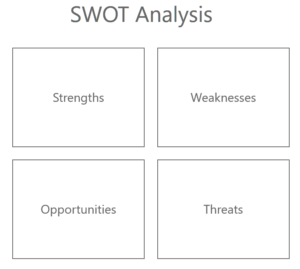
Strengths:
Consider strengths from an internal and consumer perspective.
- What advantages does your company have?
- What unique resources that you have that others do not?
- What is your company’s Unique Selling Proposition?
- What positive consumer perception does your company have?
- What low-cost resources do you have access to that others do not?
Weaknesses:
Consider weaknesses from an internal and consumer perspective.
- What does your company not do well?
- What weaknesses do consumers see in your company?
- What factors contribute to a weaker brand image?
Opportunities:
Consider opportunities from an external perspective.
- What good opportunities are available in the marketplace?
- What are some trends that your company can capitalize on?
- Are there any changes in technology or markets that your company can take advantage of?
- Are there any changes in lifestyle, social patterns, etc., that your company can take advantage of?
Threats:
Consider threats from an external perspective.
- What obstacles does your company face?
- What are your competitors doing better than you?
- Is a change in technology threatening the position of your company?
- What threats do your weaknesses put you at risk of?
- Do changes in lifestyle, social patterns, etc., pose a threat to your company?
Example of a SWOT Analysis
For example, a SWOT Analysis for McDonald’s stock can be constructed as follows:
Strengths:
- McDonald’s serves customers in more countries than any other competitor in the fast-food industry
- Significant economies of scale
- Wide audience reach
- McDonald’s exercises market power over suppliers and competitors
- The most recognized brand in the fast-food industry
- Competitive price
Weaknesses:
- High employee turnover
- Negative publicity (The perception of McDonald’s as an unhealthy food choice)
- Not much variation in seasonal products
- Quality inconsistency due to franchised operations
- Focus on fast food and not healthier options for consumers
Opportunities:
- Being responsive to social changes to healthier options
- Business expansion to new parts of the world
- Allergen-free options and gluten-free food
- Corporate social responsibility
Threats:
- More health-conscious customers
- Threat from competitors in different countries
- Threat of an economic downturn
- Social change to a more balanced meal
Key Takeaways from a SWOT Analysis
A SWOT analysis is a simple and effective framework for identifying strengths, weaknesses, opportunities, and threats that a company faces. It is important to leverage strengths, minimize threats, and to take advantage of available opportunities. Conducting a SWOT analysis is useful for strategic planning and for determining the objectives of a company.
Want to Learn More?
Enroll today in our Corporate & Business Strategy course to learn about the three levels of strategy, external and internal analysis, and the strategic planning process.
Additional Resources
CFI offers the Financial Modeling & Valuation Analyst (FMVA)™Become a Certified Financial Modeling & Valuation Analyst (FMVA)®CFI's Financial Modeling and Valuation Analyst (FMVA)® certification will help you gain the confidence you need in your finance career. Enroll today! certification program for those looking to take their careers to the next level. To keep learning and advancing your career, the following CFI resources will be helpful:
- Industry AnalysisIndustry AnalysisIndustry analysis is a market assessment tool used by businesses and analysts to understand the complexity of an industry. There are three commonly used and
- Scenario AnalysisScenario AnalysisScenario analysis is a process of examining and evaluating possible events or scenarios that could take place in the future and predicting the
- Financial Modeling for BeginnersFinancial Modeling for BeginnersFinancial modeling for beginners is our introductory guide to financial modeling - we cover how to build a model, Excel formulas, best practices, and more.
- All Strategy ResourcesStrategyCorporate and business strategy guides. Read all CFI articles and resources on business and corporate strategy, important concepts for financial analysts to incorporate in their financial modeling and analysis. First mover advantage, Porter's 5 Forces, SWOT, competitive advantage, bargaining power of suppliers
-

Parent Company Explained: Definition, Control & Examples
A parent company is a company that owns more than 50% of the outstanding voting shares of another company. Therefore, it controls the other company or companies and can directly influence the business
-

Quantitative Analysis: Definition, Methods & Applications
Quantitative analysis is the process of collecting and evaluating measurable and verifiable data such as revenues, market share, and wagesRemunerationRemuneration is any type of compensation or paymen
Business strategy
- DuPont Analysis: A Comprehensive Guide to Profitability Assessment
- Stock Analysis: A Comprehensive Guide for Investors
- 5C Analysis: A Comprehensive Framework for Business Strategy
- Holding Companies: Definition, Purpose & How They Work
- Industry Analysis: A Comprehensive Guide for Business Insights
- Kaizen: Understanding Continuous Improvement for Business
- Outsourcing: A Comprehensive Guide to Benefits & Strategy
- Pareto Analysis: The 80/20 Rule Explained | [Your Brand/Website Name]
- Ramp-Up: Definition, Benefits & How to Achieve It
-
 Understanding Financial Gearing: Debt & Leverage Explained
Gearing is the amount of debtNet DebtNet debt = total debt - cash. Net debt is a financial liquidity metric that measures a company’s ability to pay all its debts if they were due today. Compare...
-
 Leverage in Finance: Strategies, Types & Risks
In finance, leverage is a strategy that companies use to increase assets, cash flows, and returns, though it can also magnify losses. There are two main types of leverage: financial and operating. To ...