
Understanding AER: Annual Equivalent Rate Explained
The Annual Equivalent Rate (AER) is the rate of interest after taking into account the effects of compounding to normalize the interest rateInterest RateAn interest rate refers to the amount charged by a lender to a borrower for any form of debt given, generally expressed as a percentage of the principal.. The AER is the actual interest rate an investment, loan, or savings account will yield after accounting for compounding.

Summary
- The Annual Equivalent Rate (AER) is the real rate of interest because it accounts for the effects of compounding.
- It is an important tool for evaluating bonds, loans, or accounts to understand the real return on investment (ROI) or interest rate.
- The AER will always be higher than the nominal, or the stated rate, when compounding is present.
Annual Equivalent Rate Formula
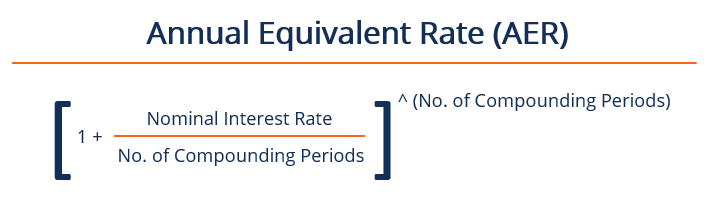
The formula for the annual equivalent rate is given below:
How AER is Used
The annual equivalent rate is used to compare the interest rates between loans or investments with different compounding periods, such as weekly, monthly, half-yearly, or yearly. Therefore, it can be used by both an individual looking for the best savings accountSavings AccountA savings account is a typical account at a bank or a credit union that allows an individual to deposit, secure, or withdraw money when the need arises. A savings account usually pays some interest on deposits, although the rate is quite low. or an investor comparing bond yields.
Significance of the AER
The AER is crucial in finding the true return on investment (ROI)Return on Investment (ROI)Return on Investment (ROI) is a performance measure used to evaluate the returns of an investment or compare efficiency of different investments. from interest-bearing assets. The nominal rate, or the stated rate, can be materially different than the AER due to the effects of compounding. It means that the AER is always higher than the nominal rate when considering compounding.
The table below visualizes the potential differences in the annual equivalent rate and the nominal rate with different compounding frequencies:
Annual Equivalent Rates of Different Compounding FrequenciesNominal Interest RateSemi-AnnuallyQuarterlyMonthlyWeeklyDaily1%1.0025%1.0038%1.0046%1.0049%1.0050%2%2.0100%2.0151%2.0184%2.0197%2.0201%3%3.0225%3.0339%3.0416%3.0446%3.0453%4%4.0400%4.0604%4.0742%4.0795%4.0808%5%5.0625%5.0945%5.1162%5.1246%5.1267%6%6.0900%6.1364%6.1678%6.1800%6.1831%7%7.1225%7.1859%7.2290%7.2458%7.2501%8%8.1600%8.2432%8.3000%8.3220%8.3278%9%9.2025%9.3083%9.3807%9.4089%9.4162%10%10.2500%10.3813%10.4713%10.5065%10.5156%15%15.5625%15.8650%16.0755%16.1583%16.1798%20%21.0000%21.5506%21.9391%22.0934%22.1336%25%26.5625%27.4429%28.0732%28.3256%28.3916%
Annual Equivalent Rate vs. Nominal Interest – Example
For example, let’s say Bond A offers a semi-annual coupon rateCoupon RateA coupon rate is the amount of annual interest income paid to a bondholder, based on the face value of the bond. of 3%. The nominal rate of the bond is 6% since it is two 3% coupons. However, the AER of the bond will be higher given that interest is paid out two times a year. Therefore, the AER of the bond will be calculated as:
AER = (1+ (0.06 / 2 )^2)) – 1 = 6.09%
Bond B, on the other hand, offers a quarterly coupon rate of 1.5%. The nominal rate of the bond is still 6%. However, the AER will be even higher, as the coupons are paid out four times a year. Therefore, the AER of the bond will be:
AER = (1+ (0.06/4)^4)) – 1 = 6.14%
After analyzing the AER of the two bond options, a rational investor will select Bond B, assuming all else equal, even though both bonds are the same from face value.
Related Readings
CFI is the official provider of the global Commercial Banking & Credit Analyst (CBCA)™Program Page - CBCAGet CFI's CBCA™ certification and become a Commercial Banking & Credit Analyst. Enroll and advance your career with our certification programs and courses. certification program, designed to help anyone become a world-class financial analyst. To keep advancing your career, the additional CFI resources below will be useful:
- Continuously Compounded ReturnContinuously Compounded ReturnContinuously compounded return is what happens when the interest earned on an investment is calculated and reinvested back into the account for an infinite number of periods. The interest is calculated on the principal amount and the interest accumulated over the given periods
- Rate of ReturnRate of ReturnThe Rate of Return (ROR) is the gain or loss of an investment over a period of time copmared to the initial cost of the investment expressed as a percentage. This guide teaches the most common formulas
- Simple Interest vs Compounded InterestSimple Interest vs Compound InterestIn this article, we will discuss simple interest vs compound interest and illustrate the major differences that can arise between them. Interest payments can be thought of as the price of borrowing funds in the market.
- Investing: A Beginner’s GuideInvesting: A Beginner's GuideCFI's Investing for Beginners guide will teach you the basics of investing and how to get started. Learn about different strategies and techniques for trading
-

Understanding the Policy Interest Rate: Its Impact on the Economy
Three more sleep inducing words have perhaps never been strung together, but the policy interest rate is actually pretty exciting insofar as it's a little number that has a profound effect on a c
-
Understanding the Overnight Interest Rate: Impact on the Economy
Overnight rate might sound like the five-dollars-more alternative to the hourly rate for the least reputable hotel in town, but in fact it’s a number that has a profound effect on a country’s entire e
finance
- Understanding APR: What It Is and How It Works
- Compound Growth Rate: Definition & Calculation | [Your Brand]
- Effective Annual Interest Rate (EAR): Understanding & Calculation
- Effective Annual Rate (EAR): Understanding & Calculation
- Equivalent Annual Annuity (EAA): Project Evaluation Explained
- Understanding Forward Rates: A Comprehensive Guide
- Understanding the Overnight Interest Rate: A Comprehensive Guide
- Prime Rate Explained: Understanding Interest Rates for Businesses & Consumers
- Understanding Average Annual Growth Rate (AAGR): Definition & Uses
-
 Understanding Swap Rate Curves: A Comprehensive Guide
The swap rate curve is a chart that depicts the relationship between swap rates and all available corresponding maturities. Essentially, it indicates the expected returnsExpected ReturnThe expected re...
-
 Understanding Implied Rates: A Comprehensive Guide
The implied rate is an interest rate that expresses the difference between the forward/future rate and the spot rate. It serves as a useful tool for comparing returns across different assets and can b...