
Effective Annual Rate (EAR): Understanding & Calculation
The Effective Annual Rate (EAR) is the rate of interestInterest ExpenseInterest expense arises out of a company that finances through debt or capital leases. Interest is found in the income statement, but can also actually earned on an investment or paid on a loan as a result of compounding the interest over a given period of time. It is usually higher than the nominal rate and is used to compare different financial products that calculate annual interest with different compounding periods – weekly, monthly, yearly, etc. Increasing the number of compounding periods makes the effective annual interest rate increase as time goes by.

The effective annual rate is normally higher than the nominal rate because the nominal rate quotes a yearly percentage rate regardless of compounding. Increasing the number of compounding periods increases the effective annual rate as compared to the nominal rate. To spin it in another light, an investment that is compounded annually will have an effective annual rate that is equal to its nominal rate. However, if the same investment was instead compounded quarterly, the effective annual rate would then be higher.
What is the Formula for the Effective Annual Rate?
The formula for the EAR is:
Effective Annual Rate = (1 + (nominal interest rate / number of compounding periods)) ^ (number of compounding periods) – 1
For example:
Union Bank offers a nominal interest rate of 12% on its certificate of deposit to Mr. Obama, a bank client. The client initially invested $1,000 and agreed to have the interest compounded monthly for one full year. As a result of compounding, the effective interest rate is 12.683%, in which the money grew by $126.83 for one year, even though the interest is offered at only 12%.
Effective Annual Rate Calculator
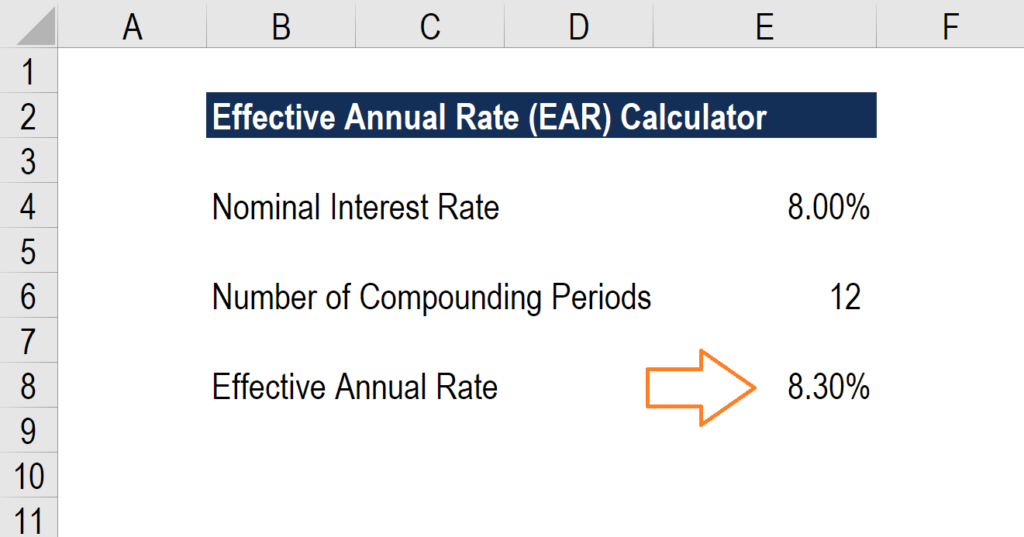
Below is a screenshot of CFI’s free effective annual rate (EAR) calculator.
As you can see in the example above, a nominal interest rate of 8.0% with 12 compounding periods per year equates to an effective annual percentage rate (EAPR) of 8.3%.
Download the Free Template
Enter your name and email in the form below and download the free template now!
What is a Nominal Interest Rate?
A nominal interest rate is a stated rate indicated by a financial instrument that is issued by a lender or guarantor. This rate is the basis for computation to derive the interest amount resulting from compounding the principal plus interest over a period of time. In essence, this is the actual monetary price that borrowers pay to lenders or that investors receive from issuers.
What is a Compounding Period?
A compounding period is the time period after which the outstanding loan or investment’s interest is added to the principal amount of said loan or investment. The period can be daily, weekly, monthly, quarterly, or semi-annually, depending on the terms agreed upon by the parties involved. As the number of compounding periods increases so does the amount of interest earned or paid on the money used. Quarterly compounding produces higher returns than semi-annual compounding, while monthly compounding generates more than quarterly, and daily compounding generates more than monthly.
Learn More About Interest Rates
To learn more about interest rates, check out CFI’s free online finance and accounting courses!
How Important is the Effective Annual Rate in Business?
The effectual annual interest rate is a useful way of evaluating the actual return on investment and ascertaining the interest expense paid on a loan. Borrowers need to have a solid understanding of the impact cost of debtCost of DebtThe cost of debt is the return that a company provides to its debtholders and creditors. Cost of debt is used in WACC calculations for valuation analysis. has on their business, as it will impact their profitability and solvency.
A higher interest expense lowers the interest coverage ratioCoverage RatioA Coverage Ratio is used to measure a company’s ability to pay its financial obligations. A higher ratio indicates a greater ability to meet obligations for a company, which could reduce its ability to service debt in the future. Additionally, the higher interest expense will lower net income and profitability for the company (all else being equal).
On the flip side, investors will benefit if the effective interest rate is greater than the nominal rate offered by the issuer. They also use this rate to compare various investment portfolios by using different compounding periods to make an effective decision.
More learning
CFI is the global provider of the Financial Modeling Certification ProgramBecome a Certified Financial Modeling & Valuation Analyst (FMVA)®CFI's Financial Modeling and Valuation Analyst (FMVA)® certification will help you gain the confidence you need in your finance career. Enroll today!, designed to teach anyone to become a world-class financial analyst. If you’re interested in advancing your career in corporate finance, these CFI articles will help you on your way:
- Weighted Average Cost of Capital (WACC)WACCWACC is a firm’s Weighted Average Cost of Capital and represents its blended cost of capital including equity and debt.
- EBITDAEBITDAEBITDA or Earnings Before Interest, Tax, Depreciation, Amortization is a company's profits before any of these net deductions are made. EBITDA focuses on the operating decisions of a business because it looks at the business’ profitability from core operations before the impact of capital structure. Formula, examples
- Basis Points (bps)Basis Points (BPS)Basis Points (BPS) are the commonly used metric to gauge changes in interest rates. A basis point is 1 hundredth of one percent.
- XIRR vs IRRXIRR vs IRRWhy use XIRR vs IRR. XIRR assigns specific dates to each individual cash flow making it more accurate than IRR when building a financial model in Excel.
- Investment BankingInvestment BankingInvestment banking is the division of a bank or financial institution that serves governments, corporations, and institutions by providing underwriting (capital raising) and mergers and acquisitions (M&A) advisory services. Investment banks act as intermediaries
- Financial ModelingWhat is Financial ModelingFinancial modeling is performed in Excel to forecast a company's financial performance. Overview of what is financial modeling, how & why to build a model.
-

Understanding the Overnight Interest Rate: A Comprehensive Guide
The overnight rate refers to the interest rate that depository institutions (e.g., banks or credit unionsCredit UnionA credit union is a type of financial organization that is owned and governed by it
-

Prime Rate Explained: Understanding Interest Rates for Businesses & Consumers
The term “prime rate” (also known as the prime lending rate or prime interest rate) refers to the interest rate that large commercial banks charge on loans and products held by their custo
finance
- Effective Annual Interest Rate (EAR): Understanding & Calculation
- Understanding AER: Annual Equivalent Rate Explained
- Understanding Annual Percentage Yield (APY): A Comprehensive Guide
- Binomial Interest Rate Tree: Definition, Uses & Applications
- Effective Annual Interest Rate (EAR): Understanding & Calculation
- Fisher Equation Explained: Understanding Inflation & Interest Rates
- Nominal Interest Rate Explained: Definition & Implications
- Swap Rate Explained: Understanding Fixed Exchange Rates in Derivatives
- Understanding the Policy Interest Rate: Its Impact on the Economy
-
 Understanding Interest Rate Risk: Definition & Impact
Interest rate risk is the probability of a decline in the value of an asset resulting from unexpected fluctuations in interest rates. Interest rate risk is mostly associated with fixed-income assets (...
-
 Interest Rate Swaps: A Comprehensive Guide
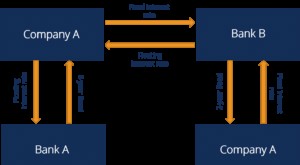
An interest rate swap is a type of a derivative contract through which two counterparties agree to exchange one stream of future interest payments for another, based on a specified principal amount. I...