
Capital Appropriation: Definition, Process & Examples
Appropriation is the process of allocating capital for specific purposes. Companies, governments, and individuals all appropriate capital for specific objectives. The budgeting process involves appropriating capital for differing business expenditures within the fiscal yearFiscal Year (FY)A fiscal year (FY) is a 12-month or 52-week period of time used by governments and businesses for accounting purposes to formulate annual.

For example, consider a clothing manufacturing company that sells via the direct-to-consumer method. In the company’s fiscal budget, it allocates capital towards marketing, capital expenditureCapital ExpenditureA capital expenditure (“CapEx” for short) is the payment with either cash or credit to purchase long term physical or fixed assets used in a, and labor expenses. The categorical allocation of expenses exemplifies a manufacturing company’s appropriation of capital.
Summary
- Appropriation is the allocation of capital for specific, actionable purposes.
- Corporations, governments, and individuals all follow processes to appropriate spending.
- There are many potential ways to allocate capital efficiently.
How Do Companies Appropriate Cash?
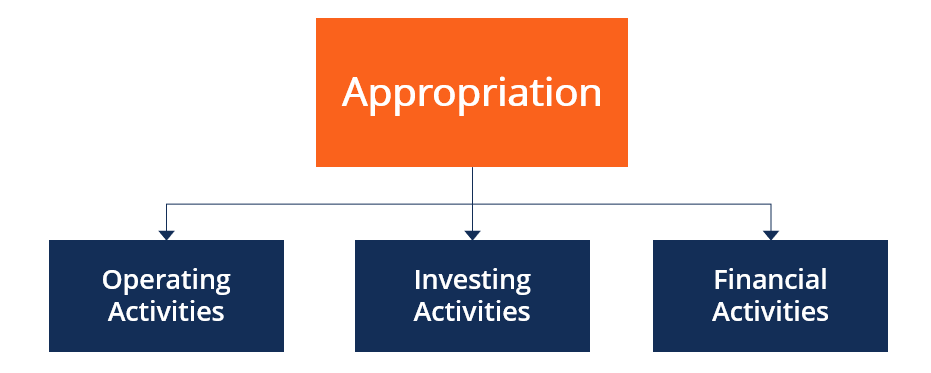
The cash flow statementCash Flow StatementA cash flow Statement contains information on how much cash a company generated and used during a given period. provides information about a company’s cash receipts and cash payments during a period. In addition, it provides insight into how a company allocates its cash across operating activities, investing activities, and financing activities.
It is important to understand that appropriating cash expenditures is very much up to the interpretation of the three types of corporate activities, as discussed below:
1. Operating Activities
Operating activities are a company’s principal revenue-producing activities. Operating flows are transactions that influence net income. Under operating activities, there are cash inflows and outflows, but only the outflows can be appropriated. Companies can appropriate payments to suppliers and creditors or even settle asset retirement obligations.
2. Investing Activities
Investing activities are related to the collection of loans, investment transactions, and transactions revolving around property, plant, equipment, and intangible assets. Capital expenditure is a company’s acquisition of long-term assets that will generate revenue in future periods. Therefore, if a company appropriates large amounts of capital for the acquisition of productive assets, it indicates a company’s commitment to growth.
3. Financial Activities
Financial activities result in alterations in the composition of a company’s capital structure. Financing cash flows revolve around capital raised through debt or equity, which ultimately results in providing lenders and shareholders contractual cash payments or return on equity investments. Companies carefully allocate their capital structure between equity and debt when leveraging debt to maximize shareholder wealth.
What is the Zero-Based Budgeting Strategy?
Peter Pyhrr, a former manager at Texas Instruments, first popularized Zero-Based Budgeting (ZBB) in the 1970s. The objective of ZBB is to tie strategy to functional organizational areas within an organization’s structure.
The zero-based budgeting (ZBB) strategy is a popular budgeting strategy where all future expenses must be reviewed and approved prior to the next fiscal period. The process drives cost management visibility and fosters ownership over budgeting accurately.
When employed successfully, ZBB can effectively reduce capital expenditure, cost of goods sold, sales, general and administrative costs, or any other type of costs. it can theoretically reduce expenditures sustainably through the construction of culture centered around sustainable cost-savings.
Advantages of Zero-Based-Budgeting
- Accountability can drive more accurate budgeting
- Can be more efficient than forecasting based on historical data
- Elimination of superfluous spending
- A healthy culture of ownership
Disadvantages of Zero-Based-Budgeting
- Increase of bureaucratic processes
- Increased time cost when it comes to monthly closing processes
- Necessary expenditure can be difficult to justify
How Do Governments Appropriate Funds?
Governments are responsible for appropriating capital towards many projects that drive value for their citizens.
Please consider the California State Government’s five largest budget allocations towards different programs in 2018.
- Healthcare
- Education
- Corrections and rehab
- Transportation
- General government
The list above represents approximately USD165 billion of capital allocation by the state of California. The budget allocation is the by-product of intensive legislative processes with the objective of managing California for the betterment of its citizens.
How Do Individuals Appropriate Funds?
Budgeting is a useful tool employed not only by companies and governments but also by your average individual. In fact, average households appropriate money for mortgage payments, food and entertainment expenditures, and credit card payments.
Properly appropriating capital towards short-term and long-term debt obligations is pivotal in obtaining a higher credit score. Credit scores can be a key factor in where one can potentially live, and more importantly, the cost of borrowing money from financial institutions.
Technological innovation leads to more improved budgeting tools for individuals. Mobile phone applications provide a means for individuals to micromanage expenditure on a periodic or activity-type basis. Furthermore, the apps can even offer guidance that can lead to a more efficient allocation of capital for individuals.
More Resources
CFI offers the Commercial Banking & Credit Analyst (CBCA)™Program Page - CBCAGet CFI's CBCA™ certification and become a Commercial Banking & Credit Analyst. Enroll and advance your career with our certification programs and courses. certification program for those looking to take their careers to the next level. To keep learning and advancing your career, the following resources will be helpful:
- Cost of Goods Sold (COGS)Cost of Goods Sold (COGS)Cost of Goods Sold (COGS) measures the “direct cost” incurred in the production of any goods or services. It includes material cost, direct
- Output/Input BudgetingOutput/Input BudgetingAn output/input budget is also known as a performance budget. It is a type of budget that reflects both the funding levels (input) and the expected output from each unit of the organization. The output/input budgeting method is often used by governments to show the relationship between the taxpayer funds (input) and the output of services
- Fiscal PolicyFiscal PolicyFiscal Policy refers to the budgetary policy of the government, which involves the government controlling its level of spending and tax rates
- Types of BudgetsTypes of BudgetsThere are four common types of budgeting methods that companies use: (1) incremental, (2) activity-based, (3) value proposition, and (4)
-
Understanding Mispricing: Market Prices vs. True Value
Mispricing causes a divergence between the market price of a security and the fundamental value of that security. The law of one price states that the market price of a security is equal to the presen
-

Synthetic Cash: Understanding Simulated Financial Instruments
Synthetic cash is a financial instrument that is created to function like other financial instruments, but certain characteristics of the simulated financial instrument are altered. The simulated inst
finance
- Understanding Appropriation Accounts: Distribution of Funds & Profits
- Basel I: Understanding Core Banking Regulations & Capital Requirements
- Understanding Capital: Types, Categories & Value Creation
- Capital Budgeting: A Comprehensive Guide for Business Leaders
- Capital Rationing: Definition, Strategy & Impact on Investment Decisions
- Understanding Cash Consideration in Mergers & Acquisitions
- Understanding Cash Flow: A Comprehensive Guide
- Cash Management: A Comprehensive Guide to Financial Stability
- Cash-on-Cash Return: Definition, Calculation & Importance
-
 Bitcoin Cash (BCH): A Comprehensive Overview - Features, History & Future
Bitcoin Cash (BCH) is a cryptocurrency created from a hard fork of Bitcoin. It is meant to have quicker transactions than Bitcoin. The fork occurred at block 478,559. At that block the Bitcoin bl...
-
 Understanding Capital Losses: Definition, Calculation & Examples
Capital loss is the reduction in the value of a company’s capital, i.e., investments, capital assets, etc. The loss is realized when capital assets are sold for a price lower than the original p...