
Beyond Budgeting: A Modern Approach to Organizational Control
Beyond Budgeting is the idea of abolishing traditional budgeting processes to eventually improve management control over an organization. By abandoning traditional budgeting processes, a company aims to establish a highly decentralized organizational system and adaptive set of management processes.

Summary
- Traditional budgeting processes carry a lot of serious flaws.
- Beyond Budgeting is an idea of abolishing traditional budgeting processes to improve management control over an organization.
- The Beyond Budgeting framework is built upon six leadership principles and six management processes principles.
Rationale Behind Beyond Budgeting
The rationale behind the Beyond Budgeting framework is that traditional budgeting processes carry a number of flaws. Some of the flaws include the following:
- Development of budget is time-consuming and costly.
- Budgets are rarely focused on the company’s strategy.
- Budgets generally do not stimulate value creation.
- Budgets may create obstacles for changes.
- Budgets increase the centralization of power within an organization.
Breaking Down Beyond Budgeting
The idea of Beyond Budgeting is still relatively new. The active development of the framework started in the last 20 years. Its rise is associated with the shift from a traditional bureaucratic organizational model to an agile business structureAgile Project ManagementThe agile project management approach arose in the early 2000s when software development teams realized they were unable to quickly and flexibly deliver.
Essentially, the Beyond Budgeting framework is based on the idea of business agility. Initially, agile enterprises were prevalent primarily among software development companies. Such companies established agile techniques of business to quickly adjust and adapt to the constantly changing goals and requirements in an extremely competitive environment. Nowadays, businesses across different industries actively implement agile techniques to adhere to demanding megatrends such as digitalization, globalization, and mobility.
Beyond Budgeting Institute is a non-profit organization that develops and promotes beyond budgeting principles. The organization hosts the annual Beyond Budgeting Round Tables (BBRT), a global network that encourages organizations to learn the BB principles. BBRT also fosters sharing information and experiences of adopting the principles.
Beyond Budgeting Principles
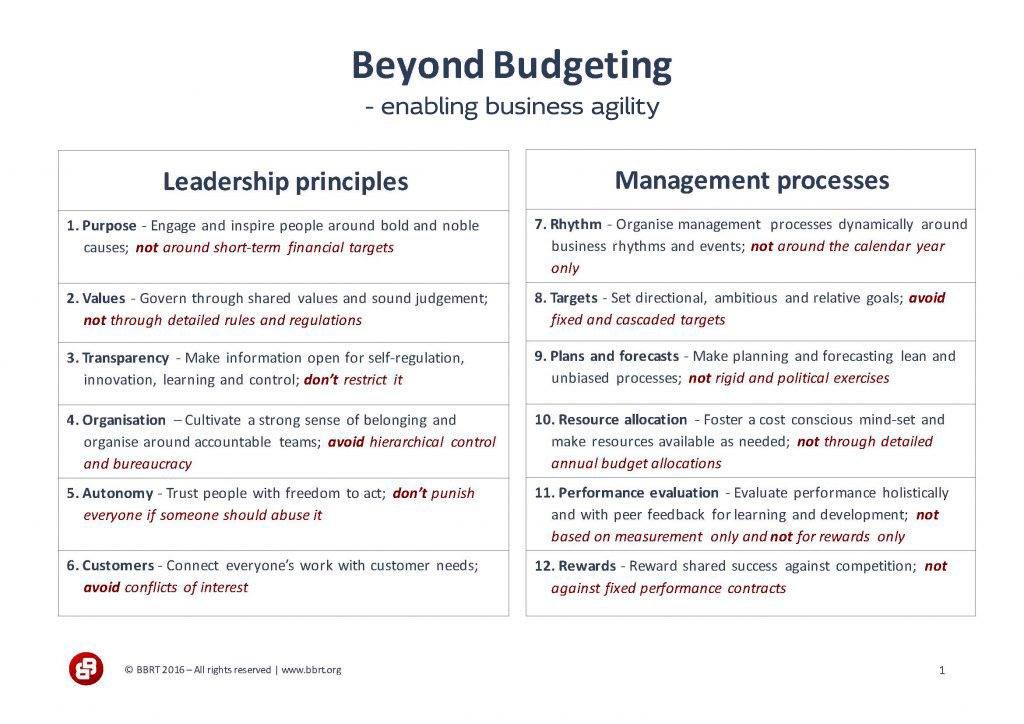
The Beyond Budgeting framework is based on 12 principles. However, according to the institute, the principles are neither a recipe nor a checklist for management. The principles merely serve as a guide to companies and managers who are willing to adopt the framework.
The two pillars of the Beyond Budgeting framework are decentralized leadership and adaptive management processes. Each dimension of the framework consists of six principles, as shown in the image below:
Beyond Budgeting Techniques
Complete abolition of traditional budgeting processes requires the implementation of new techniques that will replace them. The BB framework does not specify the exact techniques that are applicable to all companies.
However, there are some techniques that have proven to be effective in real cases in the past. These techniques include the following:
- Rolling forecasts are created monthly or quarterly rather than annually.
- Company’s targets are based on key performance indicators (KPIs)Key Performance Indicators (KPIs)Key Performance Indicators (KPIs) are metrics used to periodically track and evaluate the performance of an organization toward the achievement of specific goals. They are also used to gauge the overall performance of a company.
- The performance of the company’s managers is evaluated based on external benchmarks rather than their past performance.
- Operational managers are empowered to react to the changes in the business environment and can dynamically coordinate their actions.
Related Readings
CFI offers the Financial Modeling & Valuation Analyst (FMVA)®Become a Certified Financial Modeling & Valuation Analyst (FMVA)®CFI's Financial Modeling and Valuation Analyst (FMVA)® certification will help you gain the confidence you need in your finance career. Enroll today! certification program for those looking to take their careers to the next level. To keep learning and advancing your career, the following CFI resources will be helpful:
- BureaucracyBureaucracyThe system to maintain uniform authority within and across institutions is known as bureaucracy. Bureaucracy essentially means to rule by the office.
- Guide to Project FinanceProject Finance - A PrimerProject finance primer. Project finance is the financial analysis of the complete life-cycle of a project. Typically, a cost-benefit analysis is used to
- Top-Down BudgetingTop-Down BudgetingTop-down budgeting refers to a budgeting method where senior management prepares a high-level budget for the company. The company’s senior management prepares the budget based on its objectives and then passes it on to department managers for implementation.
- Types of Financial AnalysisTypes of Financial AnalysisFinancial analysis involves using financial data to assess a company’s performance and make recommendations about how it can improve going forward. Financial Analysts primarily carry out their work in Excel, using a spreadsheet to analyze historical data and make projections Types of Financial Analysis
-

Understanding Regulation Z: Your Rights as a Borrower
Regulation Z is a consumer-protection regulation that compels lenders to disclose the cost of credit in a clear way for consumers. Whether you’re applying for a mortgage or dealing
-

Annuities Explained: A Simple Guide to Retirement Income
So you're wondering what is an annuity? There are dozens of different flavours of annuities that perform different functions and pay their holders out in different ways, but for our purposes let’
finance
- Activity-Based Budgeting (ABB): A Comprehensive Guide
- Business Budgeting: A Comprehensive Guide to Planning & KPIs
- Incremental Budgeting: Definition, Pros & Cons | [Your Company Name]
- Negotiated Budgeting: A Collaborative Approach to Financial Planning
- Budgeting Software: Types, Features & Comparison - [Year]
- Zero-Based Budgeting: A Comprehensive Guide for Businesses
- Capital Budgeting: Evaluating Investments for Business Growth
- Incremental Budgeting: Pros, Cons & Why It's Often Problematic
- Activity-Based Budgeting (ABB): A Comprehensive Guide
-
 Jumbo CDs: Higher Rates & Deposits Explained
A jumbo CD is similar to a conventional CD although the former generally requires a higher deposit and accrues interest at a higher rate. A CD is a certificate of deposit that is offered by banks for ...
-
 Zero-Based Budgeting (ZBB): A Comprehensive Guide
Zero-based budgeting (ZBB) is a budgeting technique that allocates funding based on efficiency and necessity rather than budget historyFiscal Year (FY)A fiscal year (FY) is a 12-month or 52-week perio...