
Understanding the Business Life Cycle: Stages & Metrics
The business life cycle is the progression of a business in phases over time and is most commonly divided into five stages: launch, growth, shake-out, maturity, and decline. The cycle is shown on a graph with the horizontal axis as time and the vertical axis as dollars or various financial metrics. In this article, we will use three financial metrics to describe the status of each business life cycle phase, including salesSales RevenueSales revenue is the income received by a company from its sales of goods or the provision of services. In accounting, the terms "sales" and, profitNet IncomeNet Income is a key line item, not only in the income statement, but in all three core financial statements. While it is arrived at through, and cash flowValuationFree valuation guides to learn the most important concepts at your own pace. These articles will teach you business valuation best practices and how to value a company using comparable company analysis, discounted cash flow (DCF) modeling, and precedent transactions, as used in investment banking, equity research,.
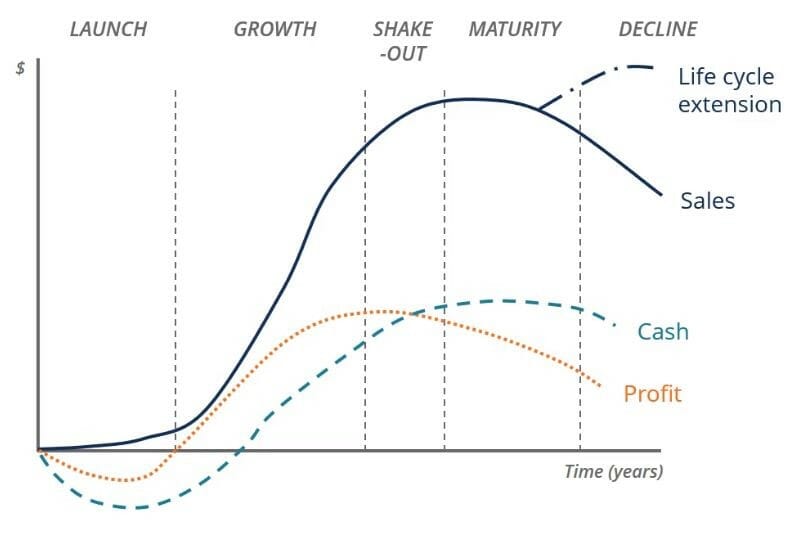
Image: CFI’s FREE Corporate Finance Class.
Phase One: Launch
Each company begins its operations as a business and usually by launching new products or servicesHow VC’s Look at Startups and FoundersA guide to how VC's look at startups and founders. The odds of being funded, the odds of commercial success, traits they look for, good vs bad pitches. During the launch phase, sales are low but slowly (and hopefully steadily) increasing. Businesses focus on marketing to their target consumer segments by advertising their comparative advantages and value propositions. However, as revenue is low and initial startup costs are high, businesses are prone to incur losses in this phase.
In fact, throughout the entire business life cycle, the profit cycle lags behind the sales cycle and creates a time delay between sales growth and profit growth. This lag is important as it relates to the funding life cycle, which is explained in the latter part of this article.
Finally, the cash flow during the launch phase is also negative but dips even lower than the profit. This is due to the capitalization of initial startup costs that may not be reflected in the business’ profit but that are certainly reflected in its cash flow.
Phase Two: Growth
In the growth phase, companies experience rapid sales growth. As sales increase rapidly, businesses start seeing profit once they pass the break-even point. However, as the profit cycle still lags behind the sales cycle, the profit level is not as high as sales. Finally, the cash flow during the growth phase becomes positive, representing an excess cash inflow.
Phase Three: Shake-out
During the shake-out phase, sales continue to increase, but at a slower rate, usually due to either approaching market saturation or the entry of new competitors in the marketThreat of New EntrantsThe Threat of New Entrants refers to the threat that new competitors pose to current players within an industry. It is one of the forces that shape the. Sales peak during the shake-out phase. Although sales continue to increase, profit starts to decrease in the shake-out phase. This growth in sales and decline in profit represents a significant increase in costs. Lastly, cash flow increases and exceeds profit.
Phase Four: Maturity
When the business matures, sales begin to decrease slowly. Profit margins get thinner, while cash flow stays relatively stagnant. As firms approach maturity, major capital spending is largely behind the business, and therefore cash generation is higher than the profit on the income statementIncome StatementThe Income Statement is one of a company's core financial statements that shows their profit and loss over a period of time. The profit or.
However, it’s important to note that many businesses extend their business life cycle during this phase by reinventing themselves and investing in new technologies and emerging markets. This allows companies to reposition themselves in their dynamic industries and refresh their growth in the marketplace.
Phase Five: Decline
In the final stage of the business life cycle, sales, profit, and cash flow all decline. During this phase, companies accept their failure to extend their business life cycle by adapting to the changing business environment. Firms lose their competitive advantageCompetitive AdvantageA competitive advantage is an attribute that enables a company to outperform its competitors. It allows a company to achieve superior margins and finally exit the market.
Corporate Funding Life Cycle
In the funding life cycle, the five stages remain the same but are placed on the horizontal axis. Across the vertical axis is the level of risk in the business; this includes the level of risk of lending money or providing capital to the business.
While the business life cycle contains sales, profit, and cash as financial metrics, the funding life cycle consists of sales, business risk, and debt funding as key financial indicators. The business risk cycle is inverse to the sales and debt funding cycle.
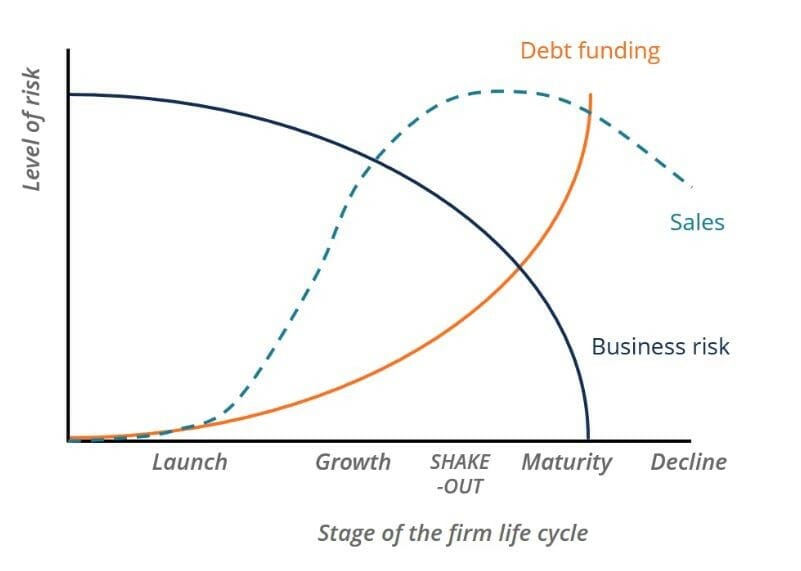
Image: CFI’s FREE Corporate Finance Class.
Phase One: Launch
At launch, when sales are the lowest, business risk is the highest. During this phase, it is impossible for a company to finance debt due to its unproven business model and uncertain ability to repay debt. As sales begin to increase slowly, the corporations’ ability to finance debt also increases.
Phase Two: Growth
As companies experience booming sales growth, business risks decrease, while their ability to raise debt increases. During the growth phase, companies start seeing a profit and positive cash flow, which evidences their ability to repay debt.
The corporations’ products or services have been proven to provide value in the marketplace. Companies at the growth stage seek more and more capital as they wish to expand their market reach and diversify their businesses.
Phase Three: Shake-out
During the shake-out phase, sales peak. The industry experiences steep growth, leading to fierce competition in the marketplace. However, as sales peak, the debt financing life cycle increases exponentially. Companies prove their successful positioning in the market, exhibiting their ability to repay debt. Business risk continues to decline.
Phase Four: Maturity
As corporations approach maturity, sales start to decline. However, unlike the earlier stages where the business risk cycle was inverse to the sales cycle, business risk moves in correlation with sales to the point where it carries no business risk. Due to the elimination of business risk, the most mature and stable businesses have the easiest access to debt capital.
Phase Five: Decline
In the final stage of the funding life cycle, sales begin to decline at an accelerating rate. This decline in sales portrays the companies’ inability to adapt to changing business environments and extend their life cycles.
Understanding the business life cycle is critical for investment bankers, corporate financial analysts, and other professionals in the financial services industry. You can benefit by checking out the additional information resources that CFI offers, such as those listed below.
Additional Resources
Thank you for reading this guide on the 5 stages of a business or industry life cycle. CFI is a global provider of the Financial Modeling & Valuation Analyst (FMVA)®Become a Certified Financial Modeling & Valuation Analyst (FMVA)®CFI's Financial Modeling and Valuation Analyst (FMVA)® certification will help you gain the confidence you need in your finance career. Enroll today! certification program and several other courses for finance professionals. To help you advance your career, check out the additional CFI resources below:
- Corporate DevelopmentCorporate DevelopmentCorporate development is the group at a corporation responsible for strategic decisions to grow and restructure its business, establish strategic partnerships, engage in mergers & acquisitions (M&A), and/or achieve organizational excellence. Corp Dev also pursues opportunities that leverage the value of the company’s business platform.
- Careers in Corporate DevelopmentCorporate Development Career PathCorporate Development jobs include executing mergers, acquisitions, divestitures & capital raising in-house for a corporation. Corporate
- Corporate StructureCorporate StructureCorporate structure refers to the organization of different departments or business units within a company. Depending on a company’s goals and the industry
- M&A Process OverviewMergers Acquisitions M&A ProcessThis guide takes you through all the steps in the M&A process. Learn how mergers and acquisitions and deals are completed. In this guide, we'll outline the acquisition process from start to finish, the various types of acquirers (strategic vs. financial buys), the importance of synergies, and transaction costs
-

Business Banking: Services, Accounts & Loans Explained
Banking services provided solely to business units are known as business banking facilities. Business units, which include corporations and limited liability partnerships (LLPs)Limited Liability Partn
-

Understanding Insolvency: Definition, Causes & Consequences
Insolvency refers to the situation in which a firm or individual is unable to meet financial obligations to creditors as debtsCurrent LiabilitiesCurrent liabilities are financial obligations of a busi
finance
- Advertising to Sales Ratio: Measuring Ad Effectiveness & ROI
- Understanding the Business Life Cycle: Stages & Metrics
- Understanding Business Metrics: Key Performance Indicators & KPIs
- Life Cycle Cost Analysis (LCCA): A Comprehensive Guide
- Understanding the Long-Term Capital Investment Cycle
- Business Visibility: Forecasting Performance & Driving Success
- Understanding the Investment Accumulation Phase: Building Wealth Over Time
- Understanding the Sales and Collection Cycle: A Comprehensive Guide
- Understanding the Industry Life Cycle: Stages & Dynamics
-
 The Presidential Cycle: Understanding Market Trends After Elections
The Presidential Cycle is a theory that suggests that the United States stock marketNew York Stock Exchange (NYSE)The New York Stock Exchange (NYSE) is the largest securities exchange in the world, ho...
-
 Business Model Canvas: A Strategic Planning Tool Explained
The business model canvas is a strategic planning Strategic PlanningStrategic planning is the art of formulating business strategies, implementing them, and evaluating their impact on organizatio...