
Understanding the Long-Term Capital Investment Cycle
The long-term capital investment cycle occurs when the large capital assets of a company go through the entire duration of their lifespan. Capital investments are usually a sizable investment in dollar value, as well as sometimes even in physical size.
The long-term capital investment cycle contains many smaller operating cycles of components or other pieces of machineryPP&E (Property, Plant and Equipment)PP&E (Property, Plant, and Equipment) is one of the core non-current assets found on the balance sheet. PP&E is impacted by Capex, that exist within the original capital investment. There are many ways that it can manifest. Below, we see a simplistic diagram of how capital moves through the investment cycle.
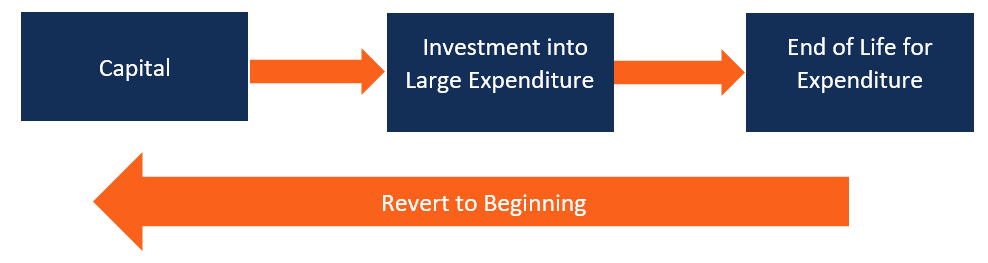
Opening Your Factory: The Long-Term Capital Investment Cycle
Let’s say that you are the owner of a medium-sized businessSmall and Medium-sized Enterprises (SMEs)SMEs, or small and medium-sized enterprises, are defined differently around the world. The country a company operates in provides the that develops and manufactures tennis rackets. You enjoyed several great years of profitability and are actively looking to expand your product line and operations. You realize that the current factory that you own is at capacity, and instead of attempting to outsource or contract out manufacturing, you decide to invest in the creation of a new factory to increase your manufacturing capacity.
Congrats! You’ve entered a major phase of the long-term capital investment cycle. The large capital expenditure will likely take place over many years while the factory is built. It does not stop there, however. The machinery needed to make the factory work like a manufacturing facility is also a part of the long-term capital investment cycle. The machines inherently come with shorter operational cycles, all of which make up the capital investment cycle.
In the case of our example, they can be assembly lines, plastic manufacturing machines, as well as different tools and dye pieces required to make the factory operational. All the machines will come with various operational cycles that exist within the larger capital investment cycle; that is, the manufacturing of a factory.
Risks within the Long-Term Capital Investment Cycle
Because of the very nature of a large capital expenditure, it may require a company to take on more leverage or divert a significant amount of its assets away from other operations. It can present a risk for a smaller company in terms of liquidity and the overall financial position of the company.
Since capital expendituresCapital ExpendituresCapital expenditures refer to funds that are used by a company for the purchase, improvement, or maintenance of long-term assets to improve, such as building a new factory, are cash-intensive and require a lot of time to see a return on investment, it can present some short-term risk if the economy were to enter a recession.
Adverse market conditions present a large risk component for any company when deciding on the contents of a long-term capital investment cycle. Even larger companies need to be cautious that they do not invest too much in setting up operations globally too quickly; a pitfall many retailers fall into.
Key Takeaway
Now that you understand what the long-term capital investment cycle is, we can better understand that when we understand the smaller operational cycles within a larger operational cycle, we, as managers and business decision-makers, are more empowered with another tool in our belt.
Related Readings
CFI is the official provider of the global Commercial Banking & Credit Analyst (CBCA)™Program Page - CBCAGet CFI's CBCA™ certification and become a Commercial Banking & Credit Analyst. Enroll and advance your career with our certification programs and courses. certification program, designed to help anyone become a world-class financial analyst. To keep advancing your career, the additional resources below will be useful:
- Business Life CycleBusiness Life CycleThe business life cycle is the progression of a business in phases over time, and is most commonly divided into five stages
- Corporate StrategyCorporate StrategyCorporate Strategy focuses on how to manage resources, risk and return across a firm, as opposed to looking at competitive advantages in business strategy
- Industry AnalysisIndustry AnalysisIndustry analysis is a market assessment tool used by businesses and analysts to understand the complexity of an industry. There are three commonly used and
- Non-Profit Business PlanNon-Profit Business PlanA non-profit business plan is simply a roadmap of the non-profit organization that outlines its goals and objectives, how it can achieve its stated purpose
-

Venture Capital: Funding Startups & Understanding Equity
Venture capital is a form of financing that provides funds to early-stage, emerging companies with high growth potential, in exchange for equity Stockholders EquityStockholders Equity (also known as S
-
Holding Period Return (HPR): Definition & Calculation
The Holding Period Return (HPR) is the total return on an assetTypes of AssetsCommon types of assets include current, non-current, physical, intangible, operating, and non-operating. Correctly identif
finance
- Equity Capital Market: Definition & How It Works
- Understanding Net Investment: A Key Metric for Business Growth
- Capital Preservation: A Guide to Protecting Your Investments
- Nasdaq Capital Market: A Guide to Small-Cap Investing
- Understanding the Accounting Cycle: A Comprehensive Guide
- Understanding the Accounting Reporting Cycle: A Comprehensive Guide
- Understanding Long-Term Capital Gains Tax: Rates & Strategies
- Capital Budgeting: Evaluating Investments for Business Growth
- Top Long-Term Investments: Stocks vs. Alternatives | GRS
-
 Cost of Capital: Definition, Calculation & Importance
Cost of capital is the minimum rate of returnInternal Rate of Return (IRR)The Internal Rate of Return (IRR) is the discount rate that makes the net present value (NPV) of a project zero. In other word...
-
 Understanding Investments: A Beginner's Guide to Growth & Income
A financial investment is any asset or instrument purchased with the intention of selling said asset for a price higher than the purchase price at some future point in time (capital gains), or with th...