
Danish Krone (DKK): Currency Overview, Value & Facts
The Danish Krone is the legal tender of the Kingdom of Denmark – and also of the Faroe Islands and Greenland, two Danish territories. The krone is sometimes referred to by its translation into English – “crown.” It is subdivided into 100 øre, which are comparable to cents in most dollar-denominated currencies.
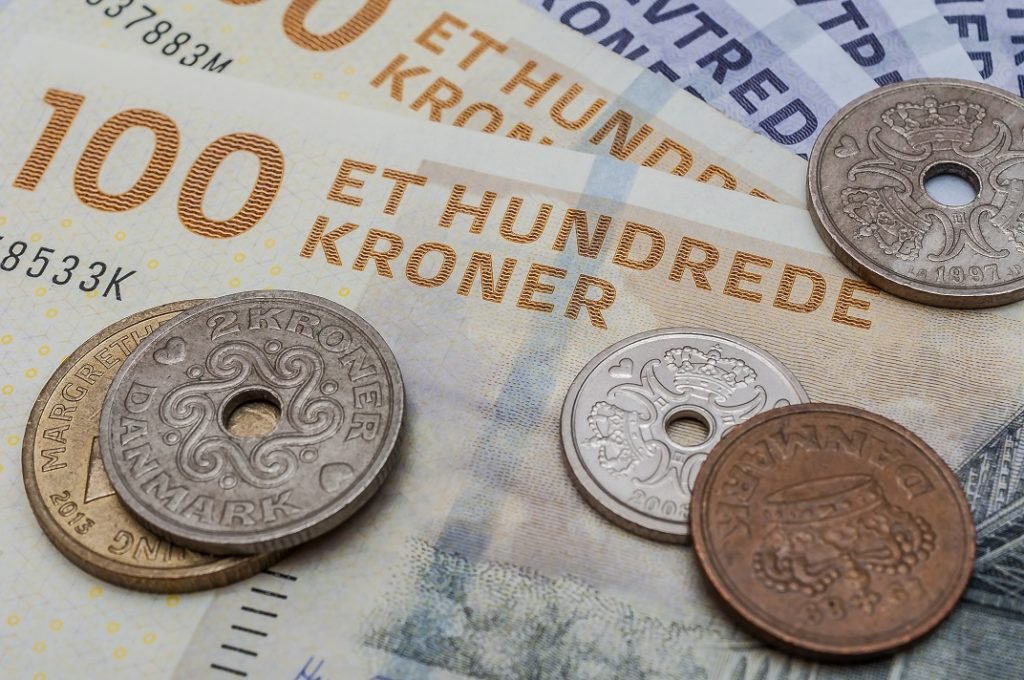
The plural of krone is kroner, not krones. The symbol for the Danish krone is kr. The symbol ordinarily follows, rather than precedes, the stated monetary amount – thus, 50 kroner is expressed as 50kr rather than kr50.
The foreign exchange market designation for the krone is DKK. For example, in late 2020, the currency pairCurrency PairA currency pair is a quotation of two different currencies, where one is quoted against the other. The first listed currency within a currency USD/DKK traded at 6.2246, which means that 6.22 kroner = 1 USD. The most widely traded Danish currency pair is the krone versus the euro – EUR/DKK.
Summary
- The Danish krone is the legal tender of the Kingdom of Denmark – and also of the Faroe Islands and Greenland.
- Coins have been produced in Denmark for more than 15 centuries.
- Over the years, the krone has been variously pegged to gold, to the British pound, and currently, to the euro.
The History of Money in Denmark
The production and use of coins in Denmark go back many centuries. Organized coin minting was going on in Denmark as far back as the 10th century. The earliest official Danish coins were based on the Carolingian silver standard, a basis for silver currency that was created in France during the time of Charlemagne to replace the gold coinage of the Roman Empire. The silver-based monetary system of pennies, shillings, and pounds eventually served as the basis for Great Britain’s British pound sterlingPound Sterling (GBP)The Pound Sterling refers to the national currency of the Isle of Man, the United Kingdom, South Sandwich Islands, Gibraltar, South Georgia,.
Unfortunately, Danish kings followed the practices of many other rulers, enriching themselves by periodically debasing their currency by reducing the actual amount of silver present in minted coins. It led to multiple remonetizations, creating new currencies to try to restore public trust in the nation’s money. One of such events was the creation of the current Danish krone in 1875.
The introduction of the krone came at a time when handling transactions with coins was becoming increasingly cumbersome. Therefore, a transition to greater use of printed banknotes accompanied the implementation of the new currency.
Denmark made multiple attempts to peg its currency to gold but eventually abandoned the effort in 1931, the same year that Great Britain dropped the gold standardGold StandardIn the simplest terms, the gold standard is a monetary system that ties a currency’s value directly with gold. Therefore, the currency can be. During Denmark’s occupation by Germany in World War II, the Danish krone was temporarily pegged to the German Reichsmark. In the immediate postwar world, it was pegged to the British pound.
The krone is currently pegged to the euro, in accord with the European Exchange Rate Mechanism (ERM) II, an exchange rate calculation tool designed to prevent excessive volatility in the euro’s exchange rate with trading partners in Europe. In recent decades, the Danish Kingdom considered joining the eurozone and adopting the euro as its official currency. However, the most recent public referendum, in 2000, rejected that notion by a small margin (53% to 47%).
The central bank of Denmark – the Dansmark Nationalbank – is the monetary authority that oversees the issuance of the country’s currency and exercises control over foreign exchange rates. However, in 2016, the bank made the decision to outsource the actual printing of Danish krone banknotes. The decision was, in part, spurred by decreasing demand for banknotes as fewer and fewer transactions involve physical cash transfers.
Danish Krone Coins and Banknotes
Danish coins currently consist of six denominations: a 50 øre coin (half a krone), 1kr, 2kr, 5kr, 10kr, and 20kr. InflationInflationInflation is an economic concept that refers to increases in the price level of goods over a set period of time. The rise in the price level signifies that the currency in a given economy loses purchasing power (i.e., less can be bought with the same amount of money). has led to smaller value coins being eased out of production over the years, with the 25 øre coin ceasing to be legal tender as of 2008.
Danish coins, in order to make them more easily managed by visually impaired people, are distinguished in color, diameter, weight, and the texture of the coin rims. The color variations roughly correspond to the old system of gold and silver coins – thus, higher-value coins are composed of an aluminum bronze that approximates a gold color, while lower value coins minted from a nickel alloy appear silver.
Both the diameter and weight of coins increase with increasing value amounts. Finally, some coins have smooth edges, while others are textured, and the three middle-value coins – the 1kr, 2kr, and 5kr – have a hole drilled through their center.
The central bank has also issued various commemorative coins, notably including a 2005 series of five different 10kr coins with the theme of fairy tales written by the famous Danish author, Hans Christian Andersen.
Danish krone banknotes have been issued in several different thematic series since 1945, and all are still accepted as legal tender in Denmark. The current 2009 series, which features images of famous bridges in the country, incorporates updated security features, such as holograms and watermarks. Banknotes are printed in five denominations: 50kr, 100kr, 200kr, 500kr, and 1000kr.
More Resources
CFI is the official provider of the global Commercial Banking & Credit Analyst (CBCA)™Program Page - CBCAGet CFI's CBCA™ certification and become a Commercial Banking & Credit Analyst. Enroll and advance your career with our certification programs and courses. certification program, designed to help anyone become a world-class financial analyst. To keep advancing your career, the additional resources below will be useful:
- DevaluationDevaluationDevaluation is a downward adjustment to the country’s value of money relative to a foreign currency or standard. Many countries that operate
- EurozoneEurozoneAll European Union countries that adopted the euro as their national currency form a geographical and economic region known as the Eurozone. The Eurozone forms one of the largest economic regions in the world. Nineteen of the 28 countries in Europe use the euro
- Foreign Exchange RiskForeign Exchange RiskForeign exchange risk, also known as exchange rate risk, is the risk of financial impact due to exchange rate fluctuations. In simpler terms,
- Swiss Franc (CHF)Swiss Franc (CHF)The Swiss franc refers to Switzerland’s national currency and is represented by ISO code CHF. It was formally recognized as Switzerland's
-
Currency Forward Explained: Contracts for Future Exchange Rates
A currency forward is a customized, written contract between parties that sets a fixed foreign currency exchange rate for a transaction that will occur on a specified future date. The future date for
-
Current Ratio: Definition, Calculation & Financial Health
The current ratio, also known as the working capitalNet Working CapitalNet Working Capital (NWC) is the difference between a companys current assets (net of cash) and current liabilities (net of debt)
finance
- Afghan Afghani (AFN): Currency Information & Overview
- Understanding Forex Spreads: A Comprehensive Guide
- Canadian Dollar (CAD): Your Complete Guide to the Canadian Currency
- Indian Rupee (INR): History, Value & Key Facts
- Interbank Market: A Comprehensive Overview of Foreign Exchange Trading
- Philippine Peso (PHP): Your Comprehensive Guide
- Swedish Krona (SEK): Your Comprehensive Guide - Currency & Riksbank
- Understanding the Temporal Method for Currency Translation
- Norwegian Krone (NOK): A Comprehensive Guide - Currency & Value
-
 Understanding Currency Depreciation: Causes & Economic Factors
What Are the Causes of Currency Depreciation? Currency depreciation occurs when the value of a particular currency falls during a specific relative to other world currencies. Factors such as ...
-
 Currency Basket Explained: Diversification & Risk Management
A currency basket is a portfolio of various currencies that are weighted against a chosen currency. The weighted value can be used to determine the market value of a chosen currency or by investors to...