
USD/CAD Currency Pair: Understanding the US Dollar to Canadian Dollar Exchange
The USD/CAD currency pair represents the quoted rate for exchanging US to CAD, or, how many Canadian dollars one receives for every US dollar. For example, a USD/CAD rate of 1.25 means 1 US dollar is equivalent to 1.25 Canadian dollars – or conversely stated, that it takes 1.25 Canadian dollars to equal 1 US dollar. This forex guideForex Trading - How to Trade the Forex MarketForex trading allows users to capitalize on appreciation and depreciation of different currencies. Forex trading involves buying and selling currency pairs based on each currency's relative value to the other currency that makes up the pair. will review factors that impact both currencies and their exchange rates.
Factors that affect the US to CAD exchange rate
The USD/CAD exchange rate is affected by economicEconomicsCFI's Economics Articles are designed as self-study guides to learn economics at your own pace. Browse hundreds of articles on economics and the most important concepts such as the business cycle, GDP formula, consumer surplus, economies of scale, economic value added, supply and demand, equilibrium, and more and political forces on both sides of the border. Below we will analyze factors that commonly impact each country.
Factors impacting the USD:
- Interest rates set by the Federal ReserveFederal Reserve (The Fed)The Federal Reserve is the central bank of the United States and is the financial authority behind the world’s largest free market economy. (the “Fed”)
- Gross Domestic Product (GDPGDP FormulaGross Domestic Product (GDP) is the monetary value, in local currency, of all final economic goods and services produced in a country during a) growth rates
- Unemployment rate
- Money supply and the printing of money by the Fed
- International trade agreements, tariffs, and duties
- Balance of paymentsBalance of PaymentsThe Balance of Payments is a statement that contains the transactions made by residents of a particular country with the rest of the world
- Budget deficit and total national debt
- Political events
- Entitlements (Social Security and Medicare)
- Consumer savings and household income rates
- And many more factors (read about 50 different factors)
Factors impacting the CAD:
- Commodity prices (oil, potash, zinc, and others)
- Bank of Canada (BoC) interest rates
- Employment rate and job creation
- Budget deficit and national debt levels
- Politics and international policies
- The quality of Canadian and US relations
- Read more: history of the Canadian dollar
History of the US to CAD Exchange Rate
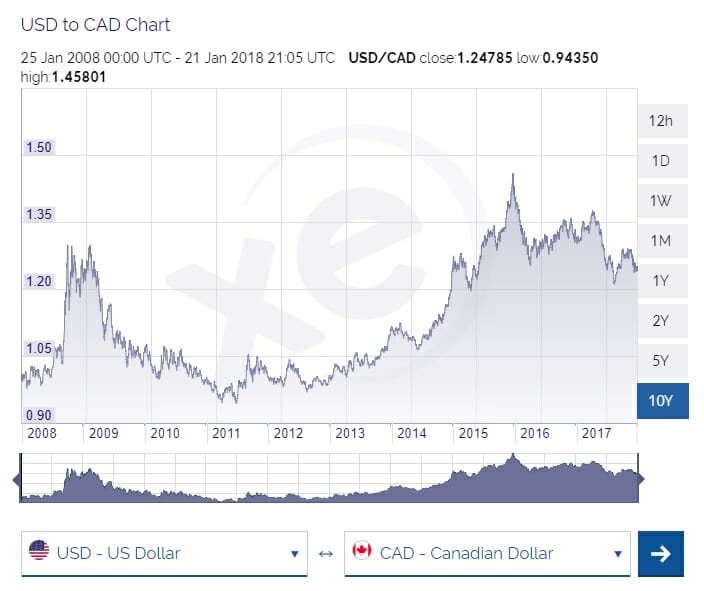
Below is a chart of the US to CAD exchange rate over the last 10 years, from 2008 to 2018. As you will notice, the FX rate has been anywhere between 0.94 and 1.46 over that time period.
The two currencies have been relatively close to each other in value over the past decade. Interestingly during this time period, they have flipped back and forth between which has been the stronger currency. But it was only in the period of 2011-2012 that the Canadian dollar was actually worth more than the US dollar (when the USD/CAD exchange rate briefly dipped below 1.00). From late 2008 – when the full impact of the 2008 financial crisis was hitting the US – to mid 2011, the Canadian dollar was strengthening against the US dollar. Since 2011-2012, however, the USD has shown renewed strength and increased in value relative to the CAD, as shown by the strong uptrend in USD/CAD that drove the exchange rate substantially higher into mid 2015. During that same time period, the US dollar was generally in an uptrend against most of the other major currencies as well.
Impacts of US to CAD on Business and Lifestyle
Since Canada and the US are neighboring countries, the exchange rate has a big impact on business, tourism, and lifestyles.
When the US dollar is stronger, there is some migration of manufacturing and labor outsourcing to Canada in an effort to lower costs. Additionally, there is more importation of goods from Canada into the US, and Americans will be more likely to go on vacation or buy properly in Canada, as it is comparatively cheaper.
The opposite is true when the Canadian dollar is stronger. Firms will tend to import more from the US into Canada and Canadians will be more likely to vacation and buy real estate In America.
Additional Resources
Thank you for reading this guide on the US to CAD exchange rate. CFI is the global provider of the Financial Modeling & Valuation Analyst certificationBecome a Certified Financial Modeling & Valuation Analyst (FMVA)®CFI's Financial Modeling and Valuation Analyst (FMVA)® certification will help you gain the confidence you need in your finance career. Enroll today!, a leading certification for financial analysts. To continue learning and advancing your career in corporate finance, these additional resources will be helpful:
- 5-Step Guide to Winning Forex Trading5-Step Guide to Winning Forex TradingHere are the secrets to winning forex trading that will enable you to master the complexities of the forex market. The forex market is the largest market in the world in terms of the dollar value of average daily trading, dwarfing the stock and bond markets.
- Forex Trading; How to Trade the Forex MarketForex Trading - How to Trade the Forex MarketForex trading allows users to capitalize on appreciation and depreciation of different currencies. Forex trading involves buying and selling currency pairs based on each currency's relative value to the other currency that makes up the pair.
- All Economics ArticlesEconomicsCFI's Economics Articles are designed as self-study guides to learn economics at your own pace. Browse hundreds of articles on economics and the most important concepts such as the business cycle, GDP formula, consumer surplus, economies of scale, economic value added, supply and demand, equilibrium, and more
- Financial Modeling GuideFree Financial Modeling GuideThis financial modeling guide covers Excel tips and best practices on assumptions, drivers, forecasting, linking the three statements, DCF analysis, more
-

Federal Discount Rate: Definition & Importance
The Federal discount rate is the rate that central banks charge banks and deposit-taking institutions that borrow money from the central bank. In the U.S. and other economies throughout the
-

Federal Funds Rate: Understanding Interest Rates & Its Impact
In the United States, the federal funds rate refers to the interest rate that depository institutions (such as banks and credit unionsCredit UnionA credit union is a type of financial organization tha
invest
- Canadian Dollar (CAD): Your Complete Guide to the Canadian Currency
- Understanding Forward Rates: A Comprehensive Guide
- Understanding the Overnight Interest Rate: A Comprehensive Guide
- Prime Rate Explained: Understanding Interest Rates for Businesses & Consumers
- Cross Currency Settlement: A Comprehensive Guide
- Cross Currency Swaps: Definition, Mechanics & Benefits
- Cross-Currency Transactions: Definition & How They Work
- Cross Rates Explained: Understanding Currency Valuation
- Understanding Implied Rates: A Comprehensive Guide
-
 Understanding Coupon Rate: A Key Bond Investment Metric
The coupon rate is the amount of annual interest income paid to a bondholder, based on the face value of the bond. Government and non-government entities issue bondsTrading & InvestingCFIs trading...
-
 Dividend Growth Rate (DGR): Definition & Calculation
The dividend growth rate (DGR) is the percentage growth rate of a company’s dividendDividendA dividend is a share of profits and retained earnings that a company pays out to its shareholders. Wh...