
CFADS Explained: Understanding Cash Flow for Debt Service
Cash Flow Available for Debt Service (CFADS), also commonly referred to as cash available for debt service (CADS), is the amount of cash available to service debt obligations. It takes into account several cash inflows and outflows to give an accurate representation of a project’s ability to generate cash flows and service debt. Financial analysts will often determine CFADS to use as one of the most important metrics in project financeProject Finance - A PrimerProject finance primer. Project finance is the financial analysis of the complete life-cycle of a project. Typically, a cost-benefit analysis is used to models.

Summary
- Cash Flow Available for Debt Service (CFADS) is a measure of how much cash is available to service debt obligations.
- CFADS seeks to be a highly accurate measure of available cash for debt and is used as an input in a number of coverage ratios such as the DSCR, LLCR, and PLCR.
- Calculating CFADS can be done in a number of ways; however, most often starts with either EBITDA or receipts from customers.
Why is Cash Flow Available for Debt Service important?
CFADS is an important metric and acts as a highly accurate gauge of a project’s ability to take on debt and pay it off. CFADS can replace EBITDA and can be used as a component of key financial ratios such as the debt service coverage ratioDebt Service Coverage RatioThe Debt Service Coverage Ratio (DSCR) measures the ability of a company to use its operating income to repay all its debt obligations, including repayment of principal and interest on both short-term and long-term debt. (DSCR), the loan life coverage ratio (LLCR), and the project life coverage ratio (PLCR). Together, the three coverage ratios determine a project’s ability to cover debt over both a period of the project, as well as over the entire lifetime of a project.
Determining CFADS is especially important in project finance, where predicted cash flows must be as accurate as possible. In corporate finance, a commonly referenced ratio to measure the ability to service debt is the times-interest-earned ratio. The metric, however, uses EBITEBIT GuideEBIT stands for Earnings Before Interest and Taxes and is one of the last subtotals in the income statement before net income. EBIT is also sometimes referred to as operating income and is called this because it's found by deducting all operating expenses (production and non-production costs) from sales revenue. as an estimate of cash flow, making this ratio less accurate to use than a coverage ratio that uses CFADS. Cash flows available for debt service is a better indicator of a project’s ability to repay debt because it takes into account the timing of cash flows and the effects of taxes.
How to Calculate Cash Flow Available for Debt Service?
CFADS can be calculated in more than one way. One way in which it is calculated is in a cash flow waterfall model. The cash flow waterfall can start with revenueRevenueRevenue is the value of all sales of goods and services recognized by a company in a period. Revenue (also referred to as Sales or Income) or EBITDAEBITDAEBITDA or Earnings Before Interest, Tax, Depreciation, Amortization is a company's profits before any of these net deductions are made. EBITDA focuses on the operating decisions of a business because it looks at the business’ profitability from core operations before the impact of capital structure. Formula, examples and will net out all cash outflows and inflows in the order that they occur. They can include items such as operating revenues, operating expenses, capital expendituresCapital ExpenditureA capital expenditure (“CapEx” for short) is the payment with either cash or credit to purchase long term physical or fixed assets used in a, taxes, and funding. Alternatively, you can start with receipts from customers and net this against any outflows to arrive at CFADS.
The following show two common ways to calculate CFADS:
1. Starting with EBITDA
- Adjust for changes in net working capitalNet Working CapitalNet Working Capital (NWC) is the difference between a company's current assets (net of cash) and current liabilities (net of debt) on its balance sheet.
- Subtract spending on capital expenditures
- Adjust for equity and debt fundingDebt vs Equity FinancingDebt vs Equity Financing - which is best for your business and why? The simple answer is that it depends. The equity versus debt decision relies on a large number of factors such as the current economic climate, the business' existing capital structure, and the business' life cycle stage, to name a few.
- Subtract taxes
2. Starting with Receipts from Customers
- Subtract payments to suppliers and employees
- Subtract royalties
- Subtract spending on capital expenditures
- Subtract taxes
How is Cash Flow Available for Debt Service Used in Financial Analysis?
As mentioned before, CFADS is often calculated using a cash flow waterfall model. The waterfall model is important in determining an accurate amount of cash flow available for debt servicing. From there, CFADS can be further analyzed in the waterfall model and broken down into cash flow available for senior debtSenior DebtSenior Debt is money owed by a company that has first claims on the company’s cash flows. It is more secure than any other debt, such as subordinated debt, junior debtJunior TrancheA junior tranche is an unsecured debt that ranks lower in repayment priority than other debts in the event of default. It is also referred to as subordinated debt., and equityFree Cash Flow to Equity (FCFE)Free cash flow to equity (FCFE) is the amount of cash a business generates that is available to be potentially distributed to shareholders. It is calculated as Cash from Operations less Capital Expenditures. This guide will provide a detailed explanation of why it’s important and how to calculate it and several.
After calculating CFADS, it can be graphed against interest and principal repayments to determine if there is sufficient cash flow available to pay this debt obligation. CFADS can also be input into several coverage ratiosCoverage RatioA Coverage Ratio is used to measure a company’s ability to pay its financial obligations. A higher ratio indicates a greater ability to meet obligations and used to analyze the project. Assessing a coverage ratio, such as the debt service coverage ratio, over a period of time can give insight as to whether there is enough cash to settle debt obligations in each period of the project.
Calculating Cash Flow Available for Debt Service (CFADS) – Worked Example
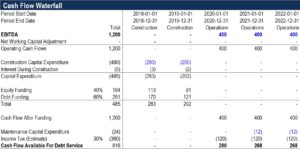
The following shows an example of how CFADS might be calculated using a cash flow waterfall modelWaterfall Chart TemplateThis waterfall chart template guides you step-by-step to construct a waterfall chart using raw data. Waterfall chart is a great way to visually show the effect of positive and negative cash flows, on a cumulative basis. In Excel 2016, there is a built-in waterfall chart option so it is a very simple and quick process. starting with EBITDA:
If you would like to learn more about financial modeling, check out CFI’s Financial Modeling Courses.
Additional Resources
CFI offers the Financial Modeling & Valuation Analyst (FMVA)®Become a Certified Financial Modeling & Valuation Analyst (FMVA)®CFI's Financial Modeling and Valuation Analyst (FMVA)® certification will help you gain the confidence you need in your finance career. Enroll today! certification program for those looking to take their careers to the next level. To keep learning and developing your knowledge base, please explore the additional relevant resources below
- Project FinanceProject Finance - A PrimerProject finance primer. Project finance is the financial analysis of the complete life-cycle of a project. Typically, a cost-benefit analysis is used to
- Debt Service Coverage RatioDebt Service Coverage RatioThe Debt Service Coverage Ratio (DSCR) measures the ability of a company to use its operating income to repay all its debt obligations, including repayment of principal and interest on both short-term and long-term debt.
- Waterfall Chart TemplateWaterfall Chart TemplateThis waterfall chart template guides you step-by-step to construct a waterfall chart using raw data. Waterfall chart is a great way to visually show the effect of positive and negative cash flows, on a cumulative basis. In Excel 2016, there is a built-in waterfall chart option so it is a very simple and quick process.
- Senior and Subordinated DebtSenior and Subordinated DebtIn order to understand senior and subordinated debt, we must first review the capital stack. Capital stack ranks the priority of different sources of financing. Senior and subordinated debt refer to their rank in a company's capital stack. In the event of a liquidation, senior debt is paid out first
-

Understanding Cash Flow from Investing Activities: A Comprehensive Guide
Cash Flow from Investing Activities is the section of a company’s cash flow statementCash Flow StatementA cash flow Statement contains information on how much cash a company generated and
-
Understanding Cash Flow from Operations: A Comprehensive Guide
Cash flow from operations is the section of a company’s cash flow statementCash Flow StatementA cash flow Statement contains information on how much cash a company generated and used duri
finance
- Cash Debt Coverage Ratio: Definition & Calculation
- Understanding Cash Flow: A Comprehensive Guide
- CFADS Explained: Understanding Cash Flow for Debt Service
- Cash Flow to Debt Ratio: Understanding and Calculation
- Understanding Conventional Cash Flow: Definitions and Examples
- Understanding Unconventional Cash Flow: A Comprehensive Guide
- Understanding Cash Flow from Financing Activities: A Comprehensive Guide
- Understanding Incremental Cash Flow: A Business Guide
- Understanding Cash Available for Debt Service (CADS)
-
 Understanding the Debt Service Reserve Account (DSRA)
The Debt Service Reserve Account (DSRA), which is a component of a debt service fund, is a reserve account used to pay interest and principal amounts of debt. The DSRA is very important when the cash ...
-
 Understanding Funds Available for Distribution (FAD) in REITs
Funds available for distribution (FAD), also known as cash available for distribution, is used in reference to REIT investing. It shows the amount of net earnings of a REIT that will be distributed to...