
Understanding the Debt Service Reserve Account (DSRA)
The Debt Service Reserve Account (DSRA), which is a component of a debt service fund, is a reserve account used to pay interest and principal amounts of debt. The DSRA is very important when the cash flow available for debt services (CFADS)Cash Flow Available For Debt Service (CFADS)Cash Flow Available for Debt Service (CFADS) is an accurate indicator of a project's ability to generate cash flows and pay off debt obligations. is below the necessary amount to make the payments.
In the case of a credit agreement, the lender will more than likely impose a clause that requires a DSRA, with a balance that must be periodically restored to a minimum amount. The minimum amount is often contingent on the amount of interest and principal remaining.

Purpose of the Debt Service Reserve Account
The Debt Service Reserve Account acts as a safety measure to ensure that the necessary payments to lenders can be met. It is an important part of project financingProject Finance - A PrimerProject finance primer. Project finance is the financial analysis of the complete life-cycle of a project. Typically, a cost-benefit analysis is used to and is commonly used to ensure the borrower gets the flexibility to resolve problems or restructure their debt during times where the debt service coverage ratioDebt Service Coverage RatioThe Debt Service Coverage Ratio (DSCR) measures the ability of a company to use its operating income to repay all its debt obligations, including repayment of principal and interest on both short-term and long-term debt. is below 1. The DSRA can be very important to lenders who are worried about borrowers defaulting on payments.
Summary
- The Debt Service Reserve Account (DSRA) is a reserve used to make debt repayments when the cash flow available to service debt is too low.
- The DSRA is a safety measure that gives the borrower time to deal with a lack of cash flow available to service debt and prevents them from defaulting.
- The DSRA target and funding method is important in project finance, and details can be found in the project term sheet and within the credit agreement.
Importance of a Debt Service Reserve Account in Project Finance
The Debt Service Reserve Account commonly exists in project finance. It is especially true for non-recourse project financing, where the lender is only entitled to repayments of profits from the funded project. The DSRA is often created once the loan becomes repayable, such as after the construction of a project.
If the project’s cash flows available for debt servicing are not enough to meet the debt obligationsDebt CapacityDebt capacity refers to the total amount of debt a business can incur and repay according to the terms of the debt agreement., the debt service reserve account is credited. Often, within the credit agreement, the debt service account is required by the borrower for the benefit of the agent.
How to Calculate the DSRA Amount
The DSRA target balance can be decided in a number of ways and takes both the interest paymentsInterest ExpenseInterest expense arises out of a company that finances through debt or capital leases. Interest is found in the income statement, but can also and principal paymentPrincipal PaymentA principal payment is a payment toward the original amount of a loan that is owed. In other words, a principal payment is a payment made on a loan that reduces the remaining loan amount due, rather than applying to the payment of interest charged on the loan. into account. In general, the DSRA must meet a required minimum balance and will be restored according to terms in the credit agreement.
The funding method can be set as periodic intervals dependent on the debt servicing time span, or it can be a fixed amount on a set date. You can generally find the funding method stated in the project term sheetTerm Sheet GuideThis term sheet guide will teach you all the important information you need to know about term sheets with detailed examples of all major sections and.
Examples of different clauses within a credit agreement pertaining to the DSRA follows:
- “Following the conversion date, on the first fiscal quarter end, the borrower shall deposit an amount no less than one-fifth of the principal and interest due into the debt service reserve account. From time to time afterward, additional or lesser amounts shall be deposited to account for changes in the amount due.”
- “On the closing date, the borrower shall deposit an amount equal to five million dollars into the debt service reserve account.”
- “Within six months of the end of each fiscal year, the various subaccounts within the debt service reserve account must be restored to at least the required amount.”
- “In the debt service fund, there will be maintained the debt service payment account and the debt service reserve account. In the occurrence of an event of default, money in the debt service reserve account may be transferred to the debt service payment account to be used to pay debt service charges with respect to the debt obligations.”
- “If a debt service charge falls due, and the subaccount within the debt service payment account is insufficient to meet the debt service charge, the trustee will transfer an amount sufficient to make up the deficiency. It will be from the appropriate subaccount within the debt service reserve account.”
Note: The example clauses above are only for educational purposes and should not be used for any other purpose.
How to Account for the DSRA in a Financial Model
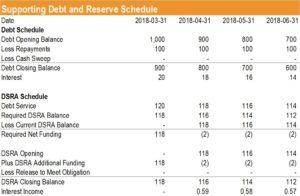
The DSRA and funding method are important to consider when creating a financial modelWhat is Financial ModelingFinancial modeling is performed in Excel to forecast a company's financial performance. Overview of what is financial modeling, how & why to build a model. for a project. The funding of the DSRA, as well as the use of this reserve account, will affect cash inflows and outflows.
Building out a debt and reserve schedule can be very useful in determining how the DSRA will affect the cash flows of a project. Following is an example of a debt and reserve schedule:
If you would like to learn more about financial modeling, check out CFI’s Financial Modeling Courses.
Additional Resources
CFI is the official provider of the global Financial Modeling & Valuation Analyst (FMVA)™Become a Certified Financial Modeling & Valuation Analyst (FMVA)®CFI's Financial Modeling and Valuation Analyst (FMVA)® certification will help you gain the confidence you need in your finance career. Enroll today! certification program, designed to help anyone become a world-class financial analyst. To keep advancing your career, the additional resources below will be useful:
- Project FinanceProject Finance - A PrimerProject finance primer. Project finance is the financial analysis of the complete life-cycle of a project. Typically, a cost-benefit analysis is used to
- Debt CapacityDebt CapacityDebt capacity refers to the total amount of debt a business can incur and repay according to the terms of the debt agreement.
- Debt Service Coverage RatioDebt Service Coverage RatioThe Debt Service Coverage Ratio (DSCR) measures the ability of a company to use its operating income to repay all its debt obligations, including repayment of principal and interest on both short-term and long-term debt.
- Debt vs. Equity FinancingDebt vs Equity FinancingDebt vs Equity Financing - which is best for your business and why? The simple answer is that it depends. The equity versus debt decision relies on a large number of factors such as the current economic climate, the business' existing capital structure, and the business' life cycle stage, to name a few.
-

Understanding EBT Cash Accounts: Benefits & How They Work
EBT cards are used for food and cash benefits. Electronic Benefits Transfer, or EBT, is a system provided by various governmental agencies throughout the United States to provide food stamp a
-

Debt Snowball Method: A Step-by-Step Guide to Debt Freedom
The debt snowball method uses quick payoffs as a motivation to continue and pay off debt quickly. You take all of your debts and pay the minimum payment amounts on all debts, except one. You foc
finance
- Cash Flow to Debt Ratio: Understanding and Calculation
- Debt Service Coverage Ratio (DSCR): Definition & Calculation
- Debt-to-Asset Ratio: Definition, Calculation & Significance
- Debt-to-Assets Ratio: Definition, Calculation & Risk Assessment
- Debt-to-Equity Ratio: Definition, Calculation & Importance
- Net Debt to EBITDA Ratio: Understanding Financial Leverage
- Federal Reserve Board (FRB): Role & Responsibilities Explained
- Reserve Ratio Explained: Understanding Bank Reserves
- ACATS Explained: Seamless Account Transfers for Investors
-
 Understanding Charged-Off Credit Card Accounts: What Happens Next?
When credit card bills go unpaid, the past due balance becomes continuously delinquent. When credit card bills go unpaid, the past due balance becomes continuously delinquent. The likelihood ...
-
 Understanding IBAN: Your Guide to International Bank Account Numbers
The International Bank Account Number – typically referred to as IBAN – is a system of identification for bank accounts that is used across national borders. Internationally agreed upon, t...