
Nominal Interest Rate Explained: Definition & Implications
The nominal interest rate refers to the rate of interest before adjusting for inflationInflationInflation is an economic concept that refers to increases in the price level of goods over a set period of time. The rise in the price level signifies that the currency in a given economy loses purchasing power (i.e., less can be bought with the same amount of money).. It also refers to the rate specified in the loan contract without adjusting for compounding. The nominal interest rate is in contrast to the real interest rate regarding the inflation adjustment and effective interest rate regarding the compounding adjustment.

Nominal interest rates can be impacted by different factors, including the demand and supplySupply and DemandThe laws of supply and demand are microeconomic concepts that state that in efficient markets, the quantity supplied of a good and quantity of money, the action of the federal government, the monetary policy of the central bank, and many others.
Central banks implement the short-term nominal interest rate as a tool of monetary policy. During an economic recession, the nominal rate is lowered to stimulate economic activities. During inflationary periods, the nominal rate is raised.
Summary
- In contrast to the real interest rate, the nominal interest rate refers to the rate of interest before adjusting for inflation.
- According to the Fisher Effect, nominal interest rate equals real interest rate plus the expected inflation rate.
- In contrast to effective interest rate, the nominal interest rate refers to the rate specified in the loan contract without adjusting for compounding.
Nominal Interest Rate vs. Real Interest Rate
Interest rate is the cost of borrowing or return of lending due to the time value of moneyTime Value of MoneyThe time value of money is a basic financial concept that holds that money in the present is worth more than the same sum of money to be received in the future. This is true because money that you have right now can be invested and earn a return, thus creating a larger amount of money in the future. (Also, with future. The rate is known as the nominal rate, which is stated in the loan contract. A nominal interest rate contains two parts: a real interest rate and an inflation premium.
As an economy grows with inflation, the purchasing power of each dollar declines over time. Thus, the return that a lender earns for each dollar he lent before is actually lower than the rate stated in the contract. The rate of returnRate of ReturnThe Rate of Return (ROR) is the gain or loss of an investment over a period of time copmared to the initial cost of the investment expressed as a percentage. This guide teaches the most common formulas after adjusting the nominal interest rate for inflation is known as the real interest rate. It is important for a lender to understand the real interest rate of a bond.
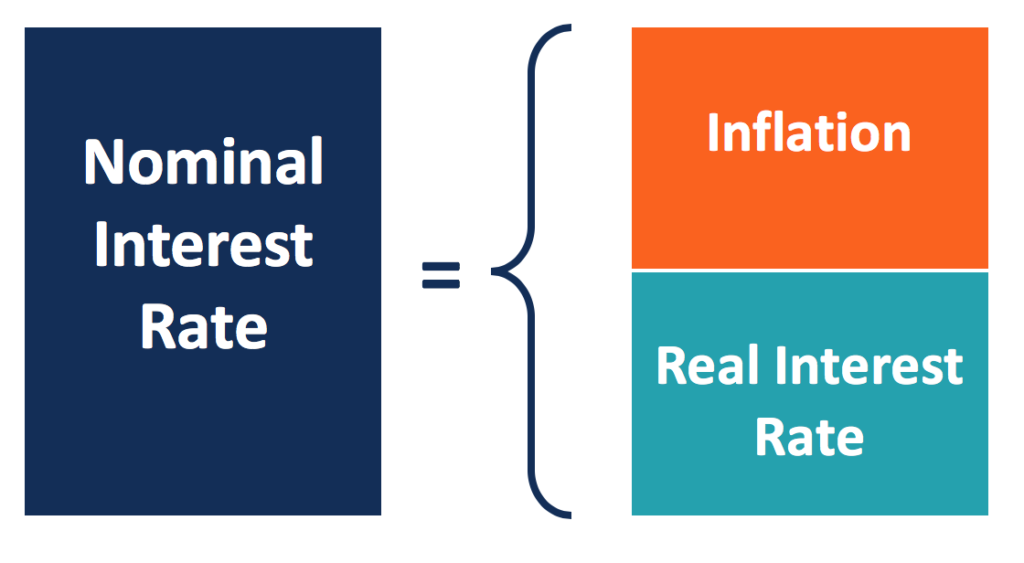
Inflation Adjustment of Nominal Interest Rate
The Fisher Effect describes the relationship between inflation and nominal or real interest rate through the equation below:
(1 + i) = (1 + R) (1 + h)
Where:
- i – Nominal interest rate
- R – Real interest rate
- h – Expected inflation rate
In a stable economy that is growing at a moderate pace, the inflation rate is usually low. With a low inflation rate, a simplified version of the Fisher equation can be implemented. It states that the nominal interest rate is approximately equal to the real interest rate plus the inflation rate (i = R + h).
For example, a bond investor is expecting a real interest rate of 5%, when the market shows an expected inflation rate of 3%. Therefore, the investor should look for a bond with a stated (nominal) interest rate of 8% (5% + 3%).
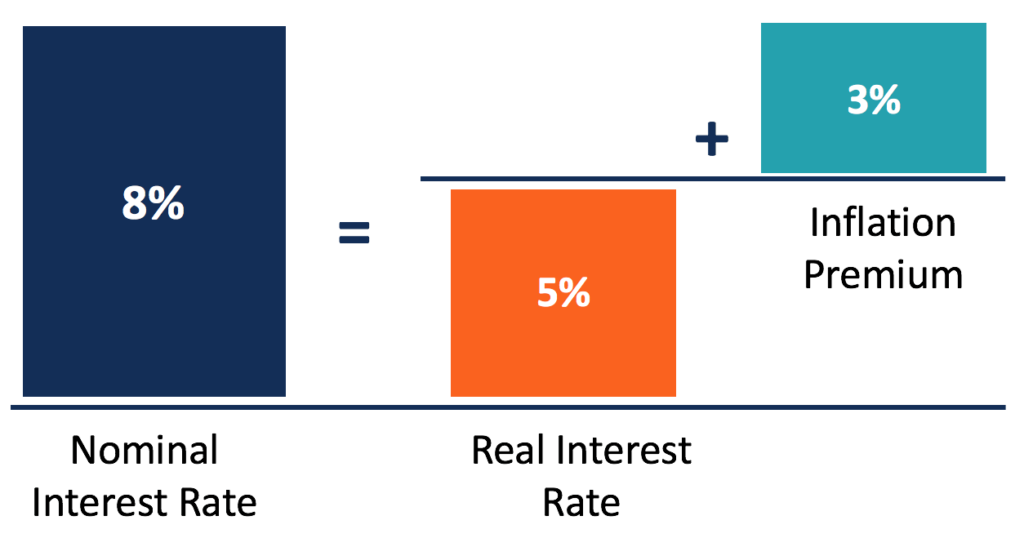
The nominal interest rate can also be calculated through the formula below. The two methods of calculation give a similar result.
i = (1 + R) (1 + h) – 1 = (1 + 5%) (1 + 3%) – 1 = 8.15%
According to the Fisher Effect, if the inflation rate increases and the nominal interest rate remains constant, the real interest rate will fall. The lender’s real return drops as a result of a faster decline in the purchasing power. If the nominal interest rate and expected inflation rate both increase at the same rate, which means the inflation premium is compensated, the real interest rate will remain unchanged.
Nominal Interest Rate vs. Effective Interest Rate
The nominal interest rate refers to the periodic interest rate multiplied by the number of periods in a year. It does not take compounding into account. Therefore, nominal interest rates are not always comparable, unless they include the same compounding periods.
Effective interest rate is considered a more accurate measure of interest. It is calculated based on the nominal interest rate and its compounding periods. Different effective interest rates can be compared directly since they’ve been adjusted to reflect the effect of compounding.
Compounding Adjustment of the Nominal Interest Rate
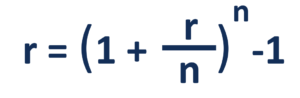
The relationship between a nominal rate and an effective rate with discrete compounding period adjustment is shown below:
If the interest is compounded continuously,

Where:
- i – Nominal interest rate
- r – Effective interest rate
- n – Number of compounding periods per year
- e – Natural log base (2.71828…)
The nominal and effective interest rates are not always different. If the compounding period is exactly one year, the nominal rate and effective rate will be the same. Consider a bond with an annual interest rate of 5%, compounded annually. The nominal interest rate of the bond is 5% (with a periodic rate of 5% and one compounding period per year). The effective interest rate is also 5%.
As long as the compounding period is less than one year, the effective interest rate is greater than the nominal interest rate. At the same nominal rate, the shorter the compounding period (more compounding periods per year), the greater the effective interest rate is, and the continuously compounded bond offers the highest effective rate.
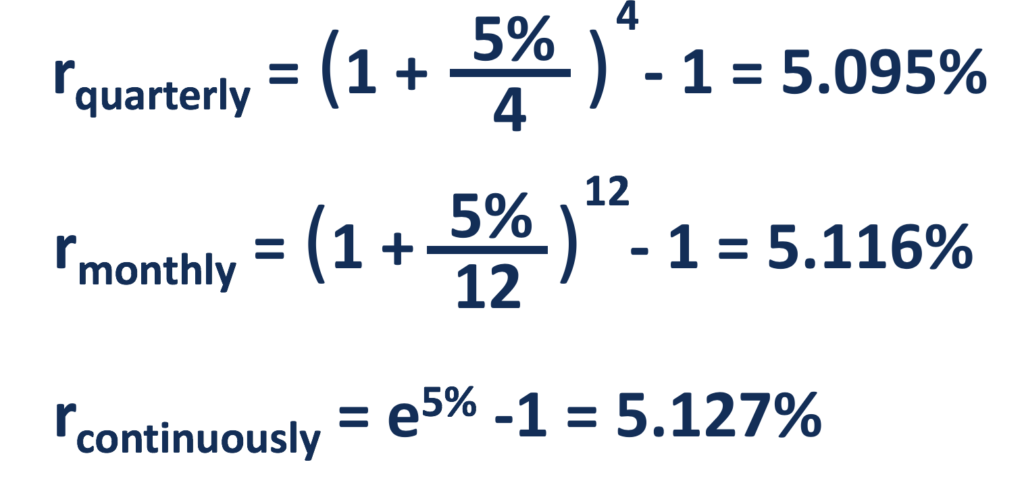
In the example above, the effective rate will be 5.095% if the 5% interest is compounded quarterly, 5.116% for monthly compounding, and 5.127% for continuous compounding. The calculation is shown below:
Additional Resources
CFI is the official provider of the global Commercial Banking & Credit Analyst (CBCA)™Program Page - CBCAGet CFI's CBCA™ certification and become a Commercial Banking & Credit Analyst. Enroll and advance your career with our certification programs and courses. certification program, designed to help anyone become a world-class financial analyst. To keep advancing your career, the additional resources below will be useful:
- Applicable Federal RateApplicable Federal Rate (AFR)The applicable federal rate (AFR) is the interest rate that applies to personal loans. It is the minimum rate applicable to such loans under U.S. law.
- Continuously Compounded InterestContinuously Compounded InterestContinuously compounded interest is interest that is computed on the initial principal, as well as all interest other interest earned. The idea is that the principal will receive interest at all points in time, rather than in a discrete way at certain points in time.
- Effective Annual Interest RateEffective Annual Interest RateThe Effective Annual Interest Rate (EAR) is the interest rate that is adjusted for compounding over a given period. Simply put, the effective
- RecessionRecessionRecession is a term used to signify a slowdown in general economic activity. In macroeconomics, recessions are officially recognized after two consecutive quarters of negative GDP growth rates.
-

Rate of Return vs. Interest Rate: Understanding the Key Differences
The rate of return is an internal measure of the return on money invested in a project. The interest rate is the external rate at which money can be borrowed from lenders. Rate of R
-

Understanding Implied Rates: A Comprehensive Guide
The implied rate is an interest rate that expresses the difference between the forward/future rate and the spot rate. It serves as a useful tool for comparing returns across different assets and can b
finance
- Binomial Interest Rate Tree: Definition, Uses & Applications
- Effective Annual Interest Rate (EAR): Understanding & Calculation
- Effective Annual Rate (EAR): Understanding & Calculation
- Fisher Equation Explained: Understanding Inflation & Interest Rates
- Understanding Interest Rates: A Comprehensive Guide
- Interest Rate Parity (IRP): Understanding the Relationship
- Swap Rate Explained: Understanding Fixed Exchange Rates in Derivatives
- Nominal Rate of Return: Definition & Calculation
- Understanding the Policy Interest Rate: Its Impact on the Economy
-
 Relative Interest Rates: Understanding Their Impact on the Economy
Understanding relative interest rates. Relative interest rates are directly related to a nation's real interest rate and can drastically affect the direction and stability of a nation'...
-
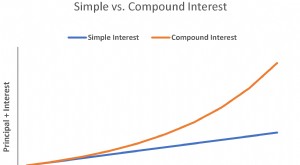 Simple Interest Explained: Calculation, Benefits & Examples
Simple interest is a calculation of interest that doesn’t take into account the effect of compounding. In many cases, interest compounds with each designated period of a loan, but in the c...