
Default Risk Premium: Understanding & Calculation
A default risk premium is effectively the difference between a debt instrument’s interest rate and the risk-free rateRisk-Free RateThe risk-free rate of return is the interest rate an investor can expect to earn on an investment that carries zero risk. In practice, the risk-free rate is commonly considered to equal to the interest paid on a 3-month government Treasury bill, generally the safest investment an investor can make.. The default risk premium exists to compensate investors for an entity’s likelihood of defaulting on their debt.

What determines the default risk premium?
Default risk premiums essentially depend on a company or an individual’s creditworthiness. There are a variety of factors that determine creditworthiness, such as the following:
Credit history
If a person or company has regularly made interest payments on time on past obligations, it signals to lenders that the entity is trustworthy. If the entity has taken on incremental debt obligations (i.e., increasing amounts of debt every time debt was taken on) and managed to stay on top of interest payments, lenders will consider the entity more trustworthy as well.
A good credit history inclines lenders to allow the entity to borrow more money, and at lower interest rates. Because the entity’s probability of default is relatively low, the default risk premium charged will be correspondingly low. The opposite is also true. A poor credit history will make lenders demand a higher default risk premium.
Liquidity and profitability
Lenders may also examine an entity’s financial position. For example, if a business is applying for a loan from a bank, the bank might examine some of the business’ recent financial statements. If the business seems to be generating reliable month-over-month revenue, effectively managing costs and producing profits, banks are more inclined to charge a lower default risk premium.
Examining the business’ balance sheetBalance SheetThe balance sheet is one of the three fundamental financial statements. The financial statements are key to both financial modeling and accounting. and cash flow statementStatement of Cash FlowsThe Statement of Cash Flows (also referred to as the cash flow statement) is one of the three key financial statements that report the cash provides insight into the business’ liquidity and ability to meet monthly interest payment obligations. Conversely, poor liquidity and profitability will solicit a higher default risk premium.
Asset ownership
Assets make borrowers attractive to banks, as the loans can be collateralized against them. For example, if a business owns a $5-million building and would like to take on a $5 million loan to finance its operations, a bank might use the building as collateral. In such a situation, the bank would be able to claim ownership of the building in the event that the business was no longer able to make the loan repayments.
Collateralization commonly underpins mortgage agreements. Banks can take ownership of a property if the borrower fails to make the loan payments. Owning lots of collateralizable assets usually enables borrowers to secure larger loans, but may not directly affect the default risk premium.
What are the components of an interest rate?
From the perspective of a bond investor, the minimum required return he/she will expect is equal to the sum of the following:
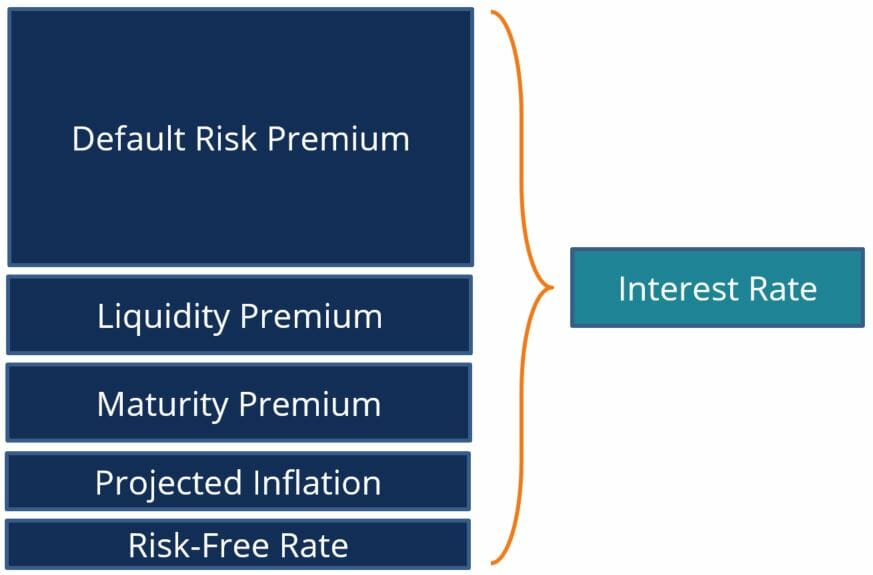
- Default Risk Premium – compensates investors for the business’ likelihood of default
- Liquidity Premium – compensates investors for investing in less liquid securities such as bonds
- Maturity Premium – compensates investors for the risk that bonds that mature many years into the future inherently carry more risk
- Projected InflationInflationInflation is an economic concept that refers to increases in the price level of goods over a set period of time. The rise in the price level signifies that the currency in a given economy loses purchasing power (i.e., less can be bought with the same amount of money). – accounts for the devaluation of currency over time
- Risk-free RateRisk-Free RateThe risk-free rate of return is the interest rate an investor can expect to earn on an investment that carries zero risk. In practice, the risk-free rate is commonly considered to equal to the interest paid on a 3-month government Treasury bill, generally the safest investment an investor can make. – refers to the rate of return an investor can expect on a riskless security (such as a T-bill)
More resources
CFI offers the Financial Modeling & Valuation Analyst (FMVA)™Become a Certified Financial Modeling & Valuation Analyst (FMVA)®CFI's Financial Modeling and Valuation Analyst (FMVA)® certification will help you gain the confidence you need in your finance career. Enroll today! certification program for those looking to take their careers to the next level. To learn more about related topics, check out the following CFI resources:
- Convertible BondConvertible BondA convertible bond is a type of debt security that provides an investor with a right or an obligation to exchange the bond for a predetermined number of shares in the issuing company at certain times of a bond’s lifetime. A convertible bond is a hybrid security
- War BondsWar BondsWar Bonds are debt instrument (bonds) that are issued by governments to finance military operations and production in wartime.
- Equity Risk PremiumEquity Risk PremiumEquity risk premium is the difference between returns on equity/individual stock and the risk-free rate of return. It is the compensation to the investor for taking a higher level of risk and investing in equity rather than risk-free securities.
- Market Risk PremiumMarket Risk PremiumThe market risk premium is the additional return an investor expects from holding a risky market portfolio instead of risk-free assets.
-

Value at Risk (VaR): Understanding Investment Risk
Value at risk is a method that is used to determine the possible risk of loss for a particular type of investment. This is a strategy that attempts to determine what the worst-case scenario is f
-
Understanding Risk Aversion in Investing: A Beginner's Guide
The term risk aversion is often applied to certain types of investors. Here are the basics of risk aversion and what it means to investors. Risk Aversion The term risk aversion basically means t
finance
- Understanding the Maturity Risk Premium in Fixed-Income Investments
- Risk Premium Explained: Understanding Investment Risk and Return
- Understanding Debt Default: Causes, Consequences, and Prevention
- Understanding Equity Risk Premium: Definition & Calculation
- Liquidity Premium: Definition, Calculation & Investment Implications
- Market Risk Premium: Definition & Calculation | Investopedia
- Understanding Operating Risk: A Key Component of Business Risk
- Understanding Financial Risk: A Comprehensive Guide
- Equity Risk Premium Explained: Understanding Investment Risk & Return
-
 Understanding Inherent Risk: A Key Concept in Risk Management
Inherent risk refers to the natural risk level in a process that has not been controlled or mitigated in risk managementRisk ManagementRisk management encompasses the identification, analysis, and res...
-
 Portfolio Diversification: Reduce Risk & Enhance Returns
Diversification is a technique of allocating portfolio resources or capital to a mix of different investments. The ultimate goal of diversification is to reduce the volatilityVIXThe Chicago Board Opti...