
Dividend Coverage Ratio (DCR): Understanding Financial Health
The Dividend Coverage Ratio, also known as dividend cover, is a financial metric that measures the number of times that a company can pay dividends to its shareholders. The dividend coverage ratio is the ratio of the company’s net incomeNet IncomeNet Income is a key line item, not only in the income statement, but in all three core financial statements. While it is arrived at through divided by the dividend paid to shareholdersStockholders EquityStockholders Equity (also known as Shareholders Equity) is an account on a company's balance sheet that consists of share capital plus.
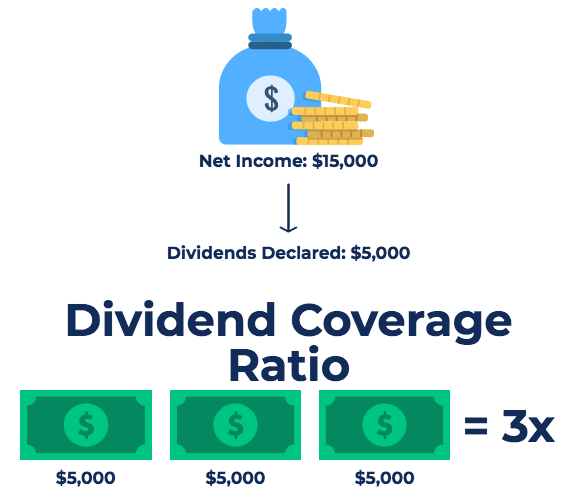
Dividend Coverage Ratio Formula
The general formula for calculating DCR is as follows:
Dividend Coverage Ratio = Net income / Dividend declared
Where:
- Net income is the earnings after all expenses, including taxes, are paid
- Dividend declared is the amount of dividend entitled to shareholders
There are also some modified versions of the dividend coverage ratio, which will be discussed below.
The first variation is used to determine the number of times a company can pay dividends to common shareholders when the company also has preferred sharesCost of Preferred StockThe cost of preferred stock to a company is effectively the price it pays in return for the income it gets from issuing and selling the stock. They calculate the cost of preferred stock by dividing the annual preferred dividend by the market price per share. to take into consideration.
The formula is:
DCR = (Net income – Required preferred dividend payments) / Dividends declared to common shareholders
This variation can also be used to determine the number of times a company can pay dividends to preferred shareholders:
The formula is:
DCR = Net income / Dividends declared to preferred shareholders
Example of Dividend Coverage Ratio
Let’s consider the following example. Company A reported the following figures:
- Profit before tax: $500,000
- Corporate tax rate: 30%
- Dividend to preferred shareholders: $20,000
- Dividend to common shareholders: $25,000
Determine the dividend coverage ratio for preferred and common shareholders:
DCR (Common shareholders) = ($500,000 x 70% – $20,000) / $25,000 = 13.2
DCR (Preferred shareholders) = ($500,000 x 70%) / $20,000 = 17.5

Download the Free Template
Enter your name and email in the form below and download the free template now!
Interpretation of Dividend Coverage Ratio
If the dividend coverage ratio is greater than 1, it indicates that the earnings generated by the company are enough to serve shareholders with their dividends. As a rule of thumb, a DCR above 2 is considered good. A deteriorating DCR or a dividend cover that is consistently below 1.5 may be a cause for concern for shareholders. A consistently low or a deteriorating dividend cover may signal poor company profitability in the future, which may mean the company will be unable to sustain its current level of dividend payouts.
Issues with the Dividend Coverage Ratio
Although DCR is a useful indicator of dividend payment risk to shareholders, there are a couple of key issues with the ratio for investors to consider:
Net income is not actual cash flow
In calculating a company’s DCR, we use net income in the numerator. Net income does not necessarily equal cash flowCash Flow StatementA cash flow Statement contains information on how much cash a company generated and used during a given period.. Therefore, a company may report a fairly high net income but still not actually have the cash available to make dividend payments.
It’s a poor indicator of future risk
Net income can change dramatically from one year to the next. Therefore, calculating a high DCR based on past historical performance may not be a reliable predictor of dividend risk in future years.
Nonetheless, the dividend cover is still commonly used by investors and market analysts to estimate the level of risk associated with receiving dividends from an investment.
Key Takeaways from Dividend Coverage Ratio
In summary, the key points to know about the DCR are:
- The dividend coverage ratio measures the number of times a company can pay its current level of dividends to shareholders.
- A DCR above 2 is considered a healthy ratio.
- A DCR below 1.5 may be a cause for concern.
- The DCR uses net income, which is not actual cash flow. Therefore, even a high net income does not guarantee adequate cash flows to fund dividend payments.
- The DCR is a fairly poor indicator of future risk. Net income can vary greatly from year to year, so looking at a company’s historical DCR is not a definitive measure of future dividend risk.
Additional Resources
CFI is a leading provider of the Financial Modeling & Valuation Analyst (FMVA)™Become a Certified Financial Modeling & Valuation Analyst (FMVA)®CFI's Financial Modeling and Valuation Analyst (FMVA)® certification will help you gain the confidence you need in your finance career. Enroll today! certification program for investment banking professionals. To help you advance your career in the financial services industry, check out the following additional CFI resources:
- Coverage RatiosCoverage RatioA Coverage Ratio is used to measure a company’s ability to pay its financial obligations. A higher ratio indicates a greater ability to meet obligations
- Dividend Payout RatioDividend Payout RatioDividend Payout Ratio is the amount of dividends paid to shareholders in relation to the total amount of net income generated by a company. Formula, example
- Dividends Per Share (DPS)Dividend Per Share (DPS)Dividend Per Share (DPS) is the total amount of dividends attributed to each individual share outstanding of a company. Calculating the dividend per share
- Dividend vs Share Buyback/RepurchaseDividend vs Share Buyback/RepurchaseShareholders invest in publicly traded companies for capital appreciation and income. There are two main ways in which a company returns profits to its shareholders – Cash Dividends and Share Buybacks. The reasons behind the strategic decision on dividend vs share buyback differ from company to company
-

Understanding Ex-Dividend Dates: A Comprehensive Guide
Ex-dividend date represents the date on or after which a security is traded without a previously declared dividend or distribution. The security is said to trade ex-dividend up to the payment da
-

Understanding Dividends: A Guide for Investors
There are advantages and disadvantages relative to investing in stocks with dividends vs stocks without dividends. Dividends are periodic payments made by companies to owners of its stock. They are a
finance
- Asset Coverage Ratio: Understanding Financial Solvency
- Cash Ratio: Understanding Your Company's Short-Term Liquidity
- Constant Dividend Payout Ratio: Definition & Implications
- Understanding Corporations: Definition, Formation & Key Features
- Coverage Ratio: Understanding Your Company's Debt Repayment Ability
- Debt Service Coverage Ratio (DSCR): Definition & Calculation
- Understanding Dividends: A Comprehensive Guide
- Dividend Payout Ratio (DPR): Understanding & Calculation
- Interest Coverage Ratio (ICR): Definition & Importance
-
 Understanding Dividend Yield: A Key Metric for Investors
The Dividend Yield is a financial ratio that measures the annual value of dividends received relative to the market valueMarket CapitalizationMarket Capitalization (Market Cap) is the most recent ...
-
 Equity Ratio: Understanding Financial Leverage & Risk
The equity ratio is a financial metric that measures the amount of leverage used by a company. It uses investments in assets and the amount of equity to determine how well a company manages its debts ...