
EBITDAL Explained: Understanding Earnings Before Interest, Tax, Depreciation, Amortization & Special Losses
EBITDAL stands for Earnings Before Interest, Taxes, Depreciation, Amortization and Special Losses. It is a non-GAAP measure of a company’s earnings that also accounts for special losses that it usually does not expect to incur on a regular basis.
EBITDAL is a variation of EBITDAEBITDAEBITDA or Earnings Before Interest, Tax, Depreciation, Amortization is a company's profits before any of these net deductions are made. EBITDA focuses on the operating decisions of a business because it looks at the business’ profitability from core operations before the impact of capital structure. Formula, examples but is significant in the sense that it also accounts for special losses that a company incurs during the financial year. It helps evaluate a company’s profitability without considering its financing decisions, accounting decisions, unusual and unforeseen expenses and losses, as well as its tax environment.
What are Special Losses?
Special losses can be referred to as sudden or unexpected expenses incurred by an organization during the financial year. They are non-recurring expenses that arise out of unforeseen events or activities. Special losses are not specifically defined by the Financial Accounting Standards Board (FASB) as EBITDAL is not a GAAPGAAPGAAP, Generally Accepted Accounting Principles, is a recognized set of rules and procedures that govern corporate accounting and financial measure.
The losses can be considered as extraordinary or non-recurring items. Special losses can range from unexpected physical destruction on account of a natural disaster to accounting losses brought on by an ill investment decision or the unexpected loss of an asset.
Formula for EBITDAL
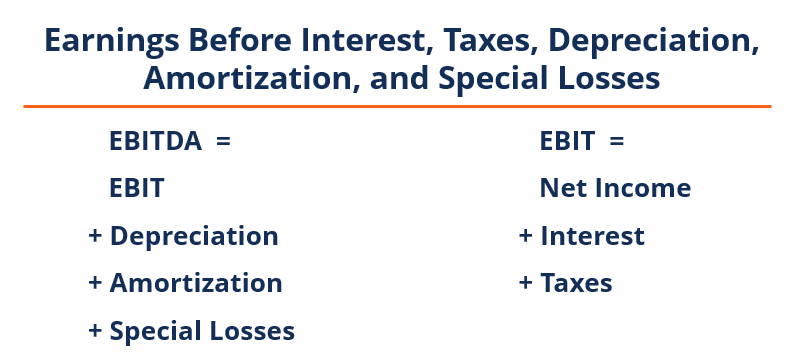
EBITDAL is calculated using the profit and loss or income statementIncome StatementThe Income Statement is one of a company's core financial statements that shows their profit and loss over a period of time. The profit or. It is not a line item on the income statement but is to be derived by using the line items that are accounted for in the statement.
EBITDAL = EBIT + Depreciation + Amortization + Special Losses
Uses of EBITDAL
1. Financial performance
EBITDAL helps measure a company’s financial performance by evaluating its earnings before the inclusion of interest, taxes, depreciationDepreciation MethodsThe most common types of depreciation methods include straight-line, double declining balance, units of production, and sum of years digits., amortization, and special losses.
2. Comparison
EBITDAL eliminates the direct impact of interest, taxes, depreciation and amortization, and special losses. The calculation of EBITDAL facilitates an easier comparison of the operating performance of companies. It helps the users of financial information analyze a company’s operating decisions by eliminating the effects of the above-mentioned expenses.
Limitations of EBITDAL
1. Deceptive measure
EBITDAL can be a deceptive measure of financial performance. It does not take into account important expenses that are applicable to every organization such as interest, taxes, and depreciation. Hence, it may not provide an accurate picture of the financial strength of an organization.
2. Window dressing
EBITDAL is often used as an attempt to window dress financial results because it eliminates major expenses such as interest and tax. It may be used to boost a company’s profitability while comparing its financial strength to other companies.
3. Financial inaccuracy
Since EBITDAL is not regulated by GAAP, it is up to the financial analyst to decide what to include and exclude in its calculation. Such a practice is especially common in the case of special losses. Hence, it can produce inaccurate financial results.
More Resources
CFI is the official provider of the Financial Modeling & Valuation Analyst (FMVA)™Become a Certified Financial Modeling & Valuation Analyst (FMVA)®CFI's Financial Modeling and Valuation Analyst (FMVA)® certification will help you gain the confidence you need in your finance career. Enroll today! certification program for those looking to take their careers to the next level. To keep learning and advancing your career, the following CFI resources will be helpful:
- Analysis of Financial StatementsAnalysis of Financial StatementsHow to perform Analysis of Financial Statements. This guide will teach you to perform financial statement analysis of the income statement,
- EBIT vs EBITDAEBIT vs EBITDAEBIT vs EBITDA - two very common metrics used in finance and company valuation. There are important differences, pros/cons to understand.
- Projecting Income Statement Line ItemsProjecting Income Statement Line ItemsWe discuss the different methods of projecting income statement line items. Projecting income statement line items begins with sales revenue, then cost
- The Ultimate Cash Flow Guide (EBITDA, CF, FCF, FCFE, FCFF)The Ultimate Cash Flow Guide (EBITDA, CF, FCF, FCFE, FCFF)This is the ultimate Cash Flow Guide to understand the differences between EBITDA, Cash Flow from Operations (CF), Free Cash Flow (FCF), Unlevered Free Cash Flow or Free Cash Flow to Firm (FCFF). Learn the formula to calculate each and derive them from an income statement, balance sheet or statement of cash flows
-

Achieve Your Dreams & Financial Freedom: A Practical Guide
Can you really follow your dreams and save for retirement? Can you follow your dreams and pay off credit card debt? What about following your dreams and building up an e
-

Tax Loss Harvesting: Reduce Your Tax Bill with Investment Losses
What is tax loss harvesting? A tax loss is a loss that you can offset with profits in other areas. Tax loss harvesting and tax gain harvesting are tax strategies that you c
finance
- Understanding EBIT: A Guide to Earnings Before Interest & Taxes
- EBITDA: Understanding Earnings Before Interest, Taxes, Depreciation & Amortization
- Understanding Earnings Guidance: A Comprehensive Guide
- Interest Tax Shields: Understanding Tax Deductions on Interest Expense
- Net Interest Income (NII): Definition & Calculation
- Profit Before Tax (PBT): Definition, Calculation & Importance
- Understanding Earnings Before Tax (EBT): Definition & Importance
- EBT vs. Pretax Income: Understanding the Difference
- EBITDA Explained: Understanding Earnings Before Interest, Taxes, Depreciation & Amortization
-
 Understanding MJSD: Financial Reporting Dates for US Public Companies
MJSD is an acronym that stands for the months of March, June, September, and December. The months are the final months of the four annual quarters for releasing financial earnings and declaring divide...
-
 Interest Checking Accounts: Benefits & Are They Right for You?
You can think of a checking account as the workhorse of financial accounts. It’s the account most people use to store the income from their paychecks and use the money to pay bills...