
Federal Discount Rate: Definition & Importance
The Federal discount rate is the rate that central banks charge banks and deposit-taking institutions that borrow money from the central bank.

In the U.S. and other economies throughout the globe, the central bank system plays a role in supporting the stability and liquidityLiquidityIn financial markets, liquidity refers to how quickly an investment can be sold without negatively impacting its price. The more liquid an investment is, the more quickly it can be sold (and vice versa), and the easier it is to sell it for fair value. All else being equal, more liquid assets trade at a premium and illiquid assets trade at a discount. of financial markets. They do this through the implementation of various types of fiscal and monetary policy.
When large commercial banks need to borrow money to support their cash positions and maintain liquidity with regards to retail and consumer finance operations, they turn to the central bank to utilize various types of loans to support their position.
In the U.S., the Federal discount rate is the interest rate that is charged to large central banks by the Federal Reserve to support regional and international financial markets. It is an important part of the discount window in the Federal Reserve system; we will also examine the importance of the relationship between them.
Summary
- The Federal discount rate is the interest rate that is charged to large central banks in the U.S. by the Federal Reserve to support regional and international financial markets.
- The three types of rates are Primary Credit, Secondary Credit, and Seasonal Credit.
- The federal discount rate is an important part of the discount window as a part of the overall Federal Reserve System.
Are There Different Types of Discount Rates?
In the U.S., the Federal Reserve offers different tiers of credit to financial and deposit-taking institutions that come with different discount rates that are fully secured by the Federal Reserve.
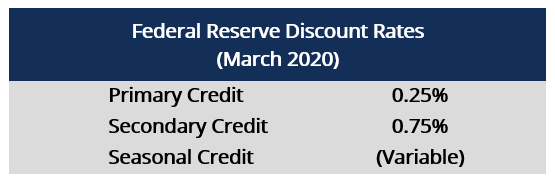
The three types of rates are Primary Credit, Secondary Credit, and Seasonal Credit. Generally, the rate on Secondary Credit is higher than that on Primary Credit, with Seasonal Credit being an average of select market rates. All Federal Reserve banks across different states keep the same rate in each tier.
1. Primary Discount Rate
As of March 2020, the interest rateInterest RateAn interest rate refers to the amount charged by a lender to a borrower for any form of debt given, generally expressed as a percentage of the principal. charged to banks and deposit-taking institutions throughout the US is 0.25%.
2. Secondary Discount Rate
When a financial institution or loan type does not meet the requirements of a primary rate, a rate that is typically half a percentage point higher is charged. Thus, the secondary discount rate in the U.S. is currently 0.75% (March 2020).
3. Seasonal Credit Rate
Seasonal discount rates exist to allow small banks or community credit organizations to meet their often-unique needs. Rural communities require different types of loans for farmers, resort, or vacation workers, as well as communities that primarily consist of students.
The Federal Reserve System provides tailored rates for communities with unique requirements due to unique local economies.
Relationship Between the Discount Window and Discount Rate
To understand how the discount rate in the Federal Reserve System is used, it is critical to understand its relationship with the discount window.
Discount window is the term used to describe the lending done by the Federal Reserve Bank in the U.S. to deposit-taking institutions throughout the country. The window is a figurative term that describes the consistent liquidity between both entities and the free flow of cash between them.
The Federal Reserve bank aims to provide liquidity and access to funds whenever an institution needs it for various purposes.
Ultimately, the consistent flow of capital through the window ends up supporting individuals on main streets by providing greater access to funding for banks, which can, in turn, lend funds out in the form of small business and personal loans.
The discount window allows for greater liquidity in times of economic distress, like recessionsRecessionRecession is a term used to signify a slowdown in general economic activity. In macroeconomics, recessions are officially recognized after two consecutive quarters of negative GDP growth rates. or unforeseen disasters that can help support financial institutions that support the free flow of capital in the general population.
It is seen as critical to maintaining liquidity, as, without it, market turmoil could turn into economic disaster and lead to a longer-term depression of the financial markets.
Additional Resources
CFI offers the Commercial Banking & Credit Analyst (CBCA)™Program Page - CBCAGet CFI's CBCA™ certification and become a Commercial Banking & Credit Analyst. Enroll and advance your career with our certification programs and courses. certification program for those looking to take their careers to the next level. To keep learning and developing your knowledge base, please explore the additional relevant resources below:
- Federal Reserve (The Fed)Federal Reserve (The Fed)The Federal Reserve is the central bank of the United States and is the financial authority behind the world’s largest free market economy.
- Discount RateDiscount RateIn corporate finance, a discount rate is the rate of return used to discount future cash flows back to their present value. This rate is often a company’s Weighted Average Cost of Capital (WACC), required rate of return, or the hurdle rate that investors expect to earn relative to the risk of the investment.
- Lending RatiosLending RatiosLending ratios, or qualifying ratios, are ratios used by banks and other lending institutions in credit analysis. Financial institutions assign a credit score
- Fiscal PolicyFiscal PolicyFiscal Policy refers to the budgetary policy of the government, which involves the government controlling its level of spending and tax rates
-

Understanding AER: Annual Equivalent Rate Explained
The Annual Equivalent Rate (AER) is the rate of interest after taking into account the effects of compounding to normalize the interest rateInterest RateAn interest rate refers to the amount charged b
-
Benefit-Cost Ratio (BCR): Understanding & Calculation
The benefit-cost ratio (BCR) is a profitability indicator used in cost-benefit analysis to determine the viability of cash flows generated from an asset or project. The BCR compares the present value
finance
- Applicable Federal Rate (AFR): Definition & How It Works
- Compound Growth Rate: Definition & Calculation | [Your Brand]
- Discount Rate: Definition, Calculation & Importance in Finance
- Federal Funds Rate: Understanding Interest Rates & Its Impact
- Understanding Forward Rates: A Comprehensive Guide
- Understanding the Overnight Interest Rate: A Comprehensive Guide
- Prime Rate Explained: Understanding Interest Rates for Businesses & Consumers
- Understanding Implied Rates: A Comprehensive Guide
- Prime Rate Explained: Understanding Interest Rates & Its Impact
-
 Understanding Federal Tax Rates on Retirement Pensions
The federal tax rate on pensions is your ordinary income tax rate; however, you'll only be taxed to the extent that you did not contribute any post-tax dollars to the pension fund. The same is tru...
-
 Understanding the Overnight Interest Rate: Impact on the Economy
Overnight rate might sound like the five-dollars-more alternative to the hourly rate for the least reputable hotel in town, but in fact it’s a number that has a profound effect on a country’s entire e...