
Benefit-Cost Ratio (BCR): Understanding & Calculation
The benefit-cost ratio (BCR) is a profitability indicator used in cost-benefit analysis to determine the viability of cash flows generated from an asset or project. The BCR compares the present value of all benefits generated from a project/asset to the present value of all costs. A BCR exceeding one indicates that the asset/project is expected to generate incremental value.
Formula for the Benefit-Cost Ratio
The formula for the benefit-cost ratio is outlined below:
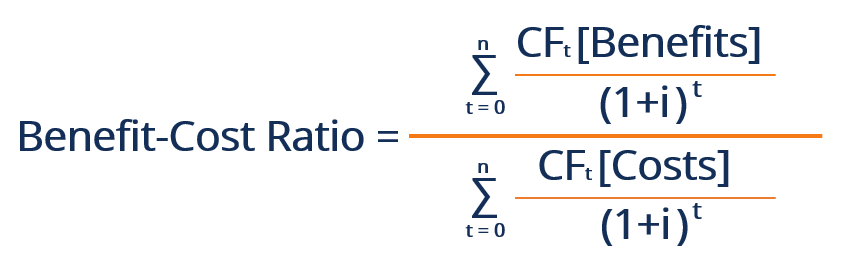
Where:
- CF = Cash flow
- i = Discount rate
- n = Number of periods
- t = Period that the cash flow occurs
Although the formula above may appear complicated, the calculation is simply the discounted cash inflows divided by the discounted cash outflows. The discount rate used refers to the cost of capital, which can be the company’s required rate of returnRequired Rate of ReturnThe required rate of return (hurdle rate) is the minimum return that an investor is expecting to receive for their investment. Essentially, the required rate of return is the minimum acceptable compensation for the investment’s level of risk., the hurdle rate, or the weighted average cost of capital.
Summary
- The benefit-cost ratio is used to determine the viability of cash flows from an asset or project.
- The higher the ratio, the more attractive the project’s risk-return profile.
- Poor cash flow forecasting or an incorrect discount rate would lead to a flawed benefit-cost ratio.
Example of the Benefit-Cost Ratio
Cash flow projections for a project are provided below. The relevant discount rateDiscount RateIn corporate finance, a discount rate is the rate of return used to discount future cash flows back to their present value. This rate is often a company’s Weighted Average Cost of Capital (WACC), required rate of return, or the hurdle rate that investors expect to earn relative to the risk of the investment. is 10%.
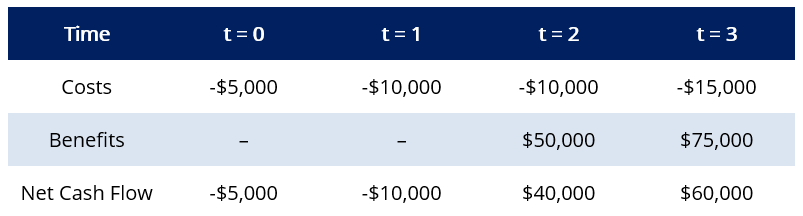
Question: What is the benefit-cost ratio of the project?
Answer:
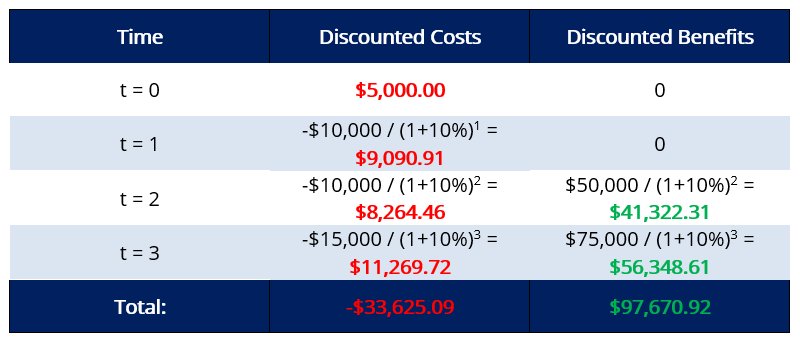
The benefit-cost ratio would be calculated as $97,670.72 / $33,625.09 = 2.90.
Interpreting the Benefit-Cost Ratio
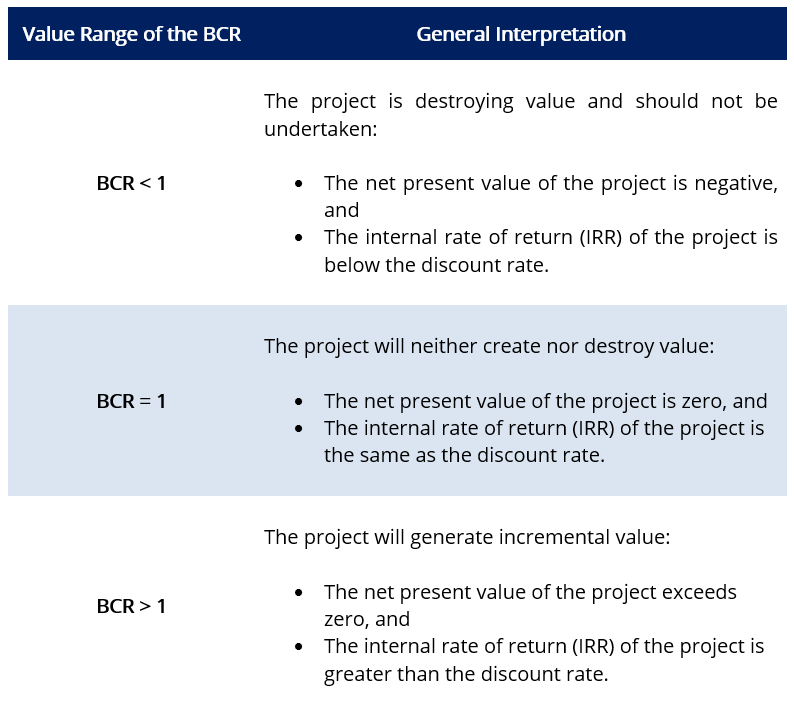
The higher the BCR, the more attractive the risk-return profile of the project/asset. The value generated by the BCR indicates the dollar value generated per dollar cost.
For example, the BCR of 2.90 in the preceding example can be interpreted as “For each $1 of cost in the project, the expected dollar benefits generated is $2.90.” The following shows the value range of the BCR and its general interpretation:
Advantages of the Benefit-Cost Ratio
Key advantages of the benefit-cost ratio include:
- It is a useful starting point in determining a project’s feasibility and whether it can generate incremental value.
- If the inputs are known (cash flows, discount rate), the ratio is relatively easy to calculate.
- The ratio considers the time value of moneyTime Value of MoneyThe time value of money is a basic financial concept that holds that money in the present is worth more than the same sum of money to be received in the future. This is true because money that you have right now can be invested and earn a return, thus creating a larger amount of money in the future. (Also, with future through the discount rate.
- The ratio indicates the value generated per dollar of costs.
Limitations of the Benefit-Cost Ratio
Key limitations of the benefit-cost ratio include:
- The reliability of the BCR depends heavily on assumptions. Poor cash flow forecasting or an incorrect discount rate would lead to a flawed ratio.
- The ratio itself does not indicate the project’s size or provide a specific value on what the asset/project will generate. For example, both projects below show a BCR of 2, but present value cash flows are significantly different:

Final Thoughts
Although the benefit-cost ratio is a simple tool to gauge the attractiveness of a project or asset, it should not be the sole determinant of a project’s feasibility. Other ratios and further analysis are recommended.
The BCR is extremely sensitive to the cash flow forecasts and discount rates. If you think the underlying assumptions are incorrect or biased, the benefit-cost ratio should not be relied on.
More Resources
CFI is the official provider of the Commercial Banking & Credit Analyst (CBCA)™Program Page - CBCAGet CFI's CBCA™ certification and become a Commercial Banking & Credit Analyst. Enroll and advance your career with our certification programs and courses. certification program, designed to transform anyone into a world-class financial analyst.
In order to help you become a world-class financial analyst and advance your career to your fullest potential, these additional resources will be very helpful:
- Analysis of Financial StatementsAnalysis of Financial StatementsHow to perform Analysis of Financial Statements. This guide will teach you to perform financial statement analysis of the income statement,
- Hurdle RateHurdle Rate DefinitionA hurdle rate, which is also known as minimum acceptable rate of return (MARR), is the minimum required rate of return or target rate that investors are expecting to receive on an investment. The rate is determined by assessing the cost of capital, risks involved, current opportunities in business expansion, rates of return for similar investments, and other factors
- Profitability RatiosProfitability RatiosProfitability ratios are financial metrics used by analysts and investors to measure and evaluate the ability of a company to generate income (profit) relative to revenue, balance sheet assets, operating costs, and shareholders' equity during a specific period of time. They show how well a company utilizes its assets to produce profit
- WACCWACCWACC is a firm’s Weighted Average Cost of Capital and represents its blended cost of capital including equity and debt.
-

Federal Discount Rate: Definition & Importance
The Federal discount rate is the rate that central banks charge banks and deposit-taking institutions that borrow money from the central bank. In the U.S. and other economies throughout the
-

Federal Funds Rate: Understanding Interest Rates & Its Impact
In the United States, the federal funds rate refers to the interest rate that depository institutions (such as banks and credit unionsCredit UnionA credit union is a type of financial organization tha
finance
- Current Ratio: Definition, Calculation & Financial Health
- Understanding Forward Rates: A Comprehensive Guide
- Operating Ratio: Definition, Calculation & Importance
- Understanding the Overnight Interest Rate: A Comprehensive Guide
- Prime Rate Explained: Understanding Interest Rates for Businesses & Consumers
- Quick Ratio: Understanding Your Business's Short-Term Liquidity
- Reserve Ratio Explained: Understanding Bank Reserves
- Understanding the Retention Ratio: Reinvesting for Growth
- Sharpe Ratio: Calculate & Interpret Investment Performance
-
 Understanding Debt-to-Income Ratio (DTI): A Comprehensive Guide
The debt-to-income (DTI) ratio is a metric used by creditors to determine the ability of a borrower to pay their debts and make interest payments. The DTI ratio compares an individual’s monthly ...
-
 Dividend Growth Rate (DGR): Definition & Calculation
The dividend growth rate (DGR) is the percentage growth rate of a company’s dividendDividendA dividend is a share of profits and retained earnings that a company pays out to its shareholders. Wh...