
Applicable Federal Rate (AFR): Definition & How It Works
The applicable federal rate (AFR) is the interest rate that applies to personal loans. It is the minimum rate applicable to such loans under U.S. law. The AFR is implemented in the form of federal tax regulations that are enforced by the Internal Revenue Service (IRS).
The applicable federal rate applies to loans where the interest rate is lower than the tax rate if the loan were to otherwise be income. The AFR varies between short, medium, and long-term loans and is subject to flexibility due to market conditions and other macroeconomic factors. The U.S. Internal Revenue Service (IRS) How to Use the IRS.gov WebsiteIRS.gov is the official website of the Internal Revenue Service (IRS), the United States’ tax collection agency. The website is used by businesses andpublishes the rates monthly, and they are made public to serve as a benchmark for lenders throughout the country.
Purpose of the Applicable Federal Rate
The purpose of the applicable federal rate is to avoid tax incidence on a personal loan. A personal loan may be thought of as a taxable gift by the IRS. Hence, the borrower would be taxed as if the loan was a part of their income. So, such a loan cannot be interest-free.
Below-Market Loans
One way to satisfy the interest rate requirement might be to offer a really low interest rate. It will make the loan practically interest-free. It is where the minimum rate requirement comes in. Any loan with a lower interest rate than the corresponding AFR is called a below-market loan.
The difference between the interest rateInterest RateAn interest rate refers to the amount charged by a lender to a borrower for any form of debt given, generally expressed as a percentage of the principal. on the lower rate and the AFR is called the imputed interest. If a lender decides to advance a loan at a lower rate, then they must pay tax on the imputed interest, as it is as income even though there is no actual cash flow.
Rates
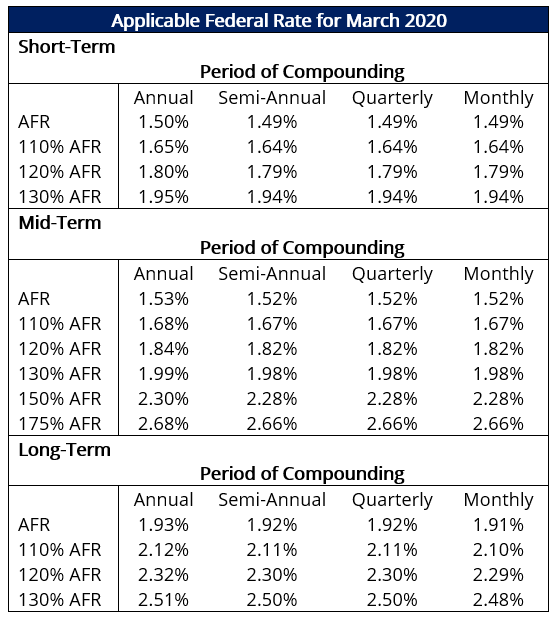
The IRS releases a document every month that enlists the applicable federal rate for different conditions. The key rates are listed based on the term and compounding frequency. Other rates usually are derived from these key rates or are determined by the Department of Treasury. The following tables are part of the IRS document.
1. Key AFR for the Current Month
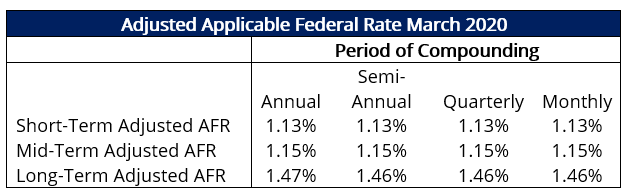
2. Adjusted Rates for Tax-Exempt Obligations
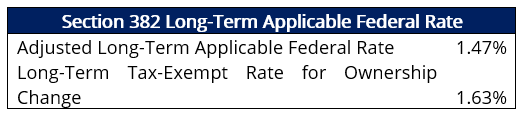
3. Section 382 Rates
The rates are determined using historical key rates. The long-term rate is the same as the adjusted long-term AFR, while in case of ownership change, the rate is the maximum adjusted long-term AFR of the current and past two months.
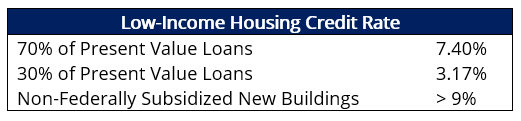
4. Rates for Low-Income Housing Credit
The rates are determined by the Department of Treasury.
5. Rate for Valuation of Annuities
The rate is 120% of the annual mid-term AFR.

Calculation of AFR
The AFR is calculated and set for each month. The IRS puts out a document every month with the listing of the relevant rates for different terms of the loans described below.
There are three types of rates depending on the term of the loan, and rates are determined based on the term:
- Short-term: Less than 3 years
- Mid-term: 3 to 9 years
- Long-term: Greater than 9 years
The law governing the determination of the rates is 26 U.S.C. § 1274(d), which is part of the Internal Revenue Code. The corresponding part of the law is reproduced below:

Put simply, the short-term rate is determined as the average of yield on the marketable debtMarketable SecuritiesMarketable securities are unrestricted short-term financial instruments that are issued either for equity securities or for debt securities of a publicly listed company. The issuing company creates these instruments for the express purpose of raising funds to further finance business activities and expansion. of the United States with a maturity of three years or less over the month preceding the month for which the rate needs to be calculated. Longer-term rates are calculated in a similar way.
The Sale-Leaseback Rule and Exceptions
A leaseback or sale-leaseback transaction is where one sells an asset then leases it back for use. For such transactions, the rule is that 110% of the applicable federal rate shall apply.
There are also exceptions to the application of the AFR in certain transactions. Some of the transactions are listed below:
- Sales of farms by individuals or small businessesSmall and Medium-sized Enterprises (SMEs)SMEs, or small and medium-sized enterprises, are defined differently around the world. The country a company operates in provides the valued at less than $1,000,000
- Sale of principal or primary residences
- Certain sales of patents
- Publicly traded debt
- Other sales as specified by the Internal Revenue Code
More Resources
CFI is the official provider of the global Commercial Banking & Credit Analyst (CBCA)™Program Page - CBCAGet CFI's CBCA™ certification and become a Commercial Banking & Credit Analyst. Enroll and advance your career with our certification programs and courses. certification program, designed to help anyone become a world-class financial analyst. To keep advancing your career, the additional CFI resources below will be useful:
- Federal Funds RateFederal Funds RateIn the United States, the federal funds rate is the interest rate that depository institutions (such as banks and credit unions) charge other depository institutions.
- Floating Interest RateFloating Interest RateA floating interest rate refers to a variable interest rate that changes over the duration of the debt obligation. It is the opposite of a fixed rate.
- LIBORLIBORLIBOR, which is an acronym of London Interbank Offer Rate, refers to the interest rate that UK banks charge other financial institutions for
- Overnight RateOvernight RateThe overnight rate refers to the interest rate that depository institutions (e.g., banks or credit unions) charge each other for overnight lending. Note that the overnight rate is called something different in different countries.
-
Benefit-Cost Ratio (BCR): Understanding & Calculation
The benefit-cost ratio (BCR) is a profitability indicator used in cost-benefit analysis to determine the viability of cash flows generated from an asset or project. The BCR compares the present value
-
Binomial Interest Rate Tree: Definition, Uses & Applications
The binomial interest rate tree is a graphical representation of possible interest rate values at different periods of time, under the assumption that at each time period, the interest rate may either
finance
- Compound Growth Rate: Definition & Calculation | [Your Brand]
- Understanding Coupon Rate: A Key Bond Investment Metric
- Dividend Growth Rate (DGR): Definition & Calculation
- Federal Discount Rate: Definition & Importance
- Federal Funds Rate: Understanding Interest Rates & Its Impact
- Understanding Forward Rates: A Comprehensive Guide
- H-Model Explained: A Quantitative Stock Valuation Method
- Understanding the Overnight Interest Rate: A Comprehensive Guide
- Prime Rate Explained: Understanding Interest Rates for Businesses & Consumers
-
 Understanding Federal Tax Rates on Retirement Pensions
The federal tax rate on pensions is your ordinary income tax rate; however, you'll only be taxed to the extent that you did not contribute any post-tax dollars to the pension fund. The same is tru...
-
 Understanding AER: Annual Equivalent Rate Explained
The Annual Equivalent Rate (AER) is the rate of interest after taking into account the effects of compounding to normalize the interest rateInterest RateAn interest rate refers to the amount charged b...