
What is Financial Compliance?
Financial compliance is the regulation and enforcement of the laws and rules in finance and the capital markets. It ranges through the entire financial spectrum, from investment banking practices to retail banking practices.
`
Why is Financial Compliance Important?
In the aftermath of the 2008 Global Financial Crisis2008-2009 Global Financial CrisisThe Global Financial Crisis of 2008-2009 refers to the massive financial crisis the world faced from 2008 to 2009. The financial crisis took its toll on individuals and institutions around the globe, with millions of American being deeply impacted. Financial institutions started to sink, many were absorbed by larger entities, and the US Government was forced to offer bailouts, financial compliance became a serious matter for regulators and other concerned parties. Adequate financial compliance in 2008 could’ve saved people’s retirement funds, houses, pensions, and decreased the overall magnitude of the recession. Additionally, financial compliance is important in order to maintain the public’s trust in capital markets and the banking system.
Who Oversees Financial Compliance?
Financial compliance covers a broad spectrum. Additionally, financial compliance and regulations vary internationally. Listed below are the important regulators in the United States financial system.
1. The Federal Reserve
The Federal Reserve is the central bank of the United States. The Federal Reserve regulates the monetary policy for the United States. It ensures that inflation is maintained at around 2%, how much money to print, and regulates the federal funds rateFederal Funds RateIn the United States, the federal funds rate is the interest rate that depository institutions (such as banks and credit unions) charge other depository institutions..
The Fed is regulated and managed by a Board of Governors. There are currently five individuals on the board. Compliance and regulation within the Federal Reserve are paramount, as their policies and decisions can greatly impact the nation’s economy.
One way it is achieved is by ensuring that the Federal Reserve is not influenced by other branches of government, such as the Secretary of the Treasury and the President. The independence of the Federal Reserve is of utmost importance to ensure the US economy is stable.
2. Securities and Exchange Commission (SEC)
The Securities and Exchange Commission (SEC) is a regulatory agency that is independent of the government and oversees the United States securities market, monitors security exchanges, and enforces securities lawThe 1933 Securities ActThe 1933 Securities Act was the first major federal securities law passed following the stock market crash of 1929. The law is also referred to as the Truth in Securities Act, the Federal Securities Act, or the 1933 Act. It was enacted on May 27, 1933 during the Great Depression. ...the law was aimed at correcting some of the wrongdoings. When monitoring security exchanges, the SEC looks for signs of front running, trading on public information, fraud, and corporate malfeasance.
The SEC’s main goal is to establish transparency throughout the securities market. An important way in which the federal agency regulates the securities market is by requiring that public companies file quarterly and annual financial reports, which are available to the public.
Also, the SEC monitors rating agenciesRating AgencyA rating agency assesses the financial strength of companies and government entities, especially their ability to meet principal and interest payments such as Standards and Poor’s and Moody’s. The SEC regulates rating agencies to ensure that they maintain the integrity of their ratings; thus, not misleading investors.
3. Federal Deposit Insurance Corporation (FDIC)
The Federal Deposit Insurance Corporation (FDIC) provides deposit insurance of at least $250,000 for accounts with banks and thrift institutions. By providing deposit insurance, the FDIC aims to preserve and promote the public’s confidence in the US financial system.
However, the FDIC only insures deposit accounts such as checking accountsChecking AccountA checking account is a type of deposit account that individuals open at financial institutions for the purpose of withdrawing and depositing money. Also known as a transactional or demand account, a checking account is very liquid. To put it simply, it provides users a quick way of accessing their money., savings accounts, and certificate of deposits (CD’s). It does not insure stocks, bonds, and mutual funds. The FDIC helps with the financial compliance of the US financial system by examining over 4,000 banks for operational safety and soundness.
Additionally, the agency ensures that banks are complying with consumer protection laws, including the Truth-In-Lending Act, the Gramm-Leach-Bliley Act, and the Community Reinvestment Act.
Know Your Client
Know your client (KYC) is a standard practice that entails investment advisors can identify the client they are working with, ensure the client is who they say they are, know the client’s tolerance to risk, and that the advisor is aware of the client’s financial position. A major benefit of KYC is the reduction of fraud.
Additionally, KYC protects clients by informing their advisors of the type of investments that best suit their personal experiences. However, one of the main benefits and uses of KYC is to ensure the financial system is not being used for criminal activities, such as money laundering, fraud, and forgery. KYC compliance is important among financial institutions to maintain trust in all financial systems.
Money Laundering
Money laundering is the act of illegally passing obtained funds through a complex system in order to make the funds appear legitimate and legal. in the United States, the Financial Crimes Enforcement Network (FinCEN) oversees government efforts to combat money laundering. FinCEN detects, prevents, and deters money laundering and terrorist financing.
The organization enforces its mandates by analyzing financial transaction reports, identifying suspicious transaction reports, ensuring compliance of reporting entities, and researching trends and patterns in money laundering and terrorist financing activities.
Examples of Unethical Financial Compliance Practices
The agencies and regulators listed above work to mitigate unethical compliance practices. The following are some unethical practices in the capital markets and banking system:
- Deceiving behavior to distort transaction prices or the value of any security.
- Distorting or attempting to mislead the appearance of public trading in a security.
- Entering an arrangement to attempt to manipulate the market or market prices.
- Not accurately disclosing the magnitude of risk of a security to a client.
- Aggressively pressuring clients into buying or selling securities that are not in their best interest.
Additional Resources
CFI is the official provider of the global Commercial Banking & Credit Analyst (CBCA)™Program Page - CBCAGet CFI's CBCA™ certification and become a Commercial Banking & Credit Analyst. Enroll and advance your career with our certification programs and courses. certification program, designed to help anyone become a world-class financial analyst. To keep advancing your career, the additional CFI resources below will be useful:
- Accounting EthicsAccounting EthicsAccounting ethics is an important topic because, as accountants, we are the key personnel who access the financial information of individuals
- Checking Account vs Savings AccountChecking Accounts vs Savings AccountsA bank client can choose to open checking accounts vs savings accounts depending on several factors, such as purpose, ease of access, or other attributes. A checking account is a type of bank account that is used for everyday transactions. It is the most basic account that banks, credit unions, and small lenders offer.
- Ethical BankingEthical BankingEthical banking involves consciousness of how banking practices affect society and the environment. Financial institutions that engage in ethical banking practices seek profit like any other financial institution. However, they strive to generate earnings without sacrificing principles or causing harm.
- Top Accounting ScandalsTop Accounting ScandalsThe last two decades saw some of the worst accounting scandals in history. Billions of dollars were lost as a result of these financial disasters. In this
-

Understanding Financial Hardship: Causes, Impacts & Relief
Different programs make hardship decisions based on different criteria. Financial hardship usually refers to a situation in which a person cannot keep up with debt payments and bills. This pa
-

Defining Financial Success: Goals & Strategies for a Secure Future
Monetary success is difficult to define in concrete terms. Even though everyone has their own definitions, there is plenty of advice on how to plan for a better financial futu
finance
- Understanding Auditors: Roles, Responsibilities & Audit Processes
- EBITDARM Explained: A Comprehensive Guide to Financial Analysis
- Eurocurrency Explained: What It Is & How It Works
- Factset: Financial Data & Analytics Solutions for Investment Professionals
- Understanding Finance: A Comprehensive Overview of Key Concepts
- Understanding Financial Crises: Causes, Impacts, and Examples
- Financial Engineering: Principles, Applications & Career Paths
- Understanding Your Financial Health: A Comprehensive Guide
- Financial Inclusion: Definition, Benefits & Impact
-
 Financial Analysis: A Comprehensive Guide for Professionals
Financial analysis involves using financial dataFinancial DataWhere to find data for financial analysts - Bloomberg, CapitalIQ, PitchBook, EDGAR, SEDAR and more sources of financial data for financial...
-
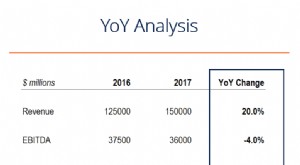 YoY Analysis: Understanding Year-over-Year Growth & Financial Insights
YoY stands for Year over Year and is a type of financial analysisAnalysis of Financial StatementsHow to perform Analysis of Financial Statements. This guide will teach you to perform financial stateme...