
Understanding the Financial Sector: Institutions and Services
The financial sector refers to the businesses and institutions that manage money and provide intermediary services to transfer and allocate financial capital in an economy.
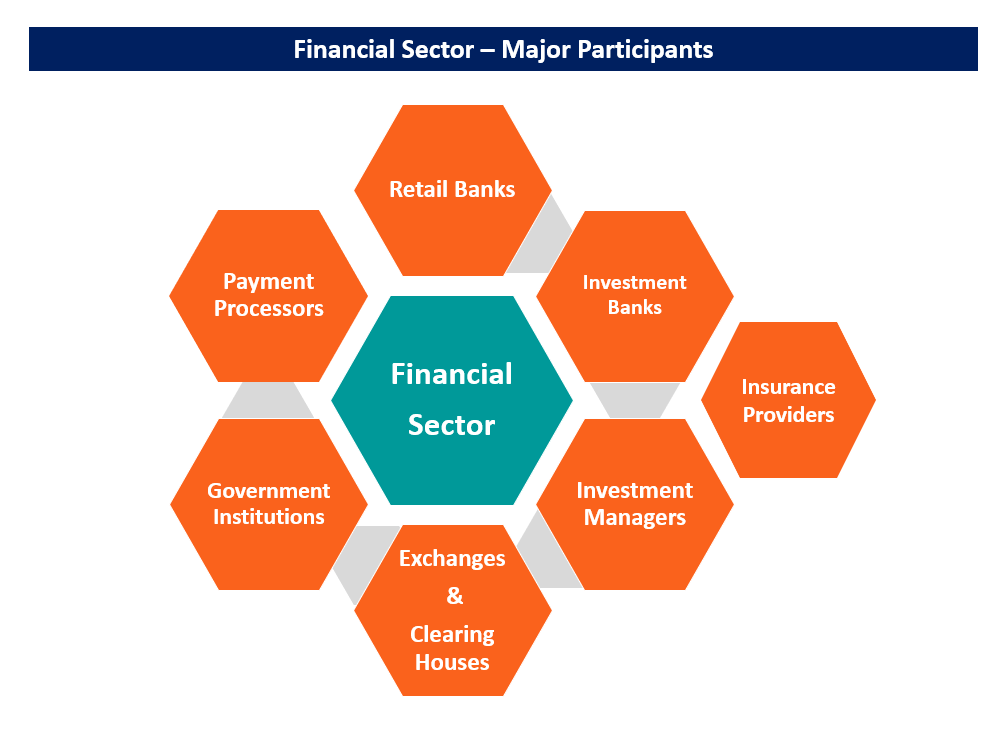
Types of Financial Institutions
The institutions can be broken down into major categories, as follows:
1. Retail Banks
Retail banks are the classic deposit-taking institutions that accept cash deposits from savers and pay interest on those savings. They generate revenue by lending out the deposits to borrowers at a higher interest rate than is paid on savings.
The bank earns the differential between the interest paid on deposits and the interest earned from loans. Some well-known examples of retail banks worldwide are Bank of America, Royal Bank of Canada, BNP Paribas, Mitsubishi UFJ, HDFC Bank. They are also known as commercial banks.
2. Investment Banks
Investment banks are non-deposit-taking institutions. They are primarily focused on the practice of corporate finance. They provide advisory services to businesses to help them raise funds from the financial markets, e.g., helping a company raise equity via an Initial Public Offering (IPO)Initial Public Offering (IPO)An Initial Public Offering (IPO) is the first sale of stocks issued by a company to the public. Prior to an IPO, a company is considered a private company, usually with a small number of investors (founders, friends, family, and business investors such as venture capitalists or angel investors). Learn what an IPO is. They also offer other services like prime brokerage, which are brokerage services like securities lending to large institutional clients.
Investment banks generate revenue primarily through fees earned by providing advisory and underwriting services. They also generate profits through trading in the financial markets.
Most commercial banks oversee an investment banking arm, though more recently, they are required to separate the two business units under the Dodd-Frank Act and other laws. Some well-known investment banks include Morgan Stanley, Barclays, and Goldman Sachs.
3. Investment Managers
Investment managers are professional firms that provide investment management services to individual and institutional clients. They include a variety of players, such as mutual fund and exchange-traded fund (ETF) managers and hedge funds.
Mutual fund and ETF managers primarily serve retail investors by offering pre-packaged investment vehicles. They generate revenue by charging a small fee on managing the total money, also called assets under management.
On the other hand, hedge funds clients are primarily institutions and a few high-net-worth individual investors. The term hedge fund here refers to the many kinds of alternative asset managers like private equity and venture capital, commodity trading advisors (CTAs), highly specialized public markets investors, etc.
Popular examples of investment managers include Fidelity (mutual funds), BlackRock (ETFs), D.E. Shaw (hedge fund), Carlyle Group (private equity).
4. Government Institutions
The government is a major player in the financial markets. Through its various institutions, it regulates the functioning of the markets. The biggest and the most influential government institution in any financial market is the central bank.
A central bank is the sole issuer of legal tender or currency in an economy. It also controls the interest rates in the domestic market and, in many cases, the exchange rate for a currency in the foreign exchange (FX) markets.
Outside of the central banks, some securities regulators lay down the rules that regulate the functioning of financial markets. Securities regulators ensure that the financial markets operate in a fair and transparent fashion. To this end, they require elaborate disclosures from various players in the financial markets to ensure transparency, as well as penalize those who indulge in illegal activities like insider trading.
Some well-known government institutions include the Federal Reserve (central bank), the Securities and Exchange Commission (SEC)Securities and Exchange Commission (SEC)The US Securities and Exchange Commission, or SEC, is an independent agency of the US federal government that is responsible for implementing federal securities laws and proposing securities rules. It is also in charge of maintaining the securities industry and stock and options exchanges, and the Federal Deposit Insurance Commission (FDIC).
5. Exchanges and Clearing Houses
These are venues where the actual trading of financial assets takes place. The most common kind of exchange is the stock exchange. For a stock to be traded on an exchange, it must be listed there.
Stock exchanges set out specific criteria that a company must meet to be listed. They collect orders from different market participants and post them on an order book. As buy and sell orders match, the trades are executed. Today’s electronic exchanges are capable of executing millions of trades per day.
Clearing houses serve a different purpose. They are responsible for settling accounts between various participants in a market. They are common in the derivatives market, where many contracts are cash-settled, i.e., one party pays the other based on the price of the underlying security. It is the job of the clearing house to assign the payer, receiver, and amount of payment.
A clearing house is often referred to as the Central Counterparty Clearing (CCP) party. An example is CME Clearing, the clearing house for the Chicago Mercantile Exchange (CME).
6. Payment Processors
Payment processors are intermediaries that facilitate the exchange of funds between disparate parties. They network various institutions and ensure a secure transfer of funds between them.
Most day-to-day electronic transactions are processed by payment processors. Whenever one uses a debit or credit card, the payment processor securely transmits the transaction information to the user’s bank and routes the funds from the user’s account to the vendor’s account.
Payment processors generate revenue by charging a small fee on every transaction that is routed through their network. Examples of payment processors include Visa, MasterCard, Interac, and American Express.
7. Insurance Providers
Insurance providers encompass another large portion of the financial sector. They provide protection against unforeseen financial losses arising from events like accidents and disasters in exchange for a small premium paid at regular intervals. They serve both individuals and institutions.
In the case of individuals, they provide products like life insurance, health insurance, auto insurance, and house insurance. For businesses, they provide products like marine insurance for goods on ships, data breach insurance, worker’s compensation insurance, etc.
There are also reinsurance companies that provide insurance to insurance companies. They help cover an insurance firm’s liabilities in case of a major disaster. Examples of insurance companies include Manulife and MunichRe (reinsurance).
Financial Sector in Macroeconomics
In macroeconomics, the economy is often modeled as a circular flow between households, companies, and the government. In the aftermath of the Great Financial Crisis2008-2009 Global Financial CrisisThe Global Financial Crisis of 2008-2009 refers to the massive financial crisis the world faced from 2008 to 2009. The financial crisis took its toll on individuals and institutions around the globe, with millions of American being deeply impacted. Financial institutions started to sink, many were absorbed by larger entities, and the US Government was forced to offer bailouts, economists realized that the financial sector exerted a significant influence on the economy and must be added to their models. It led to the development of models that included the financial sector as an integral part of the economy. It was further necessitated by the introduction of unconventional monetary policy by central banks.
Monetary Policy and the Financial Sector
To counter the effects of an economic depression, central banks use expansionary monetary policyExpansionary Monetary PolicyAn expansionary monetary policy is a type of macroeconomic monetary policy that aims to increase the rate of monetary expansion to stimulate. The policy is implemented by increasing the amount of monetary reserves available in the financial system. The expectation is that the reserves will be used for lending activities, thereby increasing economic activity.
A specific method of implementing monetary policy is known as quantitative easing (QE). Under QE, the central bank purchases high-quality securities from banks in exchange for cash. The cash is then used to meet the regulatory reserves and for increased lending and investment.
Key Takeaways
We’ve seen that the modern financial sector is not a monolith but is composed of many different players, each playing an important role. Money is often called the blood of an economy, and the financial sector is the system that circulates money throughout the economy, enabling transactions at all levels. From buying a chocolate bar to acquiring a company, nothing escapes the touch of the financial sector.
Learn More
CFI offers the Capital Markets & Securities Analyst (CMSA)®Program Page - CMSAEnroll in CFI's CMSA® program and become a certified Capital Markets &Securities Analyst. Advance your career with our certification programs and courses. certification program for those looking to take their careers to the next level. To keep learning and advance your career, the following resources will be helpful:
- Dodd-Frank ActDodd-Frank ActThe Dodd-Frank Act, or the Wall Street Reform and Consumer Protection Act of 2010, was enacted into law during the Obama administration as a response to the financial crisis of 2008. It sought to introduce significant changes to financial regulation and create new government agencies tasked with implementing the various clauses in the law.
- Financial IntermediaryFinancial IntermediaryA financial intermediary refers to an institution that acts as a middleman between two parties in order to facilitate a financial transaction. The institutions that are commonly referred to as financial intermediaries include commercial banks, investment banks, mutual funds, and pension funds.
- Quantitative EasingQuantitative EasingQuantitative easing (QE) is a monetary policy of printing money, that is implemented by the Central Bank to energize the economy. The Central Bank creates
- Federal Reserve (The Fed)Federal Reserve (The Fed)The Federal Reserve is the central bank of the United States and is the financial authority behind the world’s largest free market economy.
-

Eurocurrency Explained: What It Is & How It Works
Eurocurrency is a currency that is deposited at a foreign bank outside of its home country. Contrary to its name, the term does not refer to euros that are deposited outside of Europe. It is a general
-

Factset: Financial Data & Analytics Solutions for Investment Professionals
Factset Research Systems is a company that provides software and financial data solutions for investment professionals. The company offers a number of financial services, such as business advisory, da
finance
- Understanding the 2008-2009 Global Financial Crisis: Causes & Impact
- Understanding the Asian Financial Crisis: Causes, Impact, and Lessons Learned
- Asset-Liability Committee (ALCO): Definition & Risk Management
- Basel Accords: Understanding Banking Regulations & Credit Risk
- Understanding the CAPE Ratio: A Guide to Cyclically Adjusted P/E
- Common Size Ratios: Understanding and Application
- Dodd-Frank Act Explained: Impact & Key Provisions
- Glass-Steagall Act: History, Impact, and Significance
- Understanding the Healthcare Sector: Key Overview & Importance
-
 EBITDARM Explained: A Comprehensive Guide to Financial Analysis
EBITDARM stands for Earnings Before Interest, Taxes, Depreciation, Amortization, Rent, and Management Fees. It is a financial metricAnalysis of Financial StatementsHow to perform Analysis of Financial...
-
 Emergency Banking Act of 1933: History, Purpose & Impact
The Emergency Banking Act of 1933 was enacted during the Great DepressionThe Great DepressionThe Great Depression was a worldwide economic depression that took place from the late 1920s through the 19...