
Understanding the Healthcare Sector: Key Overview & Importance
The healthcare sector is one of 11 S&P sectors or GICS (Global Industry Classification Standard) used by the financial community. It is consistently in the top three most weighted sectors of the S&P 500 IndexS&P 500 IndexThe Standard and Poor’s 500 Index, abbreviated as S&P 500 index, is an index comprising the stocks of 500 publicly traded companies in the. The sector encompasses a wide range of businesses that pertain to the creation and provision of products and services related to healthcare.

Summary
- The healthcare sector is one of 11 S&P sectors/GICS commonly used in finance. The sector encompasses multiple subsections to group different companies based on their primary activities.
- Activities include manufacturing healthcare equipment & services, biotechnology, pharmaceuticals, life science tools, and more.
- The healthcare sector is a smart addition to balance portfolios because it is not highly correlated to the business cycle like other sectors. However, investors in the sector must keep an eye out for government intervention and principal-agent problems.
Within the Healthcare Sector
Under the umbrella sector of healthcare, two industry groups and six industries can be further distinguished:
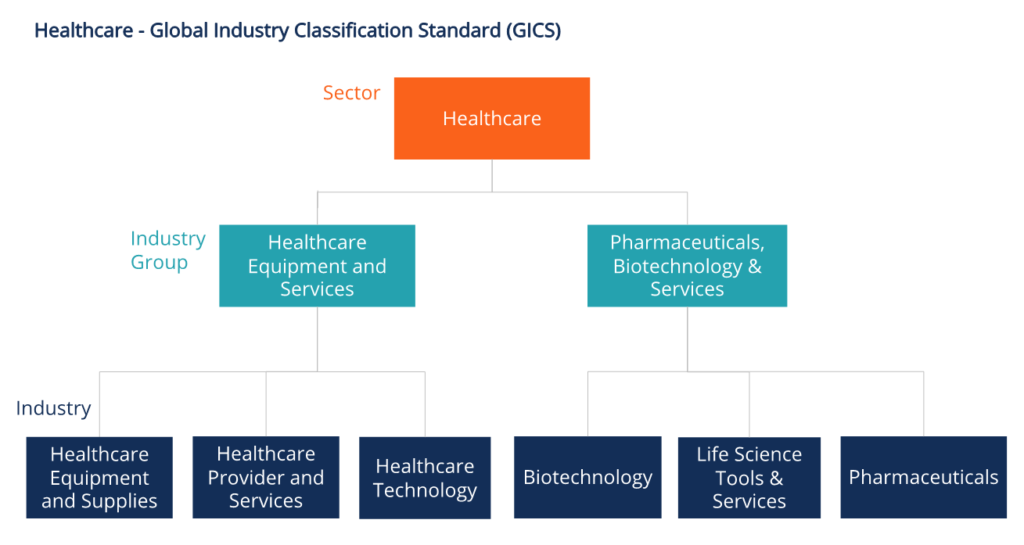
Healthcare Equipment & Services
1. Healthcare Equipment and Supplies
Includes companies that manufacture equipment and supplies, ranging from the basics such as crutches and bandages to advanced equipment like MRI machines
2. Healthcare Provider and Services
Includes companies that own and operate healthcare facilities – hospitals, rehabilitation centers, nursing homes, and animal shelters
3. Healthcare Technology
Includes companies that engage in research and development (R&D)Research and Development (R&D)Research and Development (R&D) is a process by which a company obtains new knowledge and uses it to improve existing products and introduce, as well as analyzing data to innovate current healthcare practices
Pharmaceuticals, Biotechnology & Life Sciences
1. Biotechnology
Includes companies that perform research and development or manufacturing that are generally derived from living organisms
2. Pharmaceuticals
Includes companies that develop and produce drugs and vaccines that are generally derived from a chemical basis
3. Life Sciences Tools and Services
Includes companies that study living things and provide analytical tools, clinical testing services, and general contract research services
Investing in the Healthcare Sector
Because of the intertwining nature of public and private healthcare, the sector is often subject to government intervention. Private healthcare companies are incentivized to maximize profit, while the public’s objective is to serve the community.
The clashing of goals means that the government must carefully regulate the sector and ensure that citizens can gain adequate access to social service. The presence of political influence in the healthcare sector creates uncertainties for investors, so it is important to monitor policy changes and more.
Moreover, healthcare is a highly specialized field that only professionals within the industry would have intimate knowledge of. As a result, healthcare professionals are expected to act as a principal on behalf of the agent (the general population without specialized knowledge). Because principals wield asymmetrical informationAsymmetric InformationAsymmetric information is, just as the term suggests, unequal, disproportionate, or lopsided information. It is typically used in reference to some type of business deal or financial arrangement where one party possesses more, or more detailed, information than the other. that impacts the agents, we expect principals to act in the best interest of the agents. However, the misalignment of incentives can result in principals pursuing other interests that can harm the agent.
For example, pharmaceutical giant Purdue Pharma pleaded guilty to pushing OxyContin that enabled the opioid crisis. They failed to assume their responsibility as a principal and instead pushed for profit maximization at the detriment of the agents. Occurrences of principal-agent problems not only harm the disadvantaged agents but also the principal and investors when their actions are brought to light.
Even with the inherent risks involved, the healthcare sector can be a safe haven and growth opportunity for investors. Because demand for healthcare is price inelastic – meaning demand will be relatively stable when prices fluctuate – the healthcare sector is quite resistant to the ups and downs of the business cycle.
Furthermore, healthcare is constantly being innovated, as seen in the race for the COVID-19 vaccine and the rapid shift to virtual healthcare in response to the pandemic. The aforementioned risk with politics and irregular occurrences of principal-agent problems tend to demonstrate a low correlation with other sectors. Therefore, healthcare can be a great investment to diversify portfolios.
Additional Resources
CFI offers the Capital Markets & Securities Analyst (CMSA)®Program Page - CMSAEnroll in CFI's CMSA® program and become a certified Capital Markets &Securities Analyst. Advance your career with our certification programs and courses. certification program for those looking to take their careers to the next level. To keep learning and developing your knowledge base, please explore the additional relevant resources below:
- Industry AnalysisIndustry AnalysisIndustry analysis is a market assessment tool used by businesses and analysts to understand the complexity of an industry. There are three commonly used and
- North American Industry Industry Classification System (NAICS)North American Industry Classification System (NAICS)The North American Industry Classification System (NAICS) is a hierarchical coding system that groups businesses into industries.
- Principal-Agent ProblemPrincipal-Agent ProblemA principal-agent problem is a problem in principal-agent relationships when there is a conflict of interest between the agent and the principal.
- The S&P 500 SectorsThe S&P SectorsThe S&P sectors constitute a method of sorting publicly traded companies into 11 sectors and 24 industry groups. Created by Standard & Poor's (S&P) and Morgan Stanely Capital International (MSCI), they are also known as the Global Industry Classification Standard (GICS).
-
K-Ratio Explained: Measuring Investment Growth & Consistency
The K-Ratio is a statistical tool that helps us measure two things – the growth of return and the consistency of that growth over a specified period. It is often used to determine the risk vs. r
-
Kelly Criterion: A Guide to Optimal Betting & Investment Strategy
Kelly criterion is a mathematical formula for bet sizing, which is frequently used by investors to decide how much money they should allocate to each investment or bet through a predetermined fraction
invest
- Understanding the Financial Sector: Institutions and Services
- Understanding the Investment Accumulation Phase: Building Wealth Over Time
- Bandwagon Effect: Understanding Social Influence & Conformity
- Dow 30 Explained: Understanding the Dow Jones Industrial Average
- Rule of 72: Calculate Investment Doubling Time | [Your Brand Name]
- Healthcare Funds: Investment Advantages & Growth Potential
- Healthcare Sector Investing: A Guide to Growth & Opportunities
- Metals & Mining Industry: Definition, Applications & Key Players
- Nifty 50: History, Significance & Key Stocks - A Comprehensive Guide
-
 Understanding the January Effect: Stock Market Trends & Causes
The January Effect is known to be a seasonal increase in stock prices throughout the month of January. The increase in demand for stocks is often preceded by a decrease in price during the month of De...
-
 Understanding the Joseph Effect: Trends vs. Randomness
The Joseph Effect, which derives its name from a Biblical reference, is a phrase created by Benoit Mandelbrot, a Polish-born French-American mathematician. The phrase asserts that variations over time...