
Indonesian Rupiah (IDR): Currency Overview & Information
The Indonesian rupiah – denoted with the symbol Rp – is the official currency of the sovereign Republic of Indonesia. Indonesia’s currency is authorized and issued by the Republic’s central bank, Bank Indonesia. In some instances, Indonesians will casually refer to the rupiah as “peak,” which translates as “silver.” The term, “rupiah,” came from the Sanskrit word, “rupyaka,” which also translates as “silver.”
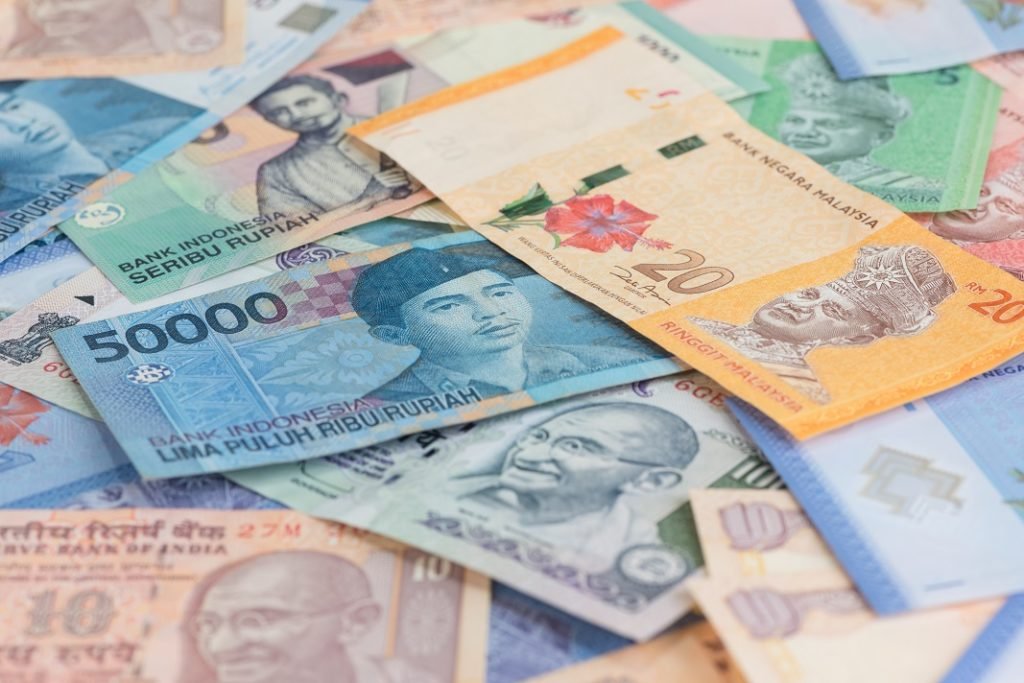
In the foreign exchange trading market (forex), the rupiah is designated as IDR. It means that the exchange rateExchange RateAn exchange rate is the rate at which one currency can be exchanged for another between nations or economic zones. It is used to determine the between the United States and Indonesia – for example – would be expressed as USD/IDR. The current USD/IDR exchange rate, as of late 2020, is 14,167.80 or approximately Rp14,167 = 1 USD.
Summary
- The rupiah is the official currency of the sovereign Republic of Indonesia; it is represented by the symbol Rp and designated as IDR in the forex market.
- The rupiah’s suffered a number of issues and setbacks, largely due to inflation and plummeting exchange rates in response to financial crises.
- Indonesian rupiah banknote denominations run as high as Rp100,000; a commemorative Rp75,000 note issued in 2020 was met with very high consumer demand.
The History of Indonesia’s Currency
In the colonial period, Indonesia used the Netherlands Indies gulden as its currency. Japanese invaders in 1942 printed a variation of the gulden. Indonesia introduced the first version of the rupiah in October 1946; however, it circulated along with a variety of other currencies from 1946 to 1950.
The Japanese adaptation of the gulden stood as the most prevalent currency, along with the Netherland’s gulden and Indonesia’s brand-new rupiah. The situation ended when the Dutch recognized Indonesia as an independent country in 1950. Indonesia’s federal government introduced currency reform immediately, declaring in 1951 that the rupiah would be the national currency.
Issues with Exchange Rates and Inflation
Throughout its entire existence, the rupiah’s been troubled by high rates of inflationInflationInflation is an economic concept that refers to increases in the price level of goods over a set period of time. The rise in the price level signifies that the currency in a given economy loses purchasing power (i.e., less can be bought with the same amount of money).. In 1965, the inflation rate skyrocketed to 635%. Political changes in 1966 led to the introduction of a stabilization program that changed the country’s economic policies, creating opportunities for debt relief, requiring more stringent bank reserves, and removing restrictions on imports.
In order to combat the skyrocketing inflation, Indonesia’s government introduced a variety of measures, including attempting to control foreign exchange (the rate was usually very unfavorable to the rupiah).
The central bank put major controls on foreign exchange rates in an effort to develop the reserves the Indonesian government desperately needed. It negatively impacted the operations of a number of Indonesian businesses that were unable to obtain an adequate supply of necessary imported materials.
The economic changes included introducing a “new” rupiah, which was implemented at an exchange rate of 1 new rupiah = 1,000 old rupiahs.
The central bank tried pegging the rupiah to the US dollar using a “managed float,” pegging to a basket of currencies. Despite the government’s intervention, the rupiah continued to suffer devaluations up through the 1990s.
The Asian Financial Crisis
The 1997 Asian Financial CrisisAsian Financial CrisisThe Asian Financial Crisis is a crisis caused by the collapse of the currency exchange rate and hot money bubble. It started in Thailand in July 1997 and impacted Indonesia and the rupiah as it did nearly all countries and their currencies in the region. It happened despite the fact that Indonesia was more well-prepared to weather the storm than some other countries, after significantly improving its foreign reserves position.
Ultimately, with substantial assistance from the International Monetary Fund (IMF)International Monetary Fund (IMF)The International Monetary Fund (IMF) is an institution of the United Nations that sets standards for the global economy with the aim of, Indonesia was able to more or less stabilize the rupiah. After hitting a low of Rp16,800 = 1 USD, the rupiah recovered to a level near Rp10,000 = 1vUSD. Still, the Indonesian rupiah remains viewed as an extremely risky currency to hold, and as noted above, the current exchange rate with the US dollar is a bit above 14,000 rupiahs.
Indonesian Rupiah Coins and Banknotes
Currently, there are two series of coins circulating in Indonesia: the old series, produced between 1991 and 2010, and a newly minted series issued in 2016. Rupiah coins are minted of bronze, nickel, or aluminum, and come in five denominations: 50, 100, 200, 500, and 1000 rupiah. The new series of coins features national heroes.
Indonesian rupiah banknotes in circulation are a combination of several issues occurring between 2000 and 2020, and come in eight denominations: Rp1,000, Rp2,000, Rp5,000, Rp10,000, Rp20,000, Rp50,000, Rp75,000 (a commemorative note), and Rp100,000.
Banknotes printed before the turn of the millennium are no longer legal tender in the country, primarily because they are sorely lacking in security features, and to a lesser extent because they are associated with the Suharto regime.
In August 2020, Indonesia introduced an Rp75,000 commemorative banknote to celebrate the country’s 75th anniversary of independence. Despite producing a massive print run of 75 million of the commemorative notes, the extremely high demand for them led Bank Indonesia to eventually implement purchase limits.
Related Resources
CFI is the official provider of the Commercial Banking & Credit Analyst (CBCA)™Program Page - CBCAGet CFI's CBCA™ certification and become a Commercial Banking & Credit Analyst. Enroll and advance your career with our certification programs and courses. certification program, designed to transform anyone into a world-class financial analyst.
In order to help you become a world-class financial analyst and advance your career to your fullest potential, these additional resources will be very helpful:
- DevaluationDevaluationDevaluation is a downward adjustment to the country’s value of money relative to a foreign currency or standard. Many countries that operate
- Fixed vs Pegged Currency RatesFixed vs. Pegged Exchange RatesForeign currency exchange rates measure one currency's strength relative to another. The strength of a currency depends on a number of factors such as its inflation rate, prevailing interest rates in its home country, or the stability of the government, to name a few.
- Four Asian TigersFour Asian TigersFour Asian Tigers is a term given to the economies of four countries – Hong Kong, Taiwan, Singapore, and South Korea. Driven by exports and
- Singapore DollarSingapore Dollar (SGD)The Singapore dollar (SGD) is the official legal currency issued by the Southeast Asian sovereign island nation, the Republic of Singapore.
-
Acid-Test Ratio: Understanding Your Company's Short-Term Liquidity
The Acid-Test Ratio, also known as the quick ratioQuick RatioThe Quick Ratio, also known as the Acid-test, measures the ability of a business to pay its short-term liabilities with assets readily conv
-

Nifty 50: History, Significance & Key Stocks - A Comprehensive Guide
The Nifty 50 refers to the fifty most popular large-cap stocks that traded at high valuations in the 1960s and 1970s. They included household names such as Xerox (XRX), IBM, Polaroid and Coca-Cola (
finance
- Current Ratio: Definition, Calculation & Financial Health
- Understanding Forward Rates: A Comprehensive Guide
- Hope Credit: Understanding Your Post-Secondary Education Tax Credit
- Libra Cryptocurrency: A Comprehensive Overview
- Modigliani-Miller Theorem: Understanding Capital Structure & Firm Value
- Understanding NCREIF: Real Estate Investment Performance Data
- Operating Ratio: Definition, Calculation & Importance
- Understanding the Overnight Interest Rate: A Comprehensive Guide
- Prime Rate Explained: Understanding Interest Rates for Businesses & Consumers
-
 Dow 30 Explained: Understanding the Dow Jones Industrial Average
The Dow 30, or Dow Jones Industrial Average, is a stock index that tracks the performance of the 30 biggest companies listed on the stock indices in the United States. Despite being used by analysts t...
-
![Rule of 72: Calculate Investment Doubling Time | [Your Brand Name]](https://www.etffin.com/article/uploadfiles/202110/2021100815281678_S.png) Rule of 72: Calculate Investment Doubling Time | [Your Brand Name]
Rule of 72: Calculate Investment Doubling Time | [Your Brand Name]In finance, the Rule of 72 is a formula that estimates the amount of time it takes for an investment to double in value, earning a fixed annual rate of returnRate of ReturnThe Rate of Return (ROR) is ...