
Understanding Insufficient Funds: Causes & Consequences
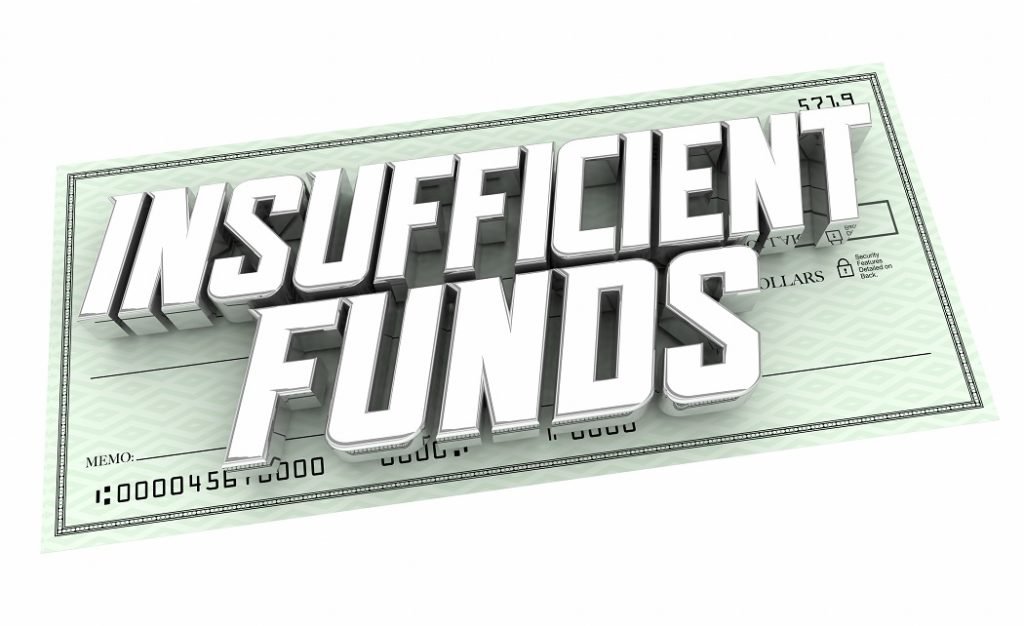
“Insufficient funds” is a checking account status where the balance is deficient. It is a banking term that may appear as a notice in bank statementsBank StatementA bank statement is a financial document that provides a summary of the account holder’s activity, generally prepared at the end of each month. or receipts. The insufficient funds status describes the scenario where a checking account does not hold sufficient funds to cover transactions.
Summary
- “Insufficient funds” describes a checking account’s status which is not sufficient to cover all the transactions that draw money from it, for example, check payments, cash withdrawals, electronic payments, etc.
- Insufficient funds can lead to insufficient fund penalty/fees if the bank refuses the payment or overdraft fees if the bank accepts the transaction and overdraws the account.
- Insufficient funds may result in legal issues, including criminal charges.
Understanding Insufficient Funds
“Insufficient funds” is a bank account status that is also known as non-sufficient funds (NSF). If a transaction draws money from a bank account while the account balance is lower than the amount drawn, the account will thus be in the insufficient funds status. The account holder will receive a notice on the bank statement or receipt.
Transactions that can lead to such a status include check payments, cash withdrawals, automatic electric payments, etc. For example, A writes a check to pay $5,000 to B, but there is only $4,500 in A’s checking account. When B tries to deposit the check, the bank that A keeps his account with will most likely refuse to transfer the money and issue an insufficient funds notice to A.
It is often referred to as a bad check or a bounced check. A may request the bank to make the transaction in the insufficient funds status, which is known as overdraft, and typically incurs a fee.
Another example can be automatic paymentsAutomatic Bill PaymentAutomatic bill payments are recurring money transfers authorized by a customer to pay certain vendors on a regular basis. The payments are for utility bills through a bank account. When the account does not hold enough money, but the utility company is still trying to draw payments from it, it will result in insufficient funds for the account.
Fees Related to Insufficient Funds
The insufficient funds status often incurs additional fees to account holders. The charges can be insufficient funds fees or overdraft fees. Hence, account holders should be cautious about their account balances to avoid such fees.
Insufficient Funds Fees
An insufficient funds fee is charged by the bank as a penalty when a payment presented by check is refused due to insufficient funds. In the U.S., the fee is from $27 to $35 conventionally. Account holders can avoid such fees by linking another account, such as a credit card or a savings accountSavings AccountA savings account is a typical account at a bank or a credit union that allows an individual to deposit, secure, or withdraw money when the need arises. A savings account usually pays some interest on deposits, although the rate is quite low., as a backup source of funds.
Overdraft Fees
Insufficient funds may also end up with an account overdraft. Account holders can opt-in overdraft policies when opening their bank accounts or request the bank for an overdraft when the insufficient funds status occurs. In such a situation, the bank will accept the check and overdraw the checking account.
For example, an individual with $100 in his checking account but made an electronic check payment of $150 for his video streaming subscription. According to the embedded overdraft policy, the bank will allow the payment to flow through and overdraw the account balance to -$50. An overdraft fee will also be charged, further reducing the account balance.
Many banks offer the overdraft line of credit to customers, which helps to cover any transactions with insufficient funds up to a certain amount. Applicants need to meet certain credit score and credit profile requirements for approval.
Legal Concerns of Insufficient Funds
“Insufficient funds” not only results in additional fees but can also cause legal concerns. Knowingly issuing multiple bad checks or in large values may lead to criminal charges. In some jurisdictions, the criminal charge for insufficient funds involves fraud.
In the U.S., many jurisdictions oversee bad check restitution programs (BCRPs) to deal with insufficient funds checks. The program allows recipients of such types of checks to collect money from local attorneys in their districts. The local agencies will follow up with check writers to collect the funds, and check writers can avoid criminal charges by making the payments in exchange. Typically, all the charges can be dropped if the bad check writers can make up their payments within six days.
Learn More
CFI offers the Capital Markets & Securities Analyst (CMSA)®Program Page - CMSAEnroll in CFI's CMSA® program and become a certified Capital Markets &Securities Analyst. Advance your career with our certification programs and courses. certification program for those looking to take their careers to the next level. To keep learning and advance your career, the following resources will be helpful:
- Unavailable FundsUnavailable FundsUnavailable funds, which are also known as uncollected funds, essentially represent a certain amount deposited into an account that is yet to clear
- How to Write a CheckHow to Write a CheckEven though digital payments are continually gaining more market share, it’s still important to know how to write a check. This guide shows you step by step
- Checking AccountChecking AccountA checking account is a type of deposit account that individuals open at financial institutions for the purpose of withdrawing and depositing money. Also known as a transactional or demand account, a checking account is very liquid. To put it simply, it provides users a quick way of accessing their money.
- Bank Account OverdraftBank Account OverdraftA bank account overdraft happens when an individual’s bank account balance goes down to below zero, resulting in a negative balance. It usually happens when there are no more funds in the account in question, but an outstanding transaction is processed through the account, leading to the account holder incurring a debt.
-
Understanding Bank Statements: A Comprehensive Guide
A bank statement is a monthly financial document that provides a summary of the account holder’s activity. Bank statements are generally prepared by the bank for the account holder at the end of
-

Demand Deposits: Definition, Function & Examples
A demand deposit is money deposited into a bank account with funds that can be withdrawn on-demand at any time. The depositor will typically use demand deposit funds to pay for everyday expenses. For
finance
- Understanding Account Balances: A Comprehensive Guide
- Understanding Account Numbers: Your Key to Financial Records
- Understanding Account Statements: A Comprehensive Guide
- Understanding Appropriation Accounts: Distribution of Funds & Profits
- Understanding Checking Accounts: A Comprehensive Guide
- Understanding Deposits: Bank Accounts & Security Funds | [Your Brand/Company Name]
- Understanding Dormant Accounts: Definition, Implications, and State Regulations
- Understanding Non-Sufficient Funds (NSF) & Overdraft Fees
- Savings Accounts: Your Guide to Secure Savings & Growth
-
 Understanding Your Available Balance: What You Need to Know
An account holder’s available balance is the amount of funds in their account that can be accessed immediately. It can be thought of as the quantity of funds available for withdrawal. It ac...
-
 Understanding Bank Overdrafts: Causes, Costs & Solutions
A bank account overdraft happens when an individual’s bank account balance goes down to below zero, resulting in a negative balance. It usually happens when there are no more funds in the accoun...