
Long-Term Debt (LTD): Definition, Types & Impact
Long Term Debt (LTD) is any amount of outstanding debt a company holds that has a maturity of 12 months or longer. It is classified as a non-current liability on the company’s balance sheetBalance SheetThe balance sheet is one of the three fundamental financial statements. The financial statements are key to both financial modeling and accounting.. The time to maturity for LTD can range anywhere from 12 months to 30+ years and the types of debt can include bondsTrading & InvestingCFI's trading & investing guides are designed as self-study resources to learn to trade at your own pace. Browse hundreds of articles on trading, investing and important topics for financial analysts to know. Learn about assets classes, bond pricing, risk and return, stocks and stock markets, ETFs, momentum, technical, mortgages, bank loans, debenturesDebentureA Debenture is an unsecured debt or bonds that repay a specified amount of money plus interest to the bondholders at maturity. A debenture is a long-term debt instrument issued by corporations and governments to secure fresh funds or capital. Coupons or interest rates are offered as compensation to the lender., etc. This guide will discuss the significance of LTD for financial analystsBecome a Certified Financial Modeling & Valuation Analyst (FMVA)®CFI's Financial Modeling and Valuation Analyst (FMVA)® certification will help you gain the confidence you need in your finance career. Enroll today!.
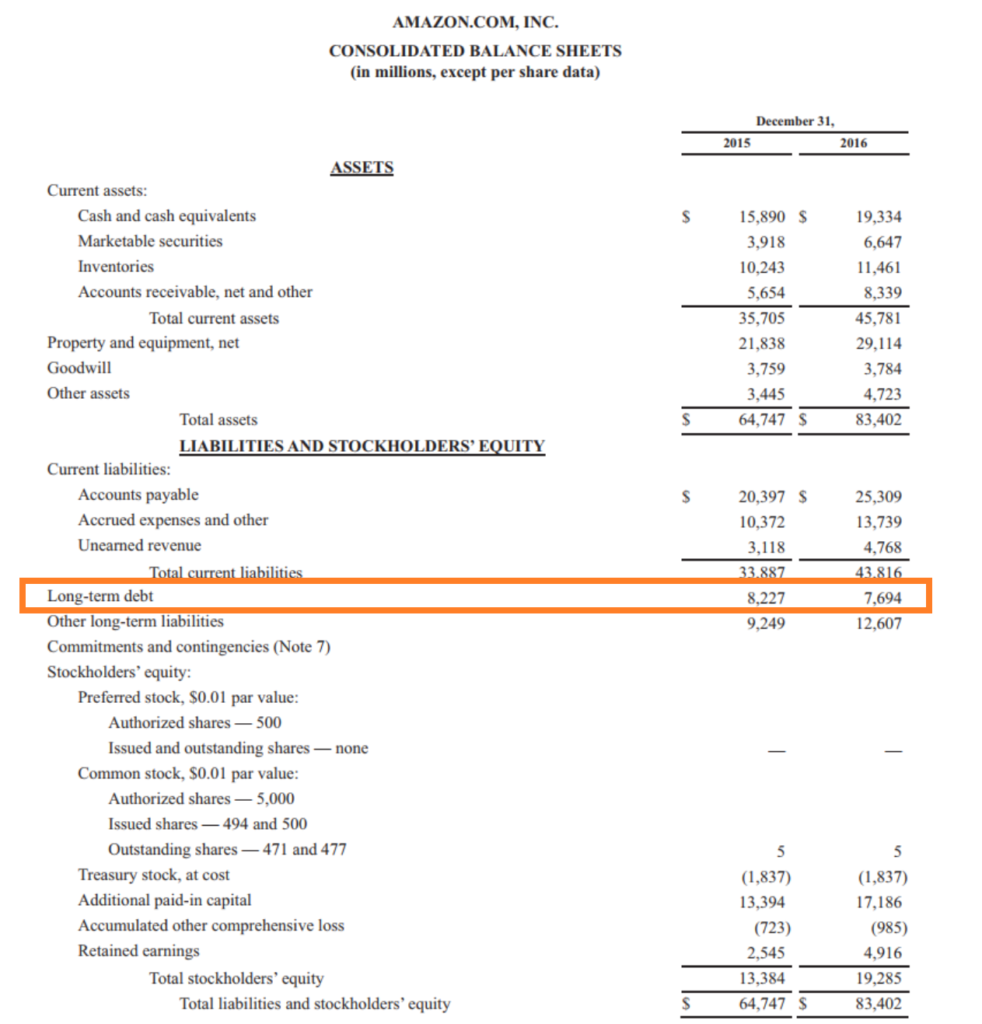
Long Term Debt on the Balance Sheet
Long Term Debt is classified as a non-current liability on the balance sheet, which simply means it is due in more than 12 months’ time. The LTD account may be consolidated into one line-item and include several different types of debt, or it may be broken out into separate items, depending on the company’s financial reporting and accounting policies.
When all or a portion of the LTD becomes due within a years’ time, that value will move to the current liabilities section of the balance sheet, typically classified as the current portion of the long term debtCurrent Portion of Long-Term DebtThe current portion of long-term debt is the portion of long-term debt due that is due within a year’s time. Long-term debt has a maturity of.
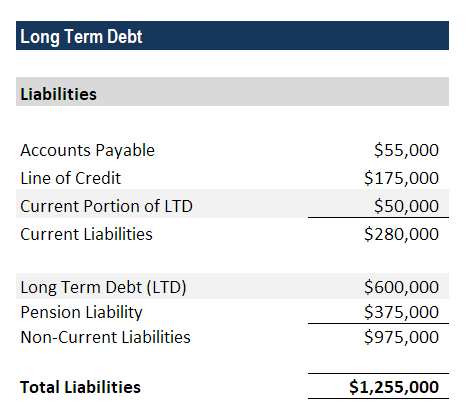
Download the Long Term Debt Spreadsheet to play with your own numbers.
Modeling Long Term Debt
Below is a screenshot of CFI’s example on how to model long term debt on a balance sheet. As you can see in the example below, if a company takes out a bank loan of $500,000 that equally amortizes over 5 years, you can see how the company would report the debt on its balance sheet over the 5 years.
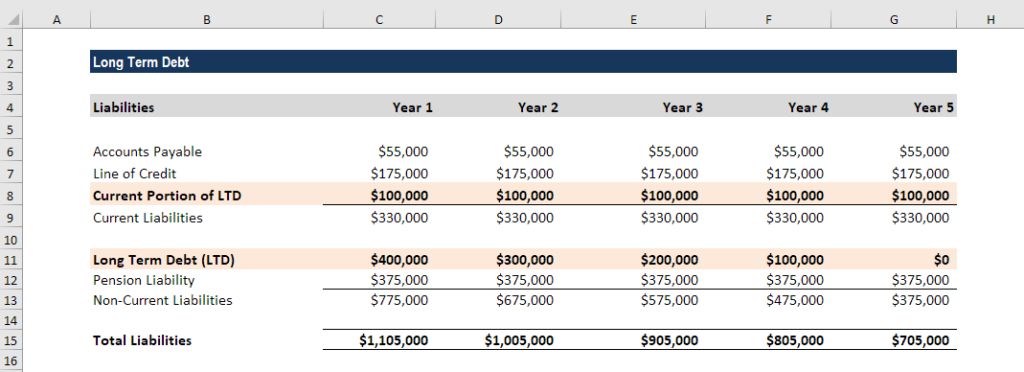
As shown above, in year 1, the company records $400,000 of the loan as long term debt under non-current liabilities and $100,000 under the current portion of LTD (assuming that portion is now due in less than 1 year).
In year 2, the current portion of LTDCurrent Portion of Long-Term DebtThe current portion of long-term debt is the portion of long-term debt due that is due within a year’s time. Long-term debt has a maturity of from year 1 is paid off and another $100,000 of long term debt moves down from non-current to current liabilities.
The process repeats until year 5 when the company has only $100,000 left under the current portion of LTD. In year 6, there are no current or non-current portions of the loan remaining.
Types of Long Term Debt
Long term debt is a catch-all phrase that includes various different types of loans. Below are some examples of the most common different types of long term debt:
- Bank Debt – This is any loan issued by a bank or other financial institution and is not tradable or transferable the way bonds are.
- Mortgages – These are loans that are backed by a specific piece of real estate, such as land and buildings.
- Bonds – These are publicly tradable securities issued by a corporation with a maturity of longer than a year. There are various types of bonds, such as convertible, puttable, callable, zero-coupon, investment grade, high yield (junk), etc.
- Debentures – These are loans that are not backed by a specific asset and, thus, rank lower than other types of debt in terms of their priority for repayment
Use of Leverage
When companies take on any kind of debt, they are creating financial leverage, which increases both the risk and the expected return on the company’s equityEquityIn finance and accounting, equity is the value attributable to a business. Book value of equity is the difference between assets and liabilities. Owners and managers of businesses will often use leverage to finance the purchase of assets, as it is cheaper than equity and does not dilute their percentage of ownership in the company.
To evaluate how much leverage a company has, a financial analyst looks at ratios such as:
- Debt/EquityFinanceCFI's Finance Articles are designed as self-study guides to learn important finance concepts online at your own pace. Browse hundreds of articles!
- Debt/Capital
- Debt/AssetsDebt to Asset RatioThe debt to asset ratio, also known as the debt ratio, is a leverage ratio that indicates the percentage of assets that are being financed with debt.
- Debt/EBITDADebt/EBITDA RatioThe net debt to earnings before interest, taxes, depreciation, and amortization (EBITDA) ratio measures financial leverage and a company’s ability to pay off its debt. Essentially, the net debt to EBITDA ratio (debt/EBITDA) gives an indication as to how long a company would need to operate at its current level to pay off all its debt.
- Interest Coverage RatioInterest Coverage RatioInterest Coverage Ratio (ICR) is a financial ratio that is used to determine the ability of a company to pay the interest on its outstanding debt.
Learn more about the above leverage ratios by clicking on each of them and reading detailed descriptions.
Additional Resources
Thank you for reading this guide to understanding long term debt.
CFI is the official provider of the Financial Modeling and Valuation Analyst (FMVA)TM Become a Certified Financial Modeling & Valuation Analyst (FMVA)®CFI's Financial Modeling and Valuation Analyst (FMVA)® certification will help you gain the confidence you need in your finance career. Enroll today!designation, created to help transform anyone into a world-class financial analyst. To continue learning and advancing your career, these additional CFI resources will be useful:
- Debt ScheduleDebt ScheduleA debt schedule lays out all of the debt a business has in a schedule based on its maturity and interest rate. In financial modeling, interest expense flows
- Senior and Subordinated DebtSenior and Subordinated DebtIn order to understand senior and subordinated debt, we must first review the capital stack. Capital stack ranks the priority of different sources of financing. Senior and subordinated debt refer to their rank in a company's capital stack. In the event of a liquidation, senior debt is paid out first
- Current LiabilitiesCurrent LiabilitiesCurrent liabilities are financial obligations of a business entity that are due and payable within a year. A company shows these on the
- Projecting Balance Sheet Line ItemsProjecting Balance Sheet Line ItemsProjecting balance sheet line items involves analyzing working capital, PP&E, debt share capital and net income. This guide breaks down how to calculate
-

Understanding Market Value of Debt: Beyond Book Value
The Market Value of Debt refers to the market price investors would be willing to buy a company’s debt for, which differs from the book value on the balance sheet. A company’s debt doesn&r
-

Understanding Net Debt: A Key Financial Metric
Net debt is a financial liquidity metricProfitability RatiosProfitability ratios are financial metrics used by analysts and investors to measure and evaluate the ability of a company to generate incom
finance
- Understanding Capital: Types, Categories & Value Creation
- Understanding Debt: Types, Obligations & Financial Implications
- Understanding Debt Capacity: A Guide for Businesses
- Debt Consolidation: Simplify Payments & Lower Interest Rates
- Understanding Debt Default: Causes, Consequences, and Prevention
- Debt Financing: A Comprehensive Guide for Businesses
- Debt Refinancing: A Comprehensive Guide to Lowering Your Payments
- Debt Restructuring: A Comprehensive Guide for Financial Distress
- Debt Settlement: Definition, How It Works & Is It Right For You?
-
 Understanding Business Financing: A Comprehensive Guide
Financing refers to the methods and types of funding a business uses to sustain and grow its operations. It consists of debtSenior and Subordinated DebtIn order to understand senior and subordinated d...
-
 Leveraged Finance Explained: Strategies & Applications
Leveraged finance is the use of an above-normal amount of debt, as opposed to equity or cash, to finance the purchase of investment assets. Leveraged finance is done with the goal of increasing a...