
Minority Interest: Definition, Implications & Proxy Voting
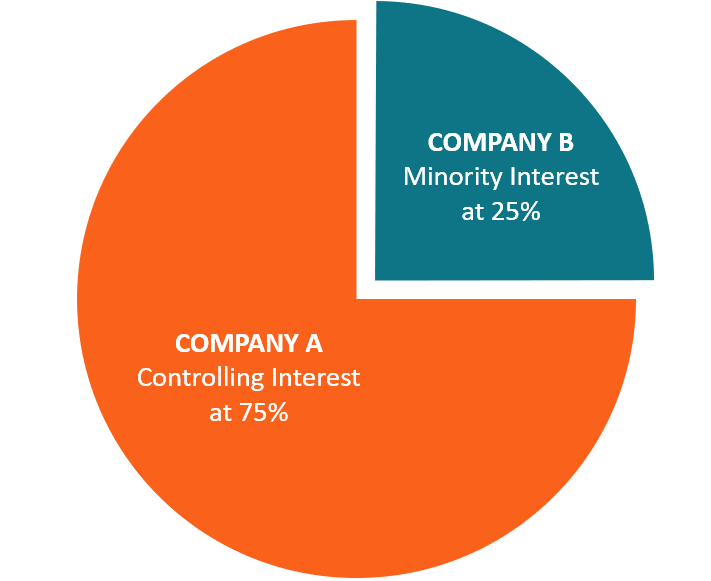
Minority interest refers to having an ownership stake in a company that is less than 50% of the total shares in terms of voting rights. Essentially, minority investors don’t exercise control over a company by way of votesProxy VoteA Proxy Vote is a delegation of voting authority to a representative on behalf of the original vote-holder. The party who receives the authority to vote is known as the Proxy and the original vote-holder is known as the Principal. The concept is important in financial markets and particularly with public companies, leaving them with little influence in the overall decision-making process.

On the balance sheet of a company with controlling interests, minority interest is shown as a non-current liabilityTypes of LiabilitiesThere are three primary types of liabilities: current, non-current, and contingent liabilities. Liabilities are legal obligations or debt, and they represent the portion of the subsidiary owned by minority interests.
Passive vs. Active Minority Interest
Minority interest can be classified as active or passive. For passive interest, the ownership percentage is usually below 20%, and these investors have little choice but to allow the majority to make the major decisions of the company. On the other hand, an active minority interest holding ranges between 21% to 49% and has significant voting rights, which may influence major decisions of the company, such as the election of board members.
Financial Reporting
For minority interest, financial reporting occurs only when the major company prepares a separate set of financial statements and consolidated financial documents. Adjustments in the minority interest take place when the major company owns a less than 100% stake in the minor company.
In terms of profit and loss account, minority interest is that part of consolidated profit and loss that comes under ordinary activities after taxation. According to IFRS regulationsIFRS StandardsIFRS standards are International Financial Reporting Standards (IFRS) that consist of a set of accounting rules that determine how transactions and other accounting events are required to be reported in financial statements. They are designed to maintain credibility and transparency in the financial world, the minority stake falls under equity. However, in the US, GAAP imposes slightly relaxed rules on reporting.
GAAP allows minority interest to be shown under the equity or liability section. On a balance sheet, minority interest is shown as a separate line item. In such a way, users of the financial statement can clearly see all the controlling interests in the parent company. Users can make informed choices based on the comparison of patterns in the different minor companies.
Valuation of Minority Interest
Valuation of a company needs proper forecasting of financial statements to understand future trends using certain parameters and assumptions. Nearly all the figures used in forecasting are directly related to net profit and revenue. Unfortunately, making forecasts based on these two parameters can generate data subject to multiple interpretations. Thus, to deal with the issue, analysts developed four methods that can be used to carry out accurate computations.
1. Constant Growth
The constant growth method is seldom used because the assumption is that there is hardly any decline or growth in the performance of a minor company.
2. Numerical Growth
In the numerical growth method, previous figures are analyzed to ascertain existing trends. The model predicts the growth of a subsidiary at a uniform rate based on past trends. Also called statistical growth, numerical growth uses a number of important tools to forecast trends, such as time series analysis, moving averages, and regression-based analysis. However, the analysis method is not applicable to companies experiencing dynamic growth such as FMCG.
3. Modeling Subsidiaries Individually
This analysis method evaluates each subsidiary on its own and then adds up the individual interests of each minor company to achieve a consolidated value. This method is much more flexible, and the results are very accurate. Unfortunately, it does not work in all cases because it results in cost and time constraints. In addition, it won’t work where there are very many subsidiaries to evaluate.
One important thing to remember is that when it comes to the valuation of minority interest, there are many factors to consider, both external and internal, that are applicable to a company and its industry of operation. The factors need careful assessment as their impact is different for each company.
4. Ratio Analysis in Minority Interest
One of the questions many people ask is whether minority interest is relevant when it comes to ratio analysis. The short answer is yes, it is very relevant. Why? Well, any financial ratio that involves investment structures should take into consideration the implication of a minority stake. Some of the ratios that are affected include return on equity, debt-to-equity ratio, and capital gearing ratio.
Minority Interest: Liability or Asset?
Liability is the compulsion of a company due to previous undertakings resulting in an outflow of resources. For example, provisions on uncleared debts, employee wages, and dues, as well as creditor balance. The examples indicate and involve the outflow of a company’s resources in the form of cash or other equivalents in due course.
However, since cash won’t be paid out to clear the interests, they are not considered a liability. On the other hand, an asset is something with value attached to it. Assets can be converted to cash or its equivalent. While an asset possesses value, the controlling company exercises no control over the value. Thus, minority interest is a non-controlling stake in a company, meaning it is neither a liability nor an asset.
Minority Interest: Equity or Obligation?
Certainly, minority interest is not a debt because a company is not obligated to repay. In other words, there are no fixed or binding payments. Thus, because minority interest is not a payable quantity, it can’t be considered a debt. Although minority interest does not meet the preconditions that would qualify it as equity, assets on a consolidated balance sheet receive some form of contribution from minority assets.
Minority Interest in the Computation of Enterprise Value
Enterprise value represents a company’s valuation. In most cases, enterprise value is usually greater than a company’s market capitalization because part of it is debt. Nevertheless, a pertinent question that people can’t seem to agree on is whether minority interest should be included in the computation of a company’s enterprise value. Yes, it should be included because enterprise value is a significant portion of a company’s stake in the market. Thus, minority interest is part of the enterprise value.
Final Word
Minority interest provides users with important information when reading a financial statement. It also helps users explore and make informed investment choices. The percentage of controlling stake determines the influence and voting rights of minority interests over the decision-making process.
In the past, the concept of minority interest was known as equity, liability, or sometimes, neither of the above. Today, very little guidance is available on the presentation and treatment of non-controlling interest.
Related Readings
Thank you for reading CFI’s explanation of minority interest. CFI offers the Financial Modeling & Valuation Analyst (FMVA)®Become a Certified Financial Modeling & Valuation Analyst (FMVA)®CFI's Financial Modeling and Valuation Analyst (FMVA)® certification will help you gain the confidence you need in your finance career. Enroll today! certification program for those looking to take their careers to the next level. To keep learning and advancing your career, the following CFI resources will be helpful:
- Cost of Preferred StockCost of Preferred StockThe cost of preferred stock to a company is effectively the price it pays in return for the income it gets from issuing and selling the stock. They calculate the cost of preferred stock by dividing the annual preferred dividend by the market price per share.
- Enterprise ValueEnterprise Value (EV)Enterprise Value, or Firm Value, is the entire value of a firm equal to its equity value, plus net debt, plus any minority interest
- Founders StockFounders StockFounders stock refers to the equity that is given to the early founders of an organization. This type of stock differs in a few important ways from common stock sold in the secondary market. Key differences are (1) that founders stock can only be issued at face value, and (2) it comes with a vesting schedule.
- Return on Equity (ROE)Return on Equity (ROE)Return on Equity (ROE) is a measure of a company’s profitability that takes a company’s annual return (net income) divided by the value of its total shareholders' equity (i.e. 12%). ROE combines the income statement and the balance sheet as the net income or profit is compared to the shareholders’ equity.
-

Interest Payable: Definition, Calculation & Importance
Interest Payable is a liability account, shown on a company’s balance sheet,Balance SheetThe balance sheet is one of the three fundamental financial statements. The financial statements are key
-

OIBDA Explained: Understanding Operating Income Before Depreciation & Amortization
OIBDA is an abbreviation for Operating Income Before Depreciation and Amortization. It is a non-GAAP measure of the financial performance of a company during a specific period of time while excluding
finance
- Acquirer Definition: Understanding Corporate Acquisitions
- Understanding Add-On Interest: How It Works & Loan Payments
- Understanding Clawbacks: Protecting Stakeholders from Failed Performance
- Understanding Financial Gearing: Debt & Leverage Explained
- Understanding Interest: Costs & Rewards of Borrowing and Lending
- Understanding Interest Income: A Comprehensive Guide
- Understanding Interest Rates: A Comprehensive Guide
- Leverage in Finance: Strategies, Types & Risks
- Mortgages Explained: Your Guide to Home Loans & Financing
-
 Understanding Expenditures: Definition and Types
An expenditure represents a payment with either cash or credit to purchase goods or services. An expenditure is recorded at a single point in time (the time of purchase), compared to an expenseAccrued...
-
 Goodwill in Accounting: Definition & Value
In accounting, goodwill is an intangible assetIntangible AssetsAccording to the IFRS, intangible assets are identifiable, non-monetary assets without physical substance. Like all assets, intangible as...