
Net Interest Income (NII): Definition & Calculation
Net interest income is defined to the difference between interest revenues and interest expenses.

For financial institutions, interest revenues represent the interest payments the bank receives on their interest-bearing assets, while interest expenses are the cost of servicing interest payments to customers on their deposits.
Summary
- Net interest income is defined as the difference between interest revenues and interest expenses.
- Interest revenues are payments that the bank receives from their interest-bearing assets, and interest expenses are the cost of servicing interest payments to customers on their deposits.
- When interest rates are increasing in the economy, net interest margins become larger. When interest rates are decreasing in the economy, net interest margins become smaller.
What Type of Assets Generate Interest Income for Investors?
Treasury Bills
Interest is defined as the difference between the purchase price and sale price. If interest rates in the economy drop and Treasury bills are sold before maturity, a capital gainCapital GainA capital gain is an increase in the value of an asset or investment resulting from the price appreciation of the asset or investment. In other words, the gain occurs when the current or sale price of an asset or investment exceeds its purchase price. will arise.
Indexed Securities
Indexed securities offer an interest rate at a discount to the market rate, and the payable balance is adjusted at maturity for inflationInflationInflation is an economic concept that refers to increases in the price level of goods over a set period of time. The rise in the price level signifies that the currency in a given economy loses purchasing power (i.e., less can be bought with the same amount of money)..
At maturity, if the adjustment is positive, it is included in interest income. If the adjustment is negative, it will be deductible, given the satisfaction of the criterion for interest rate deductibility.
Hybrid Financial Instruments
Hybrid financial products offer a guaranteed return on a pre-determined date based on the movement of a pre-specified market index, paid at maturity. Often, there are covenants, such as maximum interest, minimum interest, and exercise period, attached to the financial products.
What Type of Assets Generate Interest Income for a Bank?
For many financial institutions, the net interest margin is a primary source of income. The banks’ net interest margin can be interpreted as the cost of financial intermediation. Therefore, it is the difference between what borrowers pay for their loans and what they receive from lending.
Simply put, banks are risk-averse middlemen between depositors and borrowers of funds. Banks offer the following common financial products:
- Commercial and Personal Loans
- MortgagesMortgageA mortgage is a loan – provided by a mortgage lender or a bank – that enables an individual to purchase a home. While it’s possible to take out loans to cover the entire cost of a home, it’s more common to secure a loan for about 80% of the home’s value.
- Construction Loans
- Investment Securities
Interest Revenue
Interest revenue is generated through interest payments that the bank receives on outstanding loans. It is made up of credit lines and loans that the institution has on its balance sheet.
Calculating Interest Revenue
Interest revenue is calculated through the application of the effective interest rate to the gross carrying amount of the financial assets. There are only two exceptions in this calculation:
- Financial assets that were credit-impaired at purchase
- Financial assets that are credit-impaired
Interest Revenue = Effective Interest Rate * Financial Asset
Where:
- Financial Asset is valued at its gross carrying amount
Interest Expenses
Interest expense is the price that the lender charges the borrower in a financing transaction or the cost of borrowing money. It is the interest that accumulates on outstanding liabilities. Common examples include customer deposits and wholesale financing.
Calculating Interest Expense
To calculate the interest expense, multiply the effective interest rate by the gross carrying amount of financial liabilities.
Interest Expense = Effective Interest Rate * Financial Liability
Net Interest Margin
Net interest margin refers to the difference between the interest income generated and the amount of interest paid out to lenders. It is an industry-specific profitability ratio for banks and other financial institutions that lend out interest-earning assets.
Net Interest Margin = [Interest Revenue – Interest Expense] / Average Earning Assets
Interest Rates in the Economy and Net Interest Income
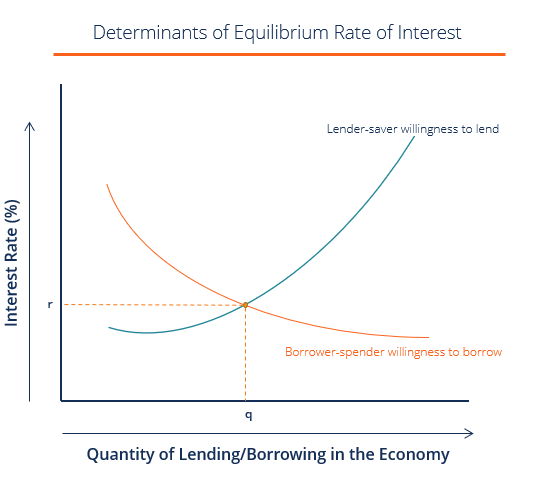
The equilibrium interest rate is primarily impacted by the demand for borrowing capital and the supply of capital that is being lent. Increasing interest rates benefit banks by increasing their net interest income.
Therefore, in periods of low interest rates, banks have lower net interest margins. Generally, a positive net interest margin is indicative of a bank that efficiently invests its capital, whereas a negative net interest margin signifies inefficiency.
Financial Institutions Shift Away from Interest Income
Declining interest rate margins for banks have altered how institutions structure their operations. Banks have been able to increase non-interest income through trading, services, and other financial operations.
Banks diversify their source of revenue thanks to financial stabilization and increase financial deregulation.
Related Readings
CFI is the official provider of the global Commercial Banking & Credit Analyst (CBCA)™Program Page - CBCAGet CFI's CBCA™ certification and become a Commercial Banking & Credit Analyst. Enroll and advance your career with our certification programs and courses. certification program, designed to help anyone become a world-class financial analyst. To keep advancing your career, the additional CFI resources below will be useful:
- Net Interest Rate SpreadNet Interest Rate SpreadNet interest rate spread refers to the difference between the interest rate a financial institution pays to depositors and the interest rate it receives
- Treasury Bills (T-Bills)Treasury Bills (T-Bills)Treasury Bills (or T-Bills for short) are a short-term financial instrument issued by the US Treasury with maturity periods from a few days up to 52 weeks.
- Interest RateInterest RateAn interest rate refers to the amount charged by a lender to a borrower for any form of debt given, generally expressed as a percentage of the principal.
- Interest IncomeInterest IncomeInterest income is the amount paid to an entity for lending its money or letting another entity use its funds. On a larger scale, interest income is the amount earned by an investor’s money that he places in an investment or project.
-

Understanding Finance: A Comprehensive Overview of Key Concepts
Finance is defined as the management of money and includes activities such as investing, borrowing, lending, budgeting, saving, and forecasting. There are three main types of finance: (1) personalPers
-

Understanding Financial Crises: Causes, Impacts, and Examples
A financial crisis is defined as any situation where one or more significant financial assets – such as stocks, real estateReal EstateReal estate is real property that consists of land and impro
finance
- Net Income Attributable to Shareholders: Definition & Significance
- Profitability Ratios: Understanding Your Company's Profitability
- Understanding Distributable Net Income (DNI): A Comprehensive Guide
- Understanding Interest Income: A Comprehensive Guide
- Net Interest Margin (NIM): Definition & Importance
- Net Interest Margin (NIM): Definition & Importance
- Understanding Net of Tax: Definition & Calculation
- Understanding Net Income: A Comprehensive Guide
- Net Income Explained: A Comprehensive Guide for Businesses & Individuals
-
 Eurocurrency Explained: What It Is & How It Works
Eurocurrency is a currency that is deposited at a foreign bank outside of its home country. Contrary to its name, the term does not refer to euros that are deposited outside of Europe. It is a general...
-
 Factset: Financial Data & Analytics Solutions for Investment Professionals
Factset Research Systems is a company that provides software and financial data solutions for investment professionals. The company offers a number of financial services, such as business advisory, da...