
Prepayment Explained: Types, Benefits & Financial Analysis
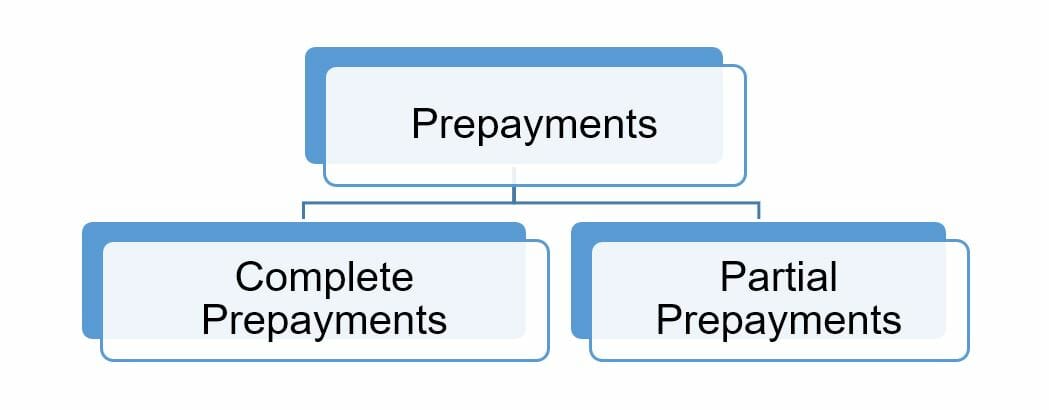
A prepayment is any payment that is made before its due date. Prepayments may be made for goods and services or toward settling a debt. They can be categorized into two groups: Complete Prepayments and Partial Prepayments.
A complete prepayment involves payment for the full balance of a liability before its official due date, whereas a partial prepayment involves payment for only a part of a liability’s balance. Understanding prepayments is important when performing financial analysisAnalysis of Financial StatementsHow to perform Analysis of Financial Statements. This guide will teach you to perform financial statement analysis of the income statement,.
Use of Prepayments
Prepayments are used by individuals, corporationsCorporationA corporation is a legal entity created by individuals, stockholders, or shareholders, with the purpose of operating for profit. Corporations are allowed to enter into contracts, sue and be sued, own assets, remit federal and state taxes, and borrow money from financial institutions., and governments to settle accounts before they are due.
Individuals
- Individuals can settle future tax obligations with prepayments.
- Individuals can pay for credit card charges in advance of their due date.
- Individuals can prepay past debt before its due date by refinancing that debt.
Corporations
- Corporations can use prepayments to pay the wages of their workers.
- Corporations can use prepayments to pay for rent for all lands used for business.
- Corporations can prepay existing (short term and long term) debt by refinancing such debt.
Governments
- Similar to corporations, governments can prepay wages and rents for public sector companies.
- Governments can prepay existing international debt owed to another country or international organization by refinancing such debt.
Complete Prepayments
If an individual, corporation or government makes a prepayment relatively early into the tenure of a loan, they can save a substantial amount in interest charges. Consider the following example.
Company XYZ borrows $200,000 from a bank at an interest rate of 15% per year for a period of 5 years. As per the terms of the loan, Company XYZ must make monthly payments to the bank. The monthly payment amounts to $4,758. At the end of the first year, Company XYZ would have paid $29,039 towards the principal and $28,057 as interestInterest ExpenseInterest expense arises out of a company that finances through debt or capital leases. Interest is found in the income statement, but can also payment. Instead, if Company XYZ had prepaid the entire amount, it would have had to pay $57,422 less as interest.
Consider a second example. John has taken a loan worth $300,000 for a period of 5 years at 15% interest per year. By prepaying the entire loan, John will save $128,219. This is shown below:
Year Principal (A) Interest (B) Total Yearly Payment (A+B) Balance % Loan Repaid Year 1$43,558$42,086$85,644$256,44214.52%Year 2$50,560$35,084$85,644$205,88231.37%Year 3$58,688$26,956$85,644$147,19550.94%Year 4$68,122$17,522$85,644$79,07373.64%Year 5$79,073$6,571$85,6440100%Total$300,001$128,219$428,220
John will have to pay $42,086 or 33% of the total interest in his first year of repayment. In his second year, John will pay $35,084 or 27% of the total interest amount. In his third year of repayment, John will pay $26,956 or 21% of the total interest amount. In his fourth year of repayment, John will pay $17,522 or 14% of the total interest amount. In his last year of repayment, John will pay $6,571 or 5% of the total interest.
From the above illustration, it is clear that if John were to prepay the entire amount early in the tenure of the loan, he would save substantially on his interest payments. In practice, if the objective of a borrower is to minimize interest payments, it is important to make the prepayment as early as possible into the repayment period. However, even at a later stage in the loan tenure, when the borrower would have already paid much of the interest, the borrower can still save on his interest payments by prepaying the loan at any time before the end of his repayment period.
Partial Prepayments
In practice, complete prepayments are rare. After all, if the borrower has the ability to repay the entire loan amount relatively early on into the repayment period, why did he borrow in the first place? Partial prepayments are used by the borrower to reduce the principal amount. The reduction in the principal amount results in a decrease in interest payments.
Consider an extension of the example above. Suppose John makes a lump sum payment of $50,000 six months into his loan. John will then save 32% on his interest payment. This is shown below:
Partial Prepayment Normal Repayment Loan Amount$300,000$300,000Rate of Interest15%15%Duration5 years or 60 months5 years or 60 monthsPartial Prepayment after 6 Months$50,0000Total Interest Paid$87,399$128,219Savings$40,8200Interest Saved Approx. 32%
Prepayment Penalties
Often, banks charge a prepayment penalty. This is done to deter borrowers from making prepayments early into the repayment period so that the bank can extract a minimum amount of interest from the borrowers. For example, banks often do not allow prepayment of a loan within 6 months of borrowing.
In other instances, banks may charge a specific portion of the loan amount as interest in the case of prepayment.
Applications in financial modeling
In financial modelingWhat is Financial ModelingFinancial modeling is performed in Excel to forecast a company's financial performance. Overview of what is financial modeling, how & why to build a model., it’s important to have a clearly modeled debt scheduleDebt ScheduleA debt schedule lays out all of the debt a business has in a schedule based on its maturity and interest rate. In financial modeling, interest expense flows. The basic starting assumption is that all debts will be repaid when they are due. In order to determine when debts are due to be paid, an analyst can look in the notes to a company’s financial statements. If, however, there is a reason to believe the debts will be repaid early, the analyst should build that into the financial model and the resulting cash flowValuationFree valuation guides to learn the most important concepts at your own pace. These articles will teach you business valuation best practices and how to value a company using comparable company analysis, discounted cash flow (DCF) modeling, and precedent transactions, as used in investment banking, equity research,.
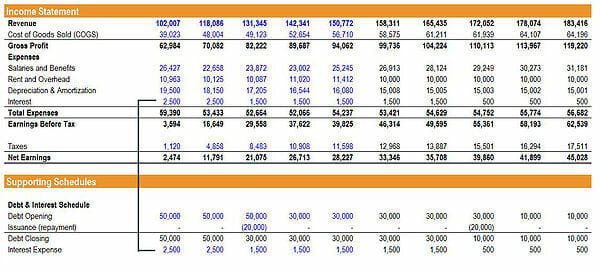
The above example is taken from CFI’s financial modeling courses.
Related Readings
CFI offers the following resources to help expand your knowledge regarding various aspects of debt.
- Debt ScheduleDebt ScheduleA debt schedule lays out all of the debt a business has in a schedule based on its maturity and interest rate. In financial modeling, interest expense flows
- Cost of DebtCost of DebtThe cost of debt is the return that a company provides to its debtholders and creditors. Cost of debt is used in WACC calculations for valuation analysis.
- Current DebtCurrent DebtOn a balance sheet, current debt is debts due to be paid within one year (12 months) or less. It is listed as a current liability and part of
- Balance SheetBalance SheetThe balance sheet is one of the three fundamental financial statements. The financial statements are key to both financial modeling and accounting.
-

Debentures Explained: A Comprehensive Guide to Unsecured Corporate & Government Debt
A debenture is a long-term debt instrument issued by corporations and governments to secure fresh funds or capital. There is no collateral or physical assets required to back up the debt, as the overa
-

Deferred Interest Explained: How it Works & Benefits
Deferred interest is a deal offered on what is essentially a loan, allowing the borrower to avoid paying interest for a set period of time, provided the borrower has paid the entirety of the loan or t
finance
- Understanding Add-On Interest: How It Works & Loan Payments
- Understanding Interest: Costs & Rewards of Borrowing and Lending
- Understanding Interest Income: A Comprehensive Guide
- Understanding Interest Rates: A Comprehensive Guide
- Mortgages Explained: Your Guide to Home Loans & Financing
- Prepayment Risk Explained: Understanding Early Loan Repayments
- Understanding Vested Interest: Definition & Implications
- Accrued Interest Explained: Accounting & Financial Definition
- Interest Payable: Definition, Calculation & Importance
-
 Understanding Certificates of Deposit (CDs): A Comprehensive Guide
A certificate of deposit (CD) refers to a financial product that is offered by financial institutions – such as banks and credit unionsCredit UnionA credit union is a type of financial organizat...
-
 Compound Interest Explained: How It Works & Benefits
Compound interest refers to interest payments that are made on the sum of the original principalPrincipalPrincipal in bonds is their par value. It is the initial investment paid for a security or bond...