
Prepayment Risk Explained: Understanding Early Loan Repayments
Prepayment risk refers to the risk that the principal amount (or a portion of the principal amount) outstanding on a loan is prematurely paid back. In other words, prepayment risk is the risk of early repayment of a loan by a borrower.

Understanding Prepayment Risk
Prepayment risk may sound counter-intuitive in that repaying a loan in a shorter period of time is considered a risk. However, to a lender, it may be preferable to have a loan outstanding for a longer period of time. To understand prepayment risk, we introduce an example.
Consider a loan with a face value of $1,000. The loan has a 10% interest rate on the face value of the loan. The borrower is to make annual interest paymentsInterest ExpenseInterest expense arises out of a company that finances through debt or capital leases. Interest is found in the income statement, but can also over a period of three years. As such, the lender would be receiving $1,300 over the life of the loan. The loan’s payment schedule is illustrated below:

Next, assume that the borrower has the option to repay the face value amount before the end of three years. In this scenario, the borrower can theoretically repay the face value of $1,000 at the end of Year 1 and end up not having to pay interest in Years 2 and 3 (due to the face value being repaid at the end of Year 1). In doing so, the lender would only end up receiving $100 in profit on the loan. The payment schedule in this scenario is illustrated below:
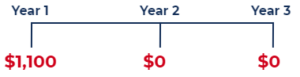
As such, prepayment risk is the risk that the borrower repays the outstanding principal amount (or a portion of the outstanding principal amount) prematurely and, in turn, causes the lender to receive less in interest payments.
Prepayment Risk in Mortgage-backed Securities
Mortgage-backed securities (MBS)Mortgage-Backed Security (MBS)A Mortgage-backed Security (MBS) is a debt security that is collateralized by a mortgage or a collection of mortgages. An MBS is an asset-backed security that is traded on the secondary market, and that enables investors to profit from the mortgage business commonly face prepayment risk. A mortgage-backed security is made up of a bundle of home loans that investors can purchase. Investors in mortgage-backed securities collect interest payments made by the underlying home loans. As such, when the homeowners repay their loans earlier than expected, investors in mortgage-backed securities face the risk of having lower future interest payments generated from the underlying home loans.
To mitigate the prepayment risk faced by investors in mortgage-backed securities, prepayment penalties are commonly imposed on homeowners who repay their home loans earlier than expected.
Interest Rates and Prepayment Risk
Although there are numerous factors that can cause a borrower to repay their loan earlier than expected, the driving factor tends to be changes in interest ratesInterest RateAn interest rate refers to the amount charged by a lender to a borrower for any form of debt given, generally expressed as a percentage of the principal..
For example, consider a homeowner that takes out a floating-rate home loan (i.e., the interest rate on the home loan increases as market interest rate increases and vice versa).
- If interest rates decrease, the homeowner will have an incentive to refinance the floating-rate home loan into a fixed-rate home loan. In this scenario, the potential for refinancing the home loan will increase the prepayment risk for the original lender.
- If interest rates increase, the homeowner will have an incentive to repay the home loan more quickly to avoid higher future interest payments. In this scenario, making principal payments earlier will reduce future interest payments and increase the prepayment risk for the lender.
As such, changes in interest rates play a key role in increasing the prepayment risk faced by lenders.
Practical Example
A homeowner takes out a mortgageMortgageA mortgage is a loan – provided by a mortgage lender or a bank – that enables an individual to purchase a home. While it’s possible to take out loans to cover the entire cost of a home, it’s more common to secure a loan for about 80% of the home’s value. at an interest rate of 15%. At the time of taking out a mortgage, the market interest rate was 15%. Two years later, the market interest rate is 10%. Explain the prepayment risk, if any, faced by the lender.
Solution: The lender faces prepayment risk on the mortgage due to the change in market interest rates from 15% to 10%. The homeowner has an incentive, assuming that there are no prepayment penalties or refinancing fees, to refinance the mortgage from an interest rate of 15% to an interest rate closer to the current market interest rate of 10%. In doing so, the lender will forego the interest payments (at the higher interest rate) that would have been made by the homeowner over the life of the mortgage.
Additional Resources
CFI offers the Financial Modeling & Valuation Analyst (FMVA)™Become a Certified Financial Modeling & Valuation Analyst (FMVA)®CFI's Financial Modeling and Valuation Analyst (FMVA)® certification will help you gain the confidence you need in your finance career. Enroll today! certification program for those looking to take their careers to the next level. To keep learning and developing your knowledge base, please explore the additional relevant CFI resources below:
- Effective Annual Interest RateEffective Annual Interest RateThe Effective Annual Interest Rate (EAR) is the interest rate that is adjusted for compounding over a given period. Simply put, the effective
- Fannie MaeFannie MaeThe Federal National Mortgage Association, typically known as Fannie Mae, is a United States government-sponsored entity that was established to expand the secondary mortgage market by making mortgages available to low and middle-income borrowers. It does not provide mortgages to borrowers, but purchases and guarantees mortgages
- Loan CovenantLoan CovenantA loan covenant is an agreement stipulating the terms and conditions of loan policies between a borrower and a lender. The agreement gives lenders leeway in providing loan repayments while still protecting their lending position. Similarly, due to the transparency of the regulations, borrowers get clear expectations of
- RenegingRenegingReneging refers to a situation where one party goes back on a promise or breaks an agreement or contract that they had previously accepted. Every day,
-

Understanding Inherent Risk: A Key Concept in Risk Management
Inherent risk refers to the natural risk level in a process that has not been controlled or mitigated in risk managementRisk ManagementRisk management encompasses the identification, analysis, and res
-
Interest Payable: Definition, Calculation & Importance
Interest Payable is a liability account, shown on a company’s balance sheet,Balance SheetThe balance sheet is one of the three fundamental financial statements. The financial statements are key
finance
- Understanding Add-On Interest: How It Works & Loan Payments
- Understanding Interest: Costs & Rewards of Borrowing and Lending
- Understanding Interest Income: A Comprehensive Guide
- Understanding Interest Rates: A Comprehensive Guide
- Understanding Interest Rate Risk: Definition & Impact
- Mortgages Explained: Your Guide to Home Loans & Financing
- Understanding Operating Risk: A Key Component of Business Risk
- Prepayment Explained: Types, Benefits & Financial Analysis
- Understanding Financial Risk: A Comprehensive Guide
-
 Understanding Market Risk: A Comprehensive Guide
The term market risk, also known as systematic risk, refers to the uncertainty associated with any investment decision. Price volatility often arises due to unanticipated fluctuations in factors that ...
-
 Accrued Interest Explained: Accounting & Financial Definition
Accrued interest refers to interest generated on an outstanding debt during a period of time, but the payment has not yet been made or received by the borrower or lender. SummaryUnder accru...